Beyond the Hype: The Science of Effective AI Integration in EdTech.
Golden Hook & Introduction
SECTION
Nova: What if I told you that the biggest problem with AI isn't its complexity, but our own simplistic understanding of it? We often treat AI like a magic wand, when it's actually a precision tool just waiting for the right hands.
Atlas: Huh. That’s a bold statement, Nova. I mean, everyone’s talking about AI as this transformative, almost mystical force. Are you saying we're all, well, a bit naive about it?
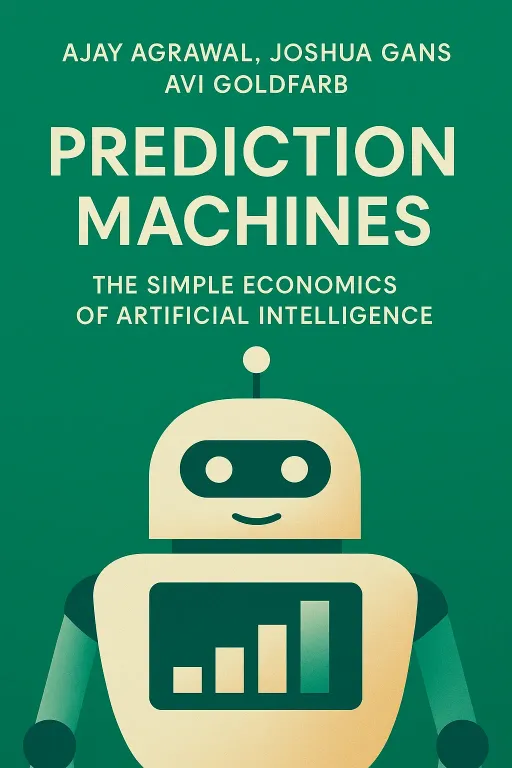
Nova: Not naive, Atlas, perhaps just a little... enchanted. We get caught up in the promise, the potential, and sometimes we miss the foundational shift that makes AI truly powerful. It’s like marveling at a skyscraper without understanding the engineering principles that hold it up. And that's exactly what Ajay Agrawal, Joshua Gans, and Avi Goldfarb unpack in their groundbreaking book, "Prediction Machines."
Atlas: "Prediction Machines." I like that. It sounds less like a sci-fi villain and more like something I could actually use. What's the core idea there?
Nova: Exactly! And it's complimented beautifully by "Human + Machine" by Paul R. Daugherty and H. James Wilson. Together, these books fundamentally redefine our perspective on AI. They strip away the mystique and present AI for what it primarily is: a prediction technology. This isn't just semantics; it's a profound reframe that unlocks concrete, strategic application.
Atlas: So, we're moving from "AI as magic" to "AI as a very sophisticated calculator that tells us what's likely to happen next." That’s a massive shift in mindset.
Nova: Precisely. And that "blind spot" we just talked about? It’s often seeing AI as this all-encompassing, sentient being, rather than a specialized tool designed to augment specific human capabilities. It's not about replacing; it's about enhancing.
Redefining AI: From Magic to Prediction
SECTION
Nova: Let's dive deeper into that. "Prediction Machines" argues that AI's core economic value comes from its ability to make predictions. Think about it: every decision we make, every action we take, is based on some prediction, whether explicit or implicit.
Atlas: Okay, I guess that makes sense. If I decide to bring an umbrella, I'm predicting rain. If I invest in a stock, I'm predicting its future performance. But how does AI change that? I mean, humans have always made predictions.
Nova: That's a great point, Atlas. Humans are incredible at prediction. But AI makes prediction cheaper, faster, and often, more accurate. Imagine the cost of predicting whether a student will drop out of a course. A human counselor might spend hours compiling data, interviewing students, looking at past performance. An AI can do it in milliseconds, sifting through millions of data points, identifying patterns a human might never see.
Atlas: Wow. So, a human prediction might cost, say, a hundred dollars and take an hour, but an AI prediction costs a few cents and takes a second. That changes everything.
Nova: It absolutely does. When the cost of prediction drops, we start using it everywhere. Think about a self-driving car. What is it doing at every split second? It's predicting: "What's the likelihood that pedestrian steps into the road? What's the probability that car will swerve? What's the optimal speed to maintain given traffic flow?" It's a continuous stream of predictions.
Atlas: Right, like a super-powered crystal ball, but with data. So, in edtech, where does this "prediction" fit in? It's not like we're predicting the stock market.
Nova: Oh, but we are predicting outcomes, which is even more critical in education. Imagine predicting student struggle it happens, allowing for timely intervention. Or predicting which learning resources will be most effective for a specific student, personalizing their path. Or even predicting course completion rates to optimize resource allocation.
Atlas: That makes me wonder, could an AI predict which growth strategies will actually work for a new edtech startup? That would be invaluable.
Nova: Precisely! For a Chief Growth Officer building 0-1 strategies, understanding AI as a prediction engine is a superpower. You're not just throwing darts at a board; you're using data-driven foresight. A small improvement in predicting what content resonates, what onboarding flow retains users, or even which marketing channels yield the highest ROI, can lead to exponential gains in user acquisition and retention.
Atlas: So, it's not about the AI magically making students smarter. It's about the AI helping us predict bottlenecks, optimize pathways, and personalize experiences, which then students to become smarter or learn more efficiently. That's a huge distinction.
Nova: It really is. It moves us from a vague hope that "AI will solve everything" to a strategic question: "Where in my value chain can I make a better prediction to create tangible value?"
Human + Machine Synergy: Strategic AI Integration
SECTION
Nova: And that naturally leads us to the second key idea, which often acts as a counterpoint to what we just discussed: the powerful synergy of human and machine. Because predictions alone aren't enough. You need to act on them, and that's where human ingenuity comes in. Daugherty and Wilson's "Human + Machine" shows how the most successful companies aren't just deploying AI; they’re brilliantly combining human strengths with AI’s capabilities.
Atlas: Okay, so if AI is excellent at predicting, what are humans excellent at? Because I can imagine a lot of people in edtech feeling a bit nervous, like, "Is AI going to take my job?"
Nova: That's a completely valid concern, Atlas, and it highlights why the "human + machine" approach is so vital. Humans excel at judgment, creativity, empathy, strategic thinking, and complex problem-solving. AI can predict whether a student is likely to drop out, but a human teacher possesses the empathy and nuanced understanding to address that student is struggling, and to craft a personalized, human-centered intervention. It's the difference between knowing might happen and understanding and to respond.
Atlas: So, it's not simply "AI does the predictions, humans do the rest." It’s more like a dance. How does this 'synergy' actually look in practice? What are the different ways companies are making this happen?
Nova: It's definitely a dance! Daugherty and Wilson reveal five distinct approaches to integrating AI effectively. For instance, some companies use AI as "orchestrators," optimizing complex processes, while humans manage the overall strategy. Others use AI as "coaches," providing insights and recommendations that augment human decision-makers. Think of it as a master chef using a super-efficient, super-smart kitchen assistant that can perfectly chop vegetables, pre-heat ovens, and even suggest flavor pairings based on vast data, but the chef still crafts the final dish, tastes it, and innovates.
Atlas: That’s a great analogy. So, in edtech, this could mean an AI-powered platform that identifies learning gaps across an entire student cohort, but then the human curriculum designer uses that insight to develop innovative new modules, rather than the AI designing the course itself.
Nova: Exactly! Or an AI tutor that can provide instant feedback on student work and guide them through practice problems, freeing up the human teacher to focus on deeper conceptual understanding, emotional support, and cultivating critical thinking skills that an AI can't yet replicate. The human becomes the strategic leader, the empathetic guide, amplified by AI.
Atlas: That sounds much more empowering for educators and for growth officers. It’s not about AI replacing the teacher or the strategist; it’s about AI making them exponentially more effective. For my edtech startup, thinking about this synergy, it feels like we should be asking, "How can AI make my team's unique human talents shine even brighter?" rather than "What can AI do instead of my team?"
Nova: You've hit on the core insight, Atlas. The most successful AI-native companies aren't just adopting AI; they're redesigning their operations and roles around this human + machine collaboration. It's about finding the friction points where human effort is high and AI's predictive or automation capabilities can offer significant leverage, then building a system where they seamlessly complement each other.
Atlas: So, for an edtech startup, instead of trying to build an AI that teaches everything, we might build an AI that predicts, or. That would make our human teachers far more impactful.
Nova: That's a perfect example. It's about identifying those specific human capabilities—whether it's personalized coaching, creative content generation, or strategic decision-making—and then asking, "How can AI augment capability?" It moves from abstract AI potential to concrete, strategic application within your edtech venture.
Synthesis & Takeaways
SECTION
Nova: So, bringing these two powerful ideas together, we've seen how reframing AI as a prediction technology, rather than a magical black box, allows us to see its true strategic value. And then, by consciously designing for human + machine synergy, we unlock its full potential, not just for efficiency, but for profound impact.
Atlas: It’s a complete paradigm shift. No longer just chasing the shiny new AI thing, but really understanding its underlying function and how it can supercharge what humans already do best. So, Nova, for our listeners, especially those like me in edtech startups, what's the one big takeaway from all of this?
Nova: The critical question, the one that can truly transform your approach, is this: where in your edtech startup could even a small improvement in prediction lead to a significant gain in learning outcomes or operational efficiency? Don't look for the biggest, most complex AI solution first. Start small, identify a specific prediction problem, and see how AI can augment your human capabilities to solve it.
Atlas: I love that. It makes it feel less daunting, more actionable. Like, instead of trying to automate the entire grading process, maybe we just use AI to predict which essays need the most human attention for personalized feedback. That's a tangible starting point.
Nova: Exactly. It's about iterative growth, finding those strategic leverage points. The future of edtech isn't just about AI; it's about intelligent collaboration between humans and machines, creating learning experiences that are both deeply personalized and profoundly human.
Atlas: That's actually really inspiring. It feels like a hopeful and empowered way to approach this new era of AI.
Nova: Absolutely. This is Aibrary. Congratulations on your growth!