

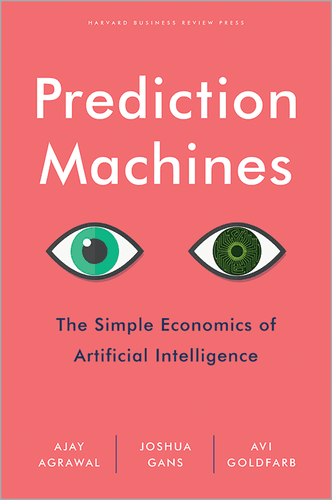
Prediction machines
Introduction: The New Economics of AI
Introduction: The New Economics of AI
Nova: Welcome back to the show. Today, we are diving deep into a book that fundamentally reframed how economists and business leaders view Artificial Intelligence: "Prediction Machines: The Simple Economics of Artificial Intelligence" by Ajay Agrawal, Joshua Gans, and Avi Goldfarb.
Nova: : That title is so intriguing. It suggests AI isn't some mystical black box, but something with a very specific, measurable economic function. What is that core function, Nova?
Nova: Exactly. The authors boil down the entire revolution of machine learning and AI into one incredibly powerful, yet simple, economic concept: AI dramatically lowers the cost of prediction. Think about it—decades ago, computation cost plummeted, leading to the digital revolution. Now, prediction is the new commodity whose price is collapsing.
Nova: : A collapsing price for prediction. That sounds like a massive lever for any industry. If I can predict something cheaply—demand, failure rates, customer behavior—what does that actually change in my day-to-day operations?
Nova: It changes everything about. The book argues that every business process is essentially a sequence of decisions, and those decisions rely on predictions. When prediction becomes cheap, you don't just get better decisions; you get to make decisions, faster, and across a broader scope than ever before. It’s a shift from relying on intuition or slow, expensive analysis to automated, continuous forecasting.
Nova: : So, this isn't just about better software; it's about restructuring the entire economic value chain around this new, cheap input. It sounds like they are giving us the economic blueprint for the AI era. I'm ready to see how this blueprint is drawn. Where do we start with their framework?
Nova: We start by understanding the two core components of any decision: prediction and judgment. And that leads us perfectly into our first deep dive chapter.
Key Insight 1: The Cost of Prediction Plummets
The Core Thesis: Prediction as a Cheap Commodity
Nova: Let's unpack the central claim. The authors state that AI is not a general-purpose technology like electricity, but rather a specific one: a prediction machine. Why is that distinction so important economically?
Nova: : Because electricity powers everything—lighting, heating, motors. If prediction is the core input, it suggests AI's impact is concentrated where prediction is vital. Can you give us a concrete example of how prediction cost used to be high?
Nova: Absolutely. Think about inventory management 30 years ago. To predict how many widgets you needed next quarter, you hired a team of highly paid analysts, they looked at historical sales data, maybe ran some complex statistical models, and delivered a prediction—a very expensive prediction, prone to human bias and slow to update.
Nova: : And that high cost meant you couldn't afford to be precise. You had to build in huge safety margins, leading to overstocking or stockouts. The cost of prediction dictated the quality of the decision.
Nova: Precisely. Now, with modern ML, that same prediction—or even a vastly superior one—can be generated in real-time, for pennies, by a system that constantly retrains itself on new data. The cost has dropped by orders of magnitude. The authors use the analogy that prediction is becoming like a utility, something you just plug into your process.
Nova: : That’s a powerful shift. If prediction is cheap, what happens to the people who used to sell expensive predictions? Are they obsolete?
Nova: Not necessarily obsolete, but their value proposition changes. They can no longer charge a premium just for the prediction itself. Their value shifts to the prediction, it, or providing the missing piece: judgment. This leads us to the second major concept in the book, which is perhaps the most crucial for understanding the future of work.
Nova: : I’m anticipating this. If the machine handles the 'if X, then Y' part, what's left for the human?
Nova: What’s left is the 'Should we?' and the 'What if?' The authors frame this beautifully by separating prediction from judgment. Prediction is about mapping inputs to outcomes based on historical patterns. Judgment is about making the final call when the prediction is imperfect, incomplete, or when the context is novel.
Nova: : So, if the AI predicts, with 95% certainty, that a specific loan applicant will default, the machine has made its prediction. The human loan officer still needs judgment to decide if that 5% chance of success is worth the risk, or if the applicant’s unique circumstances override the model.
Nova: That's the perfect illustration. Judgment is required when the prediction is uncertain, when the stakes are high, or when the decision involves ethical or subjective values that the historical data simply cannot capture. The machine tells you the odds; the human decides the strategy based on those odds.
Nova: : It sounds like the value of human expertise moves up the decision stack. We stop being data crunchers and start being strategic risk managers. But what happens when the machine gets good? When the prediction is 99.9% accurate?
Nova: That’s where the authors introduce the concept of 'diseconomies of scope.' If prediction is nearly perfect, you can automate the decision. You don't need a human to review every single transaction if the machine is right 999 times out of 1000. The cost of human review—the time, the salary, the cognitive load—becomes too high relative to the tiny benefit of catching that one error.
Nova: : So, the threshold for automation isn't perfection; it's when the cost of human intervention exceeds the cost of the occasional machine error. That’s a very pragmatic economic boundary.
Nova: It is. And this realization—that we must constantly re-evaluate where prediction ends and judgment begins—is what drives the strategic implications of the book. It forces us to look at our workflows and ask: Where are we paying too much for prediction, and where are we relying too much on human judgment when a cheap prediction could guide us better?
Nova: : It seems like the first step for any company reading this book is a massive internal audit of their decision-making architecture. It’s not about buying AI tools; it’s about redesigning the flow of information and authority.
Nova: Exactly. And that redesign leads us to the concept of the 'Prediction Factory,' which is where the rubber truly meets the road in terms of business strategy.
Key Insight 2: Restructuring Workflows for Scale
Building the Prediction Factory
Nova: In the second half of the book, the authors move from the micro-level of decision-making to the macro-level of business structure, introducing the idea of the 'Prediction Factory.' What is this factory, and why is it the natural evolution when prediction is cheap?
Nova: : If prediction is the new cheap input, then a factory is the ideal structure to mass-produce decisions based on that input. It’s about scale. It’s like Henry Ford realizing that if you standardize the process of building a car, you can produce millions. Here, we standardize the process of making decisions.
Nova: Precisely. The traditional business model often has decisions scattered across departments, relying on bespoke analysis. The Prediction Factory centralizes the prediction engine and designs standardized workflows where decisions are made automatically or semi-automatically based on the machine's output. Think about fraud detection. Historically, a team reviewed flagged transactions. Now, the factory predicts the probability of fraud, and only transactions above a very high threshold are routed to a human expert for final judgment.
Nova: : That sounds like massive efficiency gains. But I recall reading that this concept is also tied to the idea of 'data as the new oil.' If the factory runs on prediction, it must run on data, right?
Nova: It does, and this is where the authors stress the importance of data infrastructure. Cheap prediction requires abundant, high-quality, and data. If your prediction machine is trained on stale or incomplete data, your cheap prediction is worthless—or worse, actively harmful. The investment shifts from hiring PhDs to crunching numbers to building robust data pipelines that feed the machine continuously.
Nova: : So, the competitive advantage isn't just having the AI algorithm; it's having the proprietary, clean, and continuous stream of data that allows your prediction engine to run faster and more accurately than your competitor's. It’s a moat built of data flow.
Nova: That's the modern moat. And this factory model forces companies to rethink their entire scope of operations. If predicting demand for Product A is now trivial, maybe you should offer Product A in 50 new regional markets you previously avoided because the prediction cost was too high. The scope of what a business do expands dramatically.
Nova: : I saw a reference to their follow-up work, "Power and Prediction," which suggests that the real power comes from combining prediction with. How does that fit into the factory model?
Nova: It’s the next logical step. Once you have a cheap prediction, you must redesign the that follows. If the prediction machine forecasts a 30% chance of machine failure in the next 48 hours, the factory should automatically trigger a preventative maintenance order, schedule the technician, and order the part—all without human intervention unless the confidence level drops below a certain point. The action becomes automated based on the prediction.
Nova: : That’s where the risk of over-automation comes in, though. If the system is designed only to optimize for efficiency based on historical patterns, it might miss disruptive market shifts that require a fundamentally different kind of action—something truly novel.
Nova: That is a fantastic bridge to our final chapter, because while the framework is powerful, it is not a panacea. The authors themselves acknowledge that AI is a tool, and like any tool, it has limits. The factory must be managed by humans who understand those limits. We need to talk about where the prediction machine breaks down.
Key Insight 3: Where Judgment and Novelty Reign
The Boundaries of Prediction
Nova: We've established that AI excels at prediction, and businesses should build factories around it. But what are the inherent limitations of a system designed purely around predicting the future based on the past? What are the blind spots?
Nova: : The most obvious limitation, which the book touches upon, is the 'rare event' problem. If an event hasn't happened much in the training data—say, a massive, unprecedented global supply chain shock—the prediction machine is essentially guessing, or it defaults to its last known good state, which is now irrelevant.
Nova: Exactly. The machine is excellent at interpolating within the data it has seen, but terrible at extrapolating far outside that boundary. If you are in a stable industry, the prediction machine is your best friend. If you are in a truly disruptive industry, or facing a black swan event, the machine might actually lead you astray because it lacks the capacity for true conceptual novelty.
Nova: : This brings us back to judgment. If the machine says, 'Based on all historical data, this new product launch will fail,' but the CEO has a gut feeling based on qualitative market signals they’ve gathered—signals that can't be easily quantified into training data—that judgment must override the prediction.
Nova: And the authors argue that the most valuable human skill in the future will be knowing to override the machine. It requires a deep understanding of the model's confidence interval and the context of the decision. It’s not about ignoring the prediction; it’s about applying contextual wisdom to adjust the prediction's output.
Nova: : I also wonder about the ethical dimension. Prediction machines are trained on historical data, which often reflects historical biases—racial, gender, economic. If the machine predicts that certain demographics are higher risk, and we automate the decision, we are essentially automating and scaling up historical unfairness.
Nova: That is a critical limitation that the book addresses, often through the lens of societal impact. When prediction becomes cheap, the ethical burden shifts. We must use human judgment not just to correct for statistical uncertainty, but to correct for societal injustice embedded in the data. The machine predicts what; we need human judgment to decide what.
Nova: : So, the framework forces us to confront our own biases. If we automate a biased decision, we are making a conscious choice to scale that bias, because we are choosing to apply judgment to correct it.
Nova: It’s a powerful accountability mechanism. Furthermore, the authors discuss the challenge of in certain domains. In medicine, for example, rare diseases don't generate enough data for a robust prediction model. In those cases, the cost of prediction remains high because the data simply isn't there, forcing reliance on expert judgment, which is the opposite of the factory model.
Nova: : It seems the book’s greatest strength is providing this economic lens that allows us to diagnose our own processes. We can look at any business function and ask: Is this a prediction problem we can solve cheaply, or is this a judgment problem that requires expensive human capital?
Nova: Precisely. It’s a diagnostic tool. It moves the conversation away from the hype of 'AI will solve everything' to the practical reality of 'Where can cheap prediction create the most value, and where must we protect and cultivate human judgment?'
Conclusion: Mastering the New Economic Landscape
Conclusion: Mastering the New Economic Landscape
Nova: We've covered a tremendous amount today, charting the economic landscape of the AI era as defined by Agrawal, Gans, and Goldfarb. Let’s synthesize the key takeaways for our listeners.
Nova: : The absolute core idea is that Artificial Intelligence is fundamentally a technology that drives down the cost of prediction. This isn't just an incremental improvement; it’s a structural economic shift, much like the drop in computation cost was 40 years ago.
Nova: And because prediction is now cheap, the value shifts. We move away from paying for the prediction itself and towards two critical areas: first, building the 'Prediction Factory'—the scalable infrastructure to make millions of decisions based on those cheap forecasts. Second, and perhaps most importantly, we elevate the role of human judgment.
Nova: : That distinction between prediction and judgment is what I’ll be taking away. Prediction is the 'what if'; judgment is the 'should we.' Companies that try to automate judgment will fail, but companies that fail to automate prediction will be left behind.
Nova: Absolutely. The future belongs to those who can effectively blend the two. They must invest in clean, continuous data pipelines to feed their prediction engines, and simultaneously invest in training their people to exercise superior judgment when the machine’s output is uncertain, biased, or facing a truly novel situation.
Nova: : It’s a call to action for strategic reorganization, not just technological adoption. It’s about redesigning the organization around the new economics of information.
Nova: It is. The message is clear: Stop thinking about AI as magic, and start thinking about it as a utility that requires a new business architecture. The companies that master this new architecture will define the next decade of economic growth.
Nova: : A truly insightful framework for navigating the noise of the AI revolution. Thank you, Nova, for breaking down this essential text.
Nova: My pleasure. Keep questioning the cost of your decisions, listeners. Are you paying too much for a prediction that could be automated, or are you outsourcing a judgment call that requires your unique human insight? This is Aibrary. Congratulations on your growth!