Predictably Profitable: Decoding User Behavior for Startup Success
10 minGolden Hook & Introduction
SECTION
Nova: aleck, as a founder building a product, what if I told you that one of the most powerful tools for driving sales isn't a new feature, but a deliberately 'bad' option on your pricing page? An option you don't even want anyone to choose.
aleck: That sounds completely backwards. Why would I want to put a bad option in front of my customers? It feels like it would just create confusion or make my product look weak.
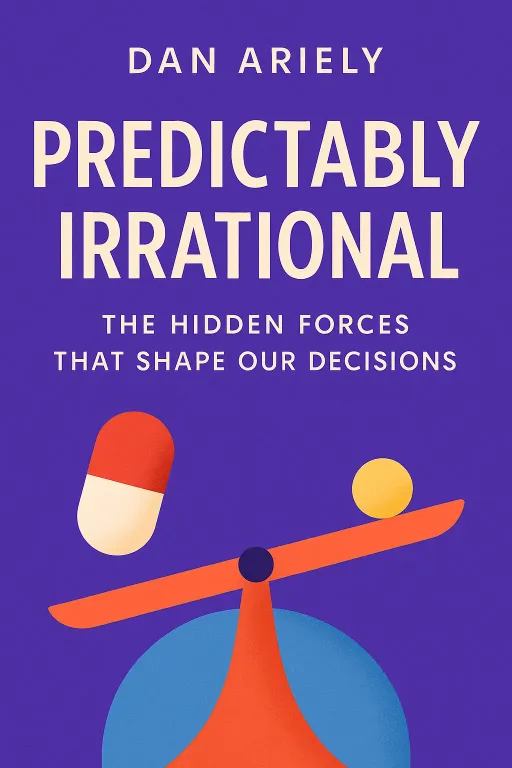
Nova: It sounds counterintuitive, but it's a core lesson from Dan Ariely's groundbreaking book, 'Predictably Irrational.' He argues that we humans are not just irrational, but we're irrational in very specific and predictable ways. And today, we're going to unpack the hidden forces that shape our decisions, looking at it from two powerful angles for any founder.
aleck: Okay, I'm intrigued. What are the angles?
Nova: First, we'll explore how to architect customer choices using the surprising power of these 'decoys'. Then, we'll shift from customers to culture, and discuss the delicate balance of social and market forces, and how to motivate your team without accidentally killing their passion.
aleck: Fantastic. This is the stuff that keeps founders up at night—how to get customers in the door, and how to keep your team inspired once they're inside. I'm ready.
Deep Dive into Core Topic 1: The Decoy Effect: Architecting Choice for Growth
SECTION
Nova: So let's start with that pricing puzzle. It comes from one of the most famous experiments in the book, involving magazine. Dan Ariely is browsing their website, and he sees this subscription offer. Aleck, picture this on a screen. You have three choices.
aleck: Okay, lay them on me.
Nova: Option one: An internet-only subscription for $59. Option two: A print-only subscription for $125. And option three: A print-and-internet subscription, also for $125.
aleck: Wait, back up. The print-only is the same price as the print-and-internet combo? That makes no sense. The print-only option is objectively a worse deal. Who would ever choose that?
Nova: Exactly! That's what Ariely thought. It seemed like a mistake. But being a behavioral economist, he suspected it was intentional. So he ran an experiment. He gave these three options to 100 of his brilliant MIT students and asked them to pick one. What do you think they chose?
aleck: Well, nobody is picking the print-only option, that's for sure. I'd guess most people would see the combo deal as a fantastic bargain and go for that. The web-only is for the super budget-conscious, but that combo just screams 'value!'
Nova: You've nailed the psychology. 16 students chose the cheap internet-only option. And a whopping 84 chose the print-and-internet combo. And you were right, aleck, not a single student chose the print-only 'decoy'. But here's where it gets wild. Ariely ran the experiment again with a new group of students. This time, he removed the 'useless' print-only option. So now the choice was just between internet-only for $59 and the combo for $125.
aleck: Okay, so now it's a straightforward choice between cheap and expensive. My guess is the numbers would flip. Without the decoy making the combo look like a steal, more people would just opt for the cheaper plan.
Nova: Precisely. This time, 68 students chose the cheap internet-only plan, and only 32 chose the expensive combo. The preferences completely reversed. That 'useless' middle option wasn't useless at all—it was a psychological weapon.
aleck: Wow. So the mere presence of that objectively bad option made the expensive combo deal seem incredibly valuable. It's not a product, it's a comparison tool. It changes the entire frame of the decision.
Nova: That's the core insight! Ariely calls it the 'decoy effect'. We don't have an internal value meter that tells us what something is worth. We think relatively. We need comparisons. And that decoy gave everyone a simple, powerful comparison: the combo is clearly better than the print-only, so it must be a great deal.
aleck: This is so directly applicable to anyone building a product, especially in software. You see it constantly with SaaS pricing tiers. You'll have a 'Basic' plan, a 'Pro' plan, and a 'Business' plan. Often, the 'Pro' plan is priced and featured in such a way that it makes the 'Business' plan look like the obvious, high-value choice for any serious company. It reframes the customer's internal question from 'Is this software worth $99 a month?'—which is a hard question to answer—to 'Which of these three plans is the best deal for me?'
Nova: And that's a much, much easier question for our predictably irrational brains to answer, isn't it? It's about guiding the customer by architecting the choice itself.
aleck: It's brilliant. You're not just selling a product; you're selling a decision.
Deep Dive into Core Topic 2: Social vs. Market Norms: The Founder's Guide to Motivation
SECTION
Nova: It's fascinating how a simple comparison can change financial decisions. But what happens when money isn't part of the equation at all... or worse, when it's introduced where it doesn't belong? This brings us to our second key idea for founders: the two worlds of social norms and market norms.
aleck: Okay, what's the distinction?
Nova: Think about it this way. When you help a friend move, that's a social norm. It's about community, goodwill. You don't expect payment; a thank you and maybe a pizza is enough. But a moving company operates on market norms. It's a transaction: you pay a specific price for a specific service. The book argues that we live in both worlds, but they have very different rules, and mixing them can be disastrous.
aleck: I can see that. If my friend offered me five dollars to help him move his couch, I'd probably be offended.
Nova: You'd be insulted! And that's the heart of another incredible story from the book. The AARP, the organization for retirees, wanted to get lawyers to offer their services to needy seniors at a discounted rate, say, $30 an hour.
aleck: A noble cause. But $30 an hour for a lawyer is… well, it’s basically nothing. I can't imagine many would agree.
Nova: They didn't. The lawyers flat-out refused. So the AARP manager tried a different approach. He went back to the same lawyers and asked: "Would you be willing to offer your services for free?"
aleck: And let me guess, based on the theme, they said yes.
Nova: Overwhelmingly, yes! And the question is why? Why would they work for zero dollars but not for thirty? Because the $30 offer triggered market norms. In the market world, $30 is a pathetic wage for a lawyer. It's an insult. But offering to work for triggered social norms. Suddenly, it wasn't a badly paid job; it was a noble act of charity. It made them feel good.
aleck: That is so powerful. It's the difference between feeling valued and feeling cheapened. As a founder, you're constantly navigating this. You know, you can't always compete on salary with the big tech giants, so you have to compete on the social side of the deal—the mission, the culture, the sense of ownership, the feeling that we're all in this together.
Nova: And Ariely warns that once you cross that line from social to market, it's almost impossible to go back. He tells this unforgettable story about a daycare in Israel. The daycare had a problem with parents showing up late to pick up their kids. So, they decided to introduce a small fine for late parents. What do you think happened?
aleck: Oh no. I have a bad feeling about this. The fine probably made it worse.
Nova: It made it much worse! Before the fine, parents who were late felt guilty. They were breaking a social contract with the teachers. But the moment the fine was introduced, the guilt vanished. It was replaced by a market transaction. Parents thought, "I can be late, and all it costs is a few shekels. It's a service I'm paying for." The fine removed the social norm and replaced it with an ineffective market norm. And even after they removed the fine, the lateness continued because the social norm of guilt had been destroyed.
aleck: And that's the trap. You think you're creating an incentive, but you're actually just putting a price tag on bad behavior. It removes the moral or social element. For a startup, this could be anything from 'fining' people for being late to a meeting to offering a tiny cash bonus for working a weekend. You might be far better off just buying everyone pizza and thanking them personally—keeping it firmly in the social world.
Nova: Exactly. A gift says, "We're a team." A small payment says, "This is all your extra time is worth to me." The messages are worlds apart.
Synthesis & Takeaways
SECTION
aleck: So, looking at both of these ideas, there's a clear thread. It’s about understanding the invisible context of a decision, whether it's a customer's or an employee's.
Nova: That's a perfect way to put it. We've seen how our decisions about what to buy are shaped by the architecture of the choice itself—by relativity and decoys. And we've seen how our motivations to contribute and collaborate can be either fueled or extinguished depending on whether we're in a social or a market mindset.
aleck: Right. It's about being intentional. Intentionally designing your pricing to guide customers toward value, and intentionally designing your culture to foster goodwill, not just transactions. It's a much more nuanced way of looking at business.
Nova: It really is. So for everyone listening, especially founders like you, aleck, here's the challenge we can take from the book this week. It's twofold. First, look at your pricing page or any choice you offer customers. Is there a decoy you could add to make your desired plan the obvious, irresistible choice?
aleck: I'm already thinking about it.
Nova: And second, identify one 'social' interaction with your team—it could be a weekly meeting, a celebration, or even just how you handle favors. Ask yourself: how can I protect this from accidentally becoming a 'market' transaction?
aleck: That's a great, actionable takeaway. It's a reminder to be a conscious architect of the human systems around you, not just the technical ones. A fantastic and deeply practical lesson from 'Predictably Irrational'. Thanks, Nova.
Nova: Thank you, aleck. It's a powerful reminder that the most hidden forces are often the ones that shape us the most.