The Human Code: Why We Act Against Our Best Interests.
9 minGolden Hook & Introduction
SECTION
Nova: POV: You've just bought something you didn't need, or maybe said 'yes' when you absolutely meant 'no,' and you're left wondering, 'Why on earth do I keep doing this?'
Atlas: Oh, I know that feeling! It’s like my brain has a secret, rebellious agenda sometimes. You think you’re in control, and then boom, you’re suddenly the proud owner of… well, another novelty coffee mug.
Nova: Exactly! That nagging question, "Why do I act against my best interests?" is precisely what we're cracking the code on today. We're diving into the groundbreaking work of two titans of human behavior: Dan Ariely and Robert Cialdini.
Atlas: Those names ring a bell. Aren't they the ones who really pull back the curtain on how our minds actually work, not just how we they work?
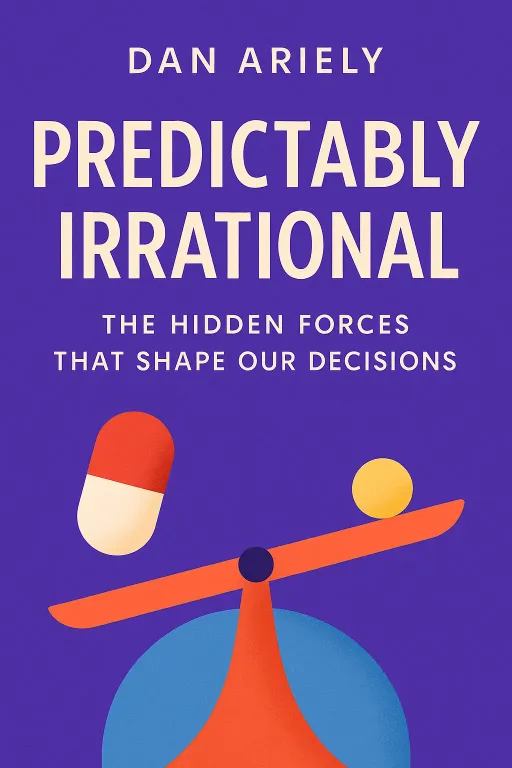
Nova: Absolutely. And Ariely, in particular, came to behavioral economics through a very personal journey—a severe accident during his youth that left him with third-degree burns. His long, painful recovery led him to observe human behavior, especially his own, in a unique and profoundly insightful way. This personal experience became the bedrock of his groundbreaking research into why we are so 'predictably irrational.'
Atlas: Wow, that’s a powerful origin story. It’s not just academic theory; it’s born from a lived experience of observing human quirks and pain points.
Nova: Precisely. It gives his work a profound depth. And that's where we begin today: with the surprising truth that our decisions are far less rational than we believe.
The Myth of Rationality & Predictable Irrationality
SECTION
Nova: Most of us walk around convinced we're rational beings, weighing pros and cons, making logical choices. But Ariely, through ingenious experiments, shows us that our decisions are, in fact, "predictably irrational." We make the same systematic mistakes over and over again.
Atlas: Wait, are you saying we're rational? That sounds a bit out there. I mean, I choose to eat breakfast every morning because I’m hungry, that seems pretty rational.
Nova: Not that we're never rational, Atlas, but that our rationality is often an illusion, especially when faced with certain choice architectures. Think of it like this: if you know exactly how someone will make an "irrational" choice under specific conditions, that choice becomes predictable, right?
Atlas: Yeah, I guess that makes sense. Predictable irrationality. Like knowing I'll always pick the shiny object, even if the dull one is more useful.
Nova: A perfect example! One of Ariely’s most famous experiments involved magazine subscriptions. They offered three options: a web-only subscription for $59, a print-only subscription for $125, and a print-and-web subscription for $125.
Atlas: Okay, so print-only for $125 and print-and-web for $125. Who would pick print-only? That’s obviously a worse deal.
Nova: Exactly! In their first test, 16% chose web-only, 0% chose print-only, and 84% chose print-and-web. But here's the kicker: when they the "print-only" option, suddenly the web-only choice jumped to 68%, and print-and-web dropped to 32%!
Atlas: Whoa. So, just having that "obviously worse" option—the print-only for $125—made people overwhelmingly choose the most expensive print-and-web option? That’s wild.
Nova: It is. The print-only option served as a decoy, making the print-and-web option look like an incredible deal by comparison. It wasn't about the intrinsic value of the print-and-web subscription itself, but how it was framed relative to an inferior, but similarly priced, alternative.
Atlas: That’s fascinating. So, if we’re so predictably irrational, how does that affect, say, a leader trying to get their team to adopt a new strategy? They might think they're presenting logical facts, but people are making choices based on… what, then? Hidden comparisons?
Nova: Precisely. A leader might present a new strategy purely on its merits, expecting rational adoption. But if there’s no clear, slightly inferior "decoy" option to compare it against, or if it's presented alongside an existing, comfortable but less effective option, the perceived value shifts dramatically. Understanding this means you don't just present the best option; you frame it in a way that highlights its superiority by comparison.
Atlas: That’s a great way to put it. It’s not about manipulating, but about understanding the human mind to make the choice easier to see.
Mastering the Human Code: Principles of Influence and Their Application
SECTION
Nova: Once we accept our irrationality, the next step is understanding how others, deliberately or not, tap into those predictable patterns. This is where Robert Cialdini's work in "Influence: The Psychology of Persuasion" becomes indispensable. He outlines six universal principles that trigger our automatic responses.
Atlas: Oh, I've heard of Cialdini's principles. But wait, isn't that just manipulation? For someone focused on mindful leadership, the idea of "influence" can sometimes feel a bit… ethically grey.
Nova: That’s a crucial distinction, Atlas, and it’s why understanding these principles is so important. Cialdini himself emphasizes that these principles can be used ethically to persuade for good, or unethically to manipulate. The difference lies in the intent and the benefit. Let's look at Reciprocity.
Atlas: Reciprocity. That’s the "you scratch my back, I'll scratch yours" idea, right?
Nova: Exactly. We feel an innate obligation to return favors. Cialdini cites studies where even a tiny, unasked-for gift, like a mint with a restaurant bill, significantly increases tips. It’s not about the value of the mint, but the feeling of being given something freely. This taps into a deep-seated human need for fairness and social exchange.
Atlas: So, how can a leader use reciprocity to foster genuine collaboration, not just obligate people? Because giving out mints before a team meeting feels a bit… odd.
Nova: A leader wouldn't literally hand out mints! But they might genuinely offer help to a team member without expecting immediate return, or share valuable resources freely. This builds a bank of goodwill. When that leader later needs support for a new initiative, people are more inclined to reciprocate that genuine earlier generosity, not because they’re forced, but because they feel a positive social obligation. It fosters a culture of mutual support.
Atlas: That makes sense. It’s about building authentic relationships, not just transactional ones. What about another one? Social Proof?
Nova: Ah, Social Proof. This is the principle that we often look to others to determine what is correct or desirable behavior, especially when we're uncertain. Think about those signs in hotels asking guests to reuse towels.
Atlas: Right, they often say, "Help save the environment."
Nova: But Cialdini’s research showed that signs saying "75% of guests who stayed in this room recycled their towels" were far more effective. It wasn't about the environmental message; it was the social proof that are doing it.
Atlas: That’s incredible. So, it's not the logical argument, it’s the perceived norm. For someone building products or communications, that’s huge. It's not just about what you your product does, but what you show doing with it.
Nova: Exactly. If you want to encourage a new behavior, whether it's adopting a new software or contributing to a community project, highlighting how others are already successfully doing it is often more powerful than just listing benefits. It validates the behavior by demonstrating it's a shared, accepted norm.
Atlas: I can see how that would be a game-changer for someone designing user experiences or even internal communications. You're not just telling people what to do; you're subtly guiding them by showing what's already happening.
Synthesis & Takeaways
SECTION
Nova: So, by understanding both our inherent irrationality, as Ariely shows, and the powerful principles of influence, as Cialdini unpacks, we gain incredible foresight. It’s about recognizing that the 'human code' has predictable glitches and triggers.
Atlas: It really is. It shifts the perspective from 'why are people so illogical?' to 'how can I understand and work human nature, rather than against it?' It feels like a key to cognitive optimization, not just for ourselves, but for the systems and teams we lead.
Nova: Precisely. Recognizing these predictable patterns allows us to design better systems, products, and communications—whether you're an innovator building the future, a nurturer fostering growth, or a strategist guiding decisions. It’s about creating environments where the right choices are the easy choices, and where influence is used to empower, not to exploit.
Atlas: That’s actually really inspiring. It’s about moving beyond just hoping people will do the rational thing, and instead, building pathways that lead to better outcomes for everyone. So, what’s one immediate thing listeners can do to start observing these patterns in their own lives?
Nova: My tiny step for everyone listening is this: observe a recent decision you made. Maybe it was a purchase, or a commitment, or even just how you spent your last hour. Can you identify an irrational bias that might have affected your choice, or an influence principle that was at play?
Atlas: I love that. It makes it real, immediately. And it’s a great way to start building that self-awareness.
Nova: Absolutely. Share your insights with us online – we’d love to hear what you uncover.
Atlas: This is Aibrary. Congratulations on your growth!
Nova: Congratulations on your growth!