Beyond the Spreadsheet: Understanding Economic Behavior for Better Decisions
9 minGolden Hook & Introduction
SECTION
Nova: Most of us walk around convinced we're making perfectly rational decisions, weighing pros and cons, acting in our own best interest. But what if I told you that's largely an illusion, and your choices are being subtly, almost imperceptibly, steered every single day?
Atlas: Oh, I love that. So, we're not the logical masterminds we think we are? That's going to resonate with anyone who struggles with decision fatigue, or, you know, just being human. What are we dissecting today to uncover these hidden puppet strings?
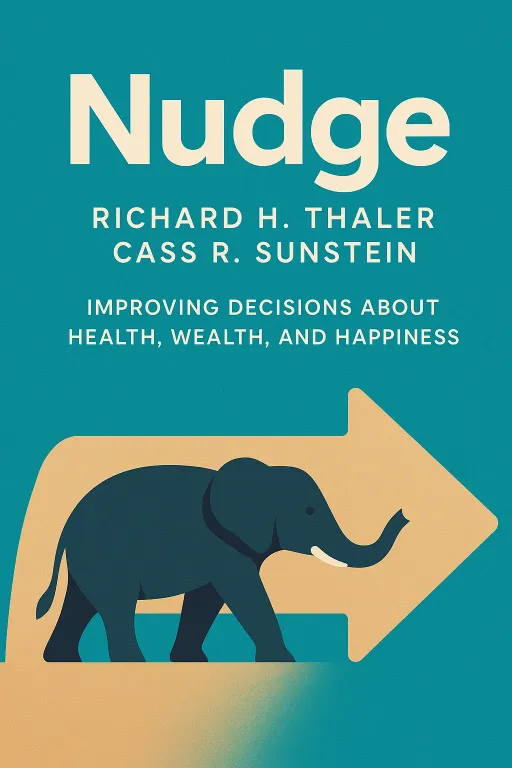
Nova: Exactly, Atlas! We're diving into a fascinating corner of human behavior today, inspired by two truly groundbreaking books: "Nudge: Improving Decisions About Health, Wealth, and Happiness" by Richard H. Thaler and Cass R. Sunstein, and "Predictably Irrational" by Dan Ariely. Thaler, in particular, was even awarded the Nobel Prize in Economic Sciences for his work in behavioral economics, showing just how much these ideas challenged the traditional view of humans as purely rational actors. These insights aren't just academic; they're a roadmap for understanding why we do what we do, and how we can design better systems, better products, and even better teams.
Atlas: Okay, so it sounds like we're moving "Beyond the Spreadsheet" and into the messy, wonderful world of human psychology. And it’s not just about pointing out our flaws, but about empowering us to influence outcomes positively, right?
Nova: Precisely. It’s about recognizing our inherent 'blind spots' and using that knowledge to our advantage. And that naturally leads us to our first deep dive: the myth of rationality and the surprisingly potent power of a well-placed nudge.
The Myth of Rationality & The Power of Nudges
SECTION
Nova: For decades, economic theory was built on the premise of —the perfectly rational human who always makes optimal choices. But Thaler and Sunstein, with their concept of 'libertarian paternalism,' completely upended that. They said, "Look, people are human. They make mistakes. But we can design environments, what they call 'choice architecture,' that gently guide them towards better decisions without restricting their freedom."
Atlas: So, basically you're saying we're all a bit like toddlers in a candy store, and someone just needs to put the broccoli at eye level?
Nova: That’s a great analogy! Think about it this way: Thaler often cites the example of the fly in the men's urinals at Amsterdam's Schiphol Airport. A small, etched image of a fly at a specific spot dramatically reduced 'spillage' by 80%. No stern warnings, no increased cleaning staff, just a tiny, almost subliminal target that nudged behavior. Or take organ donation. In some countries, you have to to be a donor, and participation rates are low. In others, you're automatically enrolled, and you have to. Participation is sky-high. The default option, a subtle nudge, has a massive impact.
Atlas: Wow, whoa. That’s actually really inspiring. I imagine a lot of our listeners, who are building products or leading teams, are constantly trying to get users or employees to adopt new features or follow new policies. Are you saying the way we the choice can be more powerful than the choice itself?
Nova: Absolutely. It’s all about the 'choice architecture.' If you want your team to save more for retirement, making the default enrollment in a 401k an opt-out rather than an opt-in can dramatically increase participation. If you’re designing a new software feature, how you present the default settings, or even the order of options in a menu, can significantly impact adoption. It's about designing systems that work human psychology, not against it. It's not about forcing, but about guiding.
Atlas: That makes me wonder, though. Isn't there a fine line between nudging for good and, well, manipulating? As empathetic leaders, we want to guide, but we also value autonomy.
Nova: That's a crucial point, and Thaler and Sunstein address it directly. They call it 'libertarian paternalism' because it preserves freedom of choice. You can always opt-out, you can always choose the less optimal path. The goal isn't to trick people, but to help them make decisions they would likely make anyway if they had unlimited time, information, and willpower. It's about helping us overcome our own cognitive laziness or biases. It's about setting up the environment so the healthier, wealthier, or happier choice is the easiest one.
Predictable Irrationality & Anticipating Human Responses
SECTION
Atlas: That's fascinating how small tweaks in the environment can guide behavior. But what about when our own brains actively our rational intentions? Does that happen systematically? I mean, are our errors predictable?
Nova: Oh, absolutely, and that's where Dan Ariely's "Predictably Irrational" comes in. He argues that our irrationality isn't random; it's systematic and predictable. We make the same kinds of mistakes over and over again. Take, for instance, the 'decoy effect.' Ariely famously illustrated this with a subscription offer for.
Atlas: Okay, so, tell me. What was the decoy?
Nova: Imagine this: three options. Option A: Web subscription for $59. Option B: Print subscription for $125. Option C: Web and Print subscription for $125. Most people, when faced with just A and B, would pick A. But with all three, Option C suddenly looks like an incredible deal, because it's the same price as the print-only, but you get both! The print-only option, Option B, is the decoy. It's designed to make Option C look like a steal, even though it might not be what you originally wanted.
Atlas: Whoa. So, the decoy isn't meant to be chosen, it's just there to make another option look better by comparison. That's a bit like when you see a really expensive, slightly absurd item on a menu, and suddenly the second most expensive item looks perfectly reasonable.
Nova: Exactly! It's our brain's tendency to make relative comparisons. We don't evaluate things in absolute terms. Another classic is 'anchoring bias.' We tend to rely too heavily on the first piece of information offered when making decisions. If a car salesman starts with an outrageously high price, even if you negotiate it down significantly, that initial anchor still influences your perception of what a "good deal" is.
Atlas: That’s such a powerful insight for a strategic builder. How can someone anticipate these predictable errors in their users or their own team? And how do we these biases, or even ethically them for better outcomes within a culture we're trying to build?
Nova: It's about awareness first. Understanding that these biases exist means you can look for them. For product design, if you want users to pick a premium package, introduce a slightly more expensive, less feature-rich "decoy" package. For team dynamics, if you're negotiating goals, be mindful of anchoring. The first number mentioned, even if arbitrary, can set the tone for the entire discussion. It’s also about building systems that decisions. For example, using checklists to prevent 'omission bias' or structured decision-making processes to counter 'confirmation bias.'
Atlas: So, it's not just about nudging people towards a choice, but understanding the very fabric of their decision-making process – the predictable cracks in our rationality. It feels like these books are saying, don't just build a better mousetrap; understand the mouse.
Nova: Precisely. Thaler and Sunstein show us how to design the maze, while Ariely shows us why the mouse runs in predictable patterns within it. Together, they empower us to create environments where people, including ourselves, are more likely to thrive. It’s about building for human nature, not some idealized version of it.
Synthesis & Takeaways
SECTION
Nova: So, whether you're a strategic builder crafting the next big product, an empathetic leader guiding your team, or a visionary trying to establish a resilient culture, understanding these two powerful ideas is foundational. It’s about moving beyond the naive assumption of pure rationality and embracing the beautiful, messy, predictable irrationality of human beings.
Atlas: It truly redefines what "smart design" means. It's not just about functionality, but about psychology. It's about designing the choice architecture, anticipating the predictable errors, and ultimately, creating systems that gently, ethically, lead to better outcomes for everyone involved.
Nova: Exactly. And for our listeners, particularly those who are constantly implementing new features or policies, consider this: How might a small 'nudge' have improved the adoption or effectiveness of a recent product feature or policy you implemented? What subtle changes could have led to a significantly better outcome?
Atlas: That's a deep question, and one that highlights the immediate, actionable power of these insights. It's not just theory; it's a call to rethink every design, every interaction, every default.
Nova: It truly is. The power lies in recognizing that our 'blind spots' aren't weaknesses to be overcome by sheer willpower, but rather predictable patterns that can be understood and designed around. And that, for any builder or leader, is a superpower.
Atlas: This is Aibrary. Congratulations on your growth!