Beyond the Product: Why Understanding Human Psychology Builds Unstoppable Traction
8 minGolden Hook & Introduction
SECTION
Nova: You know, we spend so much time optimizing for logic, for efficiency, for what we people should do. But what if I told you that most of what we consider rational decision-making is actually just an elaborate illusion?
Atlas: Whoa, hold on. An illusion? Nova, that sounds like a premise for a sci-fi movie, not a roadmap for building better products. I mean, aren't people generally rational actors? Don't they weigh pros and cons?
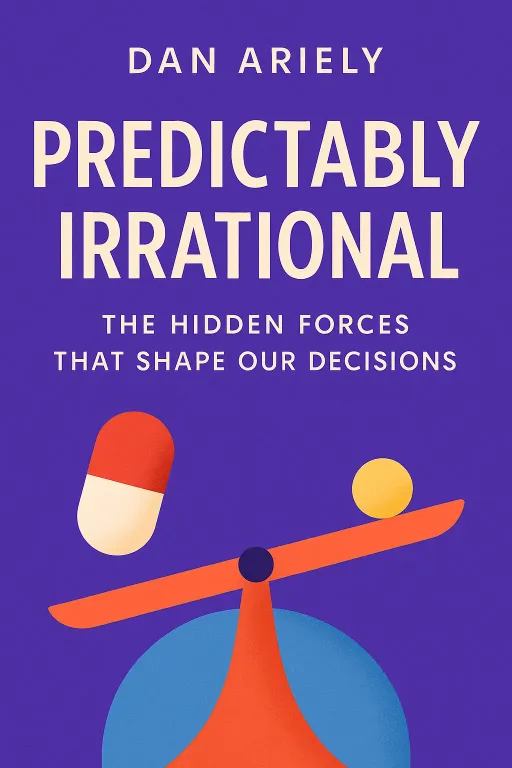
Nova: That's the blind spot, Atlas, and it's precisely what we're going to dive into today on Aibrary, as we go "Beyond the Product: Why Understanding Human Psychology Builds Unstoppable Traction." We're not talking about random quirks, but systematically predictable irrationality. And our guides for this mind-bending journey are two absolute titans: Dan Ariely, with his groundbreaking book "Predictably Irrational," and the Nobel laureate Daniel Kahneman, whose "Thinking, Fast and Slow" literally redefined our understanding of the human mind. Kahneman's work, in particular, earned him the Nobel Prize in Economic Sciences, which just underscores how profoundly these psychological insights impact fields far beyond traditional psychology.
Atlas: Okay, a Nobel Prize winner telling me my decisions are an illusion? Now you have my full attention. For anyone out there trying to build robust systems or cultivate a thriving community, ignoring the foundational understanding of how humans actually operate sounds like a recipe for constant uphill battles. So, where do we even begin to unpack this "predictable irrationality"?
The Systematic Irrationality of Choice
SECTION
Nova: We start with Dan Ariely. Imagine this: you're subscribing to a magazine. You have three options: an online-only subscription for $59, a print-only subscription for $125, or a print-and-online subscription for $125. Which one would you pick?
Atlas: That's easy, Nova. The print-and-online for $125. Why would anyone choose print-only for the same price? That seems like a no-brainer.
Nova: Exactly! And that, my friend, is the decoy effect in action, one of Ariely's brilliant demonstrations. When that "print-only for $125" option is present, it makes the "print-and-online for $125" look like an incredible deal, a clear winner. But if you remove that seemingly useless middle option, suddenly more people gravitate towards the cheaper online-only option. Our decisions aren't absolute; they're relative, and they're heavily influenced by the context and the choices we're given, even if those choices seem irrelevant.
Atlas: So you're saying that seemingly useless option isn't useless at all. It's a psychological lever, subtly nudging us toward a specific outcome. It's like, for someone cultivating a community, if you offer two tiers of membership, but one is clearly overpriced for what it offers, it makes the slightly more expensive but feature-rich tier look like a steal.
Nova: Precisely. It's not about people being dumb; it's about the architecture of choice. Ariely shows us that humans are not rational calculators; we are prone to systematic errors. Take the "power of free," for example. People will often choose something free, even if a slightly better, inexpensive option would provide more value. The emotional pull of "free" is so strong it overrides our logical assessment of utility. Think about product features: offering something "free" can often drive adoption far more than a deeply discounted but still paid equivalent.
Atlas: That's actually really inspiring, because it means these aren't just random human flaws; they're patterns. If we can predict them, we can design them. So, for an architect building a robust system, this isn't about manipulating users in a negative way, but about understanding their inherent wiring to create experiences that feel intuitive and satisfying. But what about when we have to make bigger, more complex decisions? Does this "irrationality" still hold true?
The Two Systems of Thinking and Their Impact on Design
SECTION
Nova: Absolutely, and that leads us beautifully to Daniel Kahneman and his revolutionary concept of System 1 and System 2 thinking. Think of it like this: your mind has two characters living inside it. System 1 is the fast, intuitive, emotional, automatic thinker. It’s what helps you recognize a face, understand simple sentences, or slam on the brakes when a car swerves. It operates effortlessly.
Atlas: Okay, so System 1 is basically my gut reaction. The quick, almost subconscious decision-maker. Like when I instantly know I want that coffee, no deep thought required.
Nova: Exactly. Then there's System 2: the slow, deliberate, logical, effortful thinker. This is what you use for complex calculations, learning a new language, or carefully weighing the pros and cons of a major investment. It requires concentration and consumes mental energy. The critical insight is that System 1 is always running in the background, offering suggestions, impressions, and feelings to System 2. And often, System 2 is lazy; it just accepts System 1's suggestions without much scrutiny.
Atlas: So you’re saying my "gut reaction" coffee choice is System 1, but deciding which new software architecture to implement for a client is definitely System 2. But if System 2 is lazy, how does that impact how we design for users? How do we build products that don't accidentally fight against our natural inclination towards System 1?
Nova: That's the million-dollar question, and it's where the real design magic happens. If you're designing a user interface for a routine task – say, checking notifications or liking a post – you want to cater to System 1. Make it intuitive, visually clear, and require minimal cognitive effort. Smooth animations, familiar icons, instant feedback. You want the user to glide through it without thinking.
Atlas: Right, like an effortless flow state. If I have to stop and about where the 'like' button is, you've already lost me. That breaks the System 1 experience.
Nova: Precisely. But if you're designing for a high-stakes decision – like confirming a large financial transaction, or setting up complex privacy settings – you absolutely to engage System 2. You need friction, clear warnings, multiple confirmation steps, perhaps even a moment of pause. You want to make it to make a mistake, forcing that deliberate thought process. Many products inadvertently fight against these biases by making critical decisions too easy, or routine tasks too complex.
Atlas: That's a perfect example. Someone building foundational systems needs to know when to make things frictionless and when to intentionally introduce friction for safety or clarity. It's about designing for the human, not just the function. It makes me think about the deep question from our material: Where might my current product or service inadvertently be fighting against natural human biases, and how could I adjust it to work with them? It's not just about what the product, but how it to use it, how it aligns with our psychological defaults.
Synthesis & Takeaways
SECTION
Nova: Exactly, Atlas. The profound insight here isn't just that humans are irrational; it's that our irrationality is. And once you understand those patterns, you gain an incredible superpower. You can design products, services, and even communities that resonate far more deeply with how people actually think and behave, leading to stronger engagement and, yes, unstoppable traction. It’s a shift from designing for the ideal user to designing for the real, imperfect, wonderfully biased human being.
Atlas: For anyone out there who's an architect of systems or a cultivator of communities, this isn't just academic theory; it's fundamental. It's about building lasting value by truly understanding the human element. It's about asking: "Am I leveraging the power of System 1 for effortless engagement, and intentionally calling upon System 2 for meaningful, deliberate action?" That's a powerful lens to apply to everything we create.
Nova: It truly is. It's about cultivating a deeper empathy for the user's mind. So, take a moment today, listeners, and reflect: Where in your product, your service, or even your interactions, are you assuming rationality when predictable irrationality is actually at play? How can you adjust to work that human nature, rather than against it?
Atlas: That's a fantastic challenge. It's about bringing that pragmatic clarity to our human-centered design.
Nova: This is Aibrary. Congratulations on your growth!