

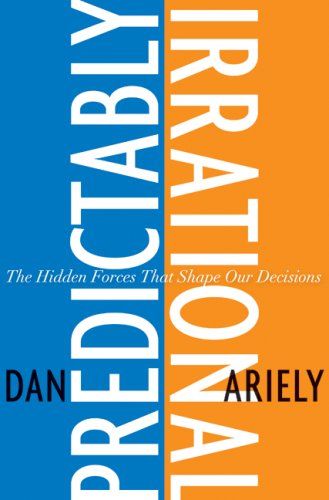
Predictably Irrational
The Hidden Forces That Shape Our Decisions
Introduction
Nova: Imagine you are in a hospital bed, covered in bandages, and the nurses have to rip them off every single day. It is agonizing. Now, the nurses believe that doing it quickly is better for you. Like pulling off a band-aid, right? But what if they are wrong? What if a slower, less intense process is actually more bearable? That exact experience is what led Dan Ariely to spend his life studying why humans make the choices we do. And as it turns out, we are not nearly as logical as we think.
Nova: They were following an intuition that felt right but was scientifically wrong. And that is the core of Ariely's book, Predictably Irrational. He argues that we do not just make random mistakes. We make the same mistakes over and over again in ways that are totally predictable if you understand the hidden forces at play.
Nova: In a way, yes. But the good news is that if you can predict the glitch, you can plan for it. Today we are diving into why we overpay for things we do not want, why we work for free but refuse to work for cheap, and how a single decoy can trick you into spending way more than you planned.
Key Insight 1
The Decoy Effect
Nova: Let us start with a classic experiment Ariely discusses involving The Economist magazine. He saw an ad that offered three options. One, a digital subscription for fifty-nine dollars. Two, a print subscription for one hundred and twenty-five dollars. And three, a print and digital package for... one hundred and twenty-five dollars.
Nova: Exactly. That is what Ariely thought. So he tested it on his students. When all three options were there, eighty-four percent of people chose the combo deal. Nobody chose the print-only option. It seemed useless.
Nova: That is the trick. When Ariely removed that useless print-only option and just gave students the choice between the fifty-nine dollar digital sub and the one hundred and twenty-five dollar combo, something wild happened. The preferences flipped. Sixty-eight percent now chose the cheaper fifty-nine dollar option.
Nova: Precisely. It is called the decoy. We do not have an internal barometer for what things are actually worth. We only know how to compare things to other things. By putting a bad deal next to a good deal, the seller makes the good deal look like a steal. Without that decoy, we start comparing the expensive version to the cheap version and realize we probably do not need the expensive one.
Nova: Exactly. You are not buying the eighty-dollar bottle, but its presence is what makes you comfortable spending fifty. We are relative creatures. We live in a world of comparisons, and marketers use that to guide our choices without us ever realizing we are being steered.
Key Insight 2
The Magic of Free
Nova: Now let us talk about the most dangerous word in the English language according to Ariely. The word is free. Most people think free is just a price, but it is actually an emotional trigger.
Nova: That is exactly how our brains process it. Ariely did an experiment with chocolates. He offered people a choice between a high-end Lindt truffle for fifteen cents and a basic Hershey’s Kiss for one cent. Now, the truffle is a much better deal at that price, and most people chose it.
Nova: But then he dropped the price of both by exactly one cent. Now the truffle was fourteen cents and the Hershey’s Kiss was free. Rational economics says the preference should stay the same because the price difference is still thirteen cents. But instead, everyone went for the Hershey’s Kiss.
Nova: Yes. People completely ignored the value proposition because the allure of free was too strong. Ariely explains that we have an irrational fear of loss. When we buy something, even for a penny, there is a risk of losing that penny if the product is bad. But if it is free, there is no visible downside. Our brains just light up.
Nova: You and everyone else! Amazon saw this when they introduced free shipping in France. In most countries, it was free if you spent a certain amount. But in France, they accidentally set it to cost one franc, which is about twenty cents. They did not see the same sales boost as other countries until they changed that one franc to zero. That tiny twenty-cent difference was the gap between a nice discount and a psychological frenzy.
Key Insight 3
Social vs. Market Norms
Nova: This is one of the most fascinating parts of the book. Ariely argues we live in two worlds simultaneously. One is governed by social norms, where we do things because we are kind or because it is a social obligation. The other is market norms, where everything is about dollars and cents.
Nova: Exactly. Imagine you go to your mother-in-law's house for a massive Thanksgiving dinner. Everything is delicious. At the end, you stand up, pull out your wallet, and say, Mom, for all the love and effort you put into this, I would like to pay you four hundred dollars. How does that go over?
Nova: Right. You just brought market norms into a social space. But here is the kicker: people will often work harder for a social cause than they will for money. Ariely cites a study where lawyers were asked if they would provide legal services for needy retirees at a discounted rate of thirty dollars an hour. Most said no.
Nova: But when they were asked if they would do it for free, most of them said yes!
Nova: It makes sense when you realize that as soon as you mention money, you trigger the market norm. The lawyers think, Is thirty dollars worth my time? No. But when it is free, the social norm kicks in. They think, Am I a good person who helps retirees? Yes.
Nova: That is a perfect example. Before the fine, parents felt guilty about being late because they were inconveniencing the teachers. It was a social norm. But when the daycare introduced a fine, the guilt vanished. The parents saw the fine as a price they were paying to stay late. They were happy to buy that extra time. Even worse, when the daycare realized the mistake and removed the fine, the lateness stayed high. The social norm had been destroyed and it could not just be turned back on.
Key Insight 4
The High Cost of Ownership
Nova: Why is it so hard to sell our old stuff on Craigslist? We always think our beat-up sofa is worth five hundred dollars, while the buyer thinks it is worth fifty. Ariely calls this the endowment effect.
Nova: We fall in love with what we own. Ariely did a study at Duke University, where basketball tickets are incredibly hard to get. Students camp out for weeks just for a chance at a lottery. He talked to students who won tickets and those who did not.
Nova: The ones who did not win said they would pay about one hundred and seventy dollars for a ticket. But the ones who did win? They refused to sell for anything less than twenty-four hundred dollars.
Nova: Once we own something, we start focusing on what we might lose rather than what we could gain. We also assume the buyer has the same emotional connection to the item that we do. It is also why trials and thirty-day money-back guarantees work so well. Once that rug is in your living room, you do not see it as a rug you are testing. You see it as your rug. Giving it back feels like a loss.
Nova: Absolutely. Ariely calls it the IKEA effect. The more work you put into something, the more you value it. If you build a shaky bookshelf from IKEA, you will think it is a masterpiece because you built it. If you buy a pre-assembled one that is ten times better, you might not care as much. We become irrationally attached to our own creations and our own ideas, which often makes us blind to better alternatives.
Key Insight 5
Expectations and the Power of Price
Nova: Do you think a more expensive aspirin works better than a cheap one?
Nova: And you might actually be right, but not for the reason you think. Ariely conducted a study where he gave people electric shocks and then gave them a painkiller. Half the group was told the pill cost two dollars and fifty cents. The other half was told it cost ten cents.
Nova: Much less. Even though both pills were just Vitamin C. It was a placebo, but the price itself acted as a signal. Our expectations literally change our physiology. If we expect a drink to be refreshing or a medicine to be powerful because of the price tag or the branding, our brains make it so.
Nova: Exactly. He even did this with beer. He added balsamic vinegar to Budweiser and offered it to people. If he did not tell them what was in it, they loved it. They thought it was a craft brew. But if he told them it had vinegar before they tasted it, they hated it.
Nova: Yes. Knowledge and expectations shape our reality. This is why fancy plating in a restaurant makes the food taste better. You are not just paying for the ingredients; you are paying for the psychological prep that tells your brain, This is going to be amazing.
Conclusion
Nova: We have covered a lot today. From the way decoys trick us into spending more, to the emotional grip of free products, and how we overvalue our own stuff just because it is ours. The big takeaway from Predictably Irrational is that we are not the rational, economic machines we were taught to be in school.
Nova: Precisely. Ariely suggests that we need to build fences around our behavior. Since we know we are predictably irrational, we can design our lives to account for it. We can set up automatic savings because we know we will spend what we see. We can acknowledge that we will procrastinate and set hard deadlines for ourselves.
Nova: Spot on. We are all susceptible to these hidden forces, but being aware of them is the first step toward regaining control. Next time you see a deal that looks too good to be true, or you feel insulted by a friend offering to pay you for a favor, remember Dan Ariely. Remember that your brain is playing a game, and now you finally know the rules.
Nova: That is the goal. Understanding the hidden forces helps us make slightly better decisions every day. This is Aibrary. Congratulations on your growth!