

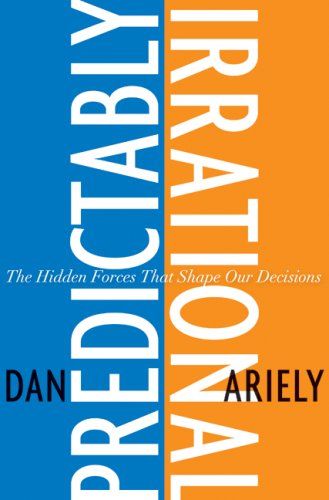
Unlocking Human Behavior: The Logic of Irrationality
Golden Hook & Introduction
SECTION
Nova: Most of us walk around convinced we're paragons of logic, making perfectly rational decisions every single day. We weigh the pros and cons, assess the risks, and choose wisely. Right?
Atlas: Oh, absolutely! I mean, who doesn't feel like a perfectly optimized decision-making machine, especially before that first cup of coffee? But wait, I sense a "but" coming. Are you about to tell me my brain is secretly sabotaging me?
Nova: Well, sabotage might be a strong word, but what if I told you your brain is constantly playing a series of predictable, systematic tricks on you, leading to decisions that are consistently "irrational" – but in a way that's entirely logical to itself?
Atlas: That sounds a bit out there, but also... strangely relatable. Are you saying there's a method to our madness? A logic to our irrationality?
Nova: Precisely! Today, we're diving into the fascinating world revealed by groundbreaking work in behavioral science, exploring the profound "logic of irrationality." This field has fundamentally reshaped how we understand human decision-making, moving it from abstract philosophical debates into observable, predictable patterns.
Atlas: I know this research has been hugely influential, challenging the very foundations of classical economics, which often assumed perfect rationality. It’s like discovering the secret operating system running beneath our conscious thoughts. For anyone who's ever tried to bridge disparate fields or make complex ideas accessible, understanding this underlying system is critical. So, where do we begin to unravel this hidden logic?
Nova: We start with the hidden architects of our daily choices: cognitive biases. These aren't personal failings, but rather systematic errors in thinking that affect everyone, leading us to deviate from pure rationality in predictable ways.
Deep Dive into Cognitive Biases – The Hidden Architects
SECTION
Atlas: Okay, "systematic errors in thinking." That sounds a little alarming. Can you give me an example that would make it clear how these architects operate?
Nova: Absolutely. Let's talk about the Anchoring Bias. Imagine you're at a street market, and you see a beautiful, handcrafted vase. The seller immediately says, "This vase usually goes for $500, but for you, today, I can do $300."
Atlas: Five hundred dollars for a vase? That's steep! My immediate thought would be, "No way."
Nova: Exactly. But here's the trick. Even if you ultimately pay $200, or even $150, that initial, ridiculously high $500 price tag, the "anchor," subtly influences your perception of value. Suddenly, $300 feels like a deal, and $150 feels like an absolute steal, even if the vase might objectively only be worth $100.
Atlas: Hold on, so even if I it's a highball offer, my brain still gets stuck on that initial number? That feels... almost manipulative. It's like my brain refuses to completely ignore the first piece of information it receives.
Nova: That's the power of the anchor. Our brains, seeking efficiency, latch onto that initial figure and then adjust, but typically, they adjust insufficiently. The $500 sets a reference point, and all subsequent figures are evaluated in relation to it. It's not a conscious decision; it's an automatic cognitive process.
Atlas: That's fascinating. For someone trying to influence decisions ethically, or even structure information clearly in a presentation, understanding this is crucial. Like, how does a designer ensure their pricing or their data presentation doesn't unfairly anchor users to a potentially misleading starting point?
Nova: It's about awareness, first and foremost. Knowing that the first piece of information presented can disproportionately sway perception means you have a responsibility to present that initial information thoughtfully. If you're designing a choice architecture, you need to consider what the "default" or initial option communicates, because it can become a powerful anchor. The cause is our brain’s efficiency, the process is insufficient adjustment from a starting point, and the outcome is a predictable deviation from an objectively rational choice.
Atlas: So it's not about being 'stupid,' but about how our brains are wired to process information under certain conditions. It's a feature, not a bug, that can sometimes lead us astray.
Nova: Exactly. It's the logic of an efficient system, but not always the logic of perfect rationality. And often, these biases are a byproduct of another fascinating aspect of our brains: mental shortcuts, or heuristics.
Deep Dive into Heuristics – Mental Shortcuts with Surprising Consequences
SECTION
Atlas: Ah, heuristics. I've heard that term. So, if biases are systematic errors, are heuristics the quick rules of thumb that cause those errors?
Nova: You've got it. Heuristics are mental shortcuts that allow us to make quick, efficient judgments and decisions without having to perform exhaustive calculations or analyses. They're incredibly useful for navigating a complex world, but they come with their own set of surprising consequences.
Atlas: Give me an example. Something I might do every day without even realizing it.
Nova: Consider the Availability Heuristic. This is our tendency to overestimate the likelihood of events that are easily recalled or vivid in our minds. Think about your fears. Many people are more afraid of flying in a plane than driving in a car, despite car accidents being statistically far more common.
Atlas: That's true! Plane crashes are terrifying, and they get massive media coverage. Car accidents, while tragic, are often localized news.
Nova: Precisely. The vividness and extensive reporting of plane crashes make them more "available" in our memory. So, when asked to assess the risk of flying, our brain quickly pulls up these dramatic, easily accessible memories, leading us to overestimate the danger. The cause is our brain's preference for readily available information, the process is quick recall, and the outcome is a judgment skewed by vividness rather than actual probability.
Atlas: That makes me wonder, how many "gut feelings" are actually just our brain taking the easy way out? Like, when I'm trying to synthesize complex data for a project, am I just grabbing the most vivid piece of information, or the most recent, rather than the most representative? That could lead to some really skewed insights if I'm not careful.
Nova: It absolutely could. In a world overflowing with information, our brains naturally prioritize what's immediate and salient. This heuristic is incredibly efficient for quick survival decisions – if you see a lion, you don't run a statistical analysis of lion attacks; you run! But in complex, data-driven environments, it can lead to misjudgments, especially when trying to structure information for clarity or make an impact with accurate insights.
Atlas: So, the "logic of irrationality" is that these shortcuts logical from an energy-saving perspective, even if they lead to suboptimal outcomes in modern, nuanced situations? It's our ancient brain trying to navigate a new world.
Nova: Exactly. These mechanisms evolved to help us survive in a much simpler, more immediate environment. Now, they're still running in the background, shaping how we perceive risk, value, and even truth, often without our conscious awareness. Understanding this isn't about shaming our brains; it's about gaining mastery over our decision-making.
Synthesis & Takeaways
SECTION
Nova: So, what we've really explored today is that our brains aren't broken; they're just optimized for different things than perfect rationality. Cognitive biases and heuristics aren't flaws, but features of an incredibly efficient system designed for quick decision-making. They are, in essence, the 'logic' behind our 'irrationality.'
Atlas: It’s a powerful insight. It means that what might seem like a random, inexplicable human choice can often be traced back to a predictable pattern of thought. For anyone driven by making complex ideas accessible, or someone who wants to inform and influence effectively, this understanding is a superpower. It allows you to anticipate how people might react and to design systems or communications that account for these inherent biases.
Nova: Absolutely. Knowing that a simple anchor can shift perception, or that a vivid story can override statistics, gives us immense power. And with that power comes the responsibility to use it ethically, to design for better outcomes, and to help others navigate their own 'logical irrationality.'
Atlas: That's actually really inspiring. It frames self-awareness not as a struggle against our nature, but as an understanding of our nature, allowing us to leverage it. So, for our listeners, what's one concrete step they can take to start applying this insight?
Nova: Next time you find yourself making a quick decision, or feeling a strong "gut reaction," just pause for a moment. Ask yourself: "What initial information might be anchoring my judgment?" Or, "Am I basing this on the most easily recalled information, rather than the most relevant?" Just that moment of reflection can begin to unlock the logic of your own irrationality.
Atlas: That's a fantastic, actionable takeaway. It’s about cultivating that awareness. We'd love to hear from you all: where have you noticed your own "logical irrationality" at play? Share your experiences with us.
Nova: This is Aibrary. Congratulations on your growth!