

Practice Makes Perfect
English Conversation
Introduction
Nova: Did you know that there are currently over one and a half billion people on this planet trying to learn English? It is the most studied language in history, but here is the catch. Most of those people hit a massive wall long before they ever feel fluent. They learn the rules, they memorize some words, but they cannot actually use the language when it counts. That is where Jean Yates comes in. She is the mastermind behind many of the most popular titles in the Practice Makes Perfect series, and today we are diving into why her approach is considered the gold standard for bridging that gap from student to speaker.
Atlas: That one point five billion number is staggering, Nova. But I get it. I have been that person with a stack of flashcards who still freezes up when someone asks for directions. It feels like there is this huge canyon between knowing what a verb is and actually using it in a sentence without sounding like a robot. Is Yates just giving people more rules, or is she doing something different?
Nova: She is doing something much more practical. The Practice Makes Perfect philosophy, especially under Yates's guidance, is not about the abstract theory of linguistics. It is about building a functional architecture in your brain. She treats English less like a subject to study and more like a tool to build. Today we are looking at her core methodology and how books like English Grammar for ESL Learners and English Conversation turn that daunting canyon into a series of manageable steps.
Key Insight 1
The Architecture of Mastery
Nova: One of the biggest reasons Jean Yates has become a household name in the ESL world is her use of the building block approach. Instead of overwhelming a learner with a five-hundred-page manual on every single English tense, she breaks things down into these incredibly focused, bite-sized modules. If you look at her book English Sentence Builder, she starts with the absolute skeleton of a thought and gradually adds the muscle and skin.
Atlas: I like that analogy. So, she does not just say here is the past tense, now go write a novel. How does she actually layer it? Is it like Lego blocks?
Nova: Exactly like Lego. She starts with the subject and the verb, the simplest units. But here is the Yates magic: she introduces the nuances of American English specifically. She shows how a slight shift in word order or a specific preposition choice changes the entire vibe of a sentence. In her grammar books, she avoids those long, academic explanations that make your eyes glaze over. She gives you a clear, half-page explanation, and then she immediately hands you the steering wheel.
Atlas: That sounds much more approachable. I think a lot of people get intimidated because textbooks try to cover everything at once. It is like trying to learn to drive by looking at the engine blueprints instead of just getting behind the wheel and feeling the pedals.
Nova: That is a perfect comparison. Yates knows that if you understand the engine but have never touched the pedals, you are going to crash. Her books are designed to create muscle memory. In English Grammar for ESL Learners, she focuses on the high-frequency structures first. She knows you do not need to master the past perfect continuous on day one to have a meaningful conversation at a grocery store.
Atlas: So, she prioritizes what is actually used in real life? That seems like a common-sense approach that is surprisingly rare in formal education.
Nova: It really is. She filters out the fluff. She focuses on what she calls the essentials of functional fluency. You see this in how she structures her chapters. Each one builds on the previous one. You are never just repeating the same level of difficulty; you are constantly, almost imperceptibly, being pushed to integrate more complex ideas into those simple foundations you just built.
Atlas: It sounds like she is designing a workout program for the brain. You start with light weights to get the form right, and then you gradually increase the resistance.
Nova: That is exactly it. And because the steps are so small, you do not feel the weight increasing until you look back and realize you are suddenly constructing complex, multi-clause sentences that would have terrified you three chapters ago. It is psychological as much as it is pedagogical.
Key Insight 2
The Philosophy of the Doing
Nova: Now, the title of the series is Practice Makes Perfect, and Jean Yates takes that very literally. Her books are famous for having an incredible volume of exercises. We are talking over two hundred exercises in a single volume sometimes. This is not a book you just read; it is a book you write in, you sweat over, and you finish with a pencil that is half the size it was when you started.
Atlas: Two hundred exercises? That sounds like a lot of homework, Nova. Does it not get repetitive? Or is there a method to the madness of doing that many drills?
Nova: There is a very specific cognitive science reason for it. It is called the retrieval effect. Every time you have to recall a word or a grammar rule to fill in a blank, you are strengthening the neural pathway to that information. Yates does not just give you one type of exercise either. She uses fill-in-the-blanks, sentence transformations, and even creative prompts where you have to apply the rules to your own life.
Atlas: Okay, so it is not just mindless repetition. It is about forced recall in different contexts. I can see how that would make the knowledge stick better than just highlighting a paragraph in a textbook.
Nova: Exactly. Passive reading is the enemy of language learning. You can read a chapter on the present perfect tense ten times and feel like you understand it, but the moment you try to use it in a conversation, your brain stalls. Yates forces you to use it in the first five minutes. She uses a technique called scaffolding. She gives you a lot of support in the early exercises of a chapter, maybe providing some of the words for you, and then she slowly takes the training wheels off.
Atlas: It is almost like she is tricking you into being confident. You do the first few, they feel easy, so you keep going. By the time you get to the hard ones, you have already built up enough momentum that you do not want to quit.
Nova: That is a huge part of her success. These small wins are addictive. In the world of ESL, motivation is the biggest hurdle. Most people quit because they feel like they are not making progress. With the Yates method, you can see your progress on every single page. You can look at a completed page of exercises and say, I did that. I mastered this specific piece of the language today.
Atlas: I have always felt that digital apps like Duolingo are great for streaks and gamification, but they sometimes lack that depth. Does Yates's approach offer a middle ground between an old-school boring textbook and a modern app?
Nova: I think she offers the depth that apps often miss. While an app might have you tapping on pictures, Yates has you physically writing or typing out full sentences. There is something about the tactile act of writing that helps with memory retention. Plus, her exercises are rooted in realistic scenarios. You are not translating nonsense sentences like the green cow jumped over the moon. You are practicing how to explain your work history or how to order a specific meal with dietary restrictions.
Key Insight 3
Real Talk and Conversation
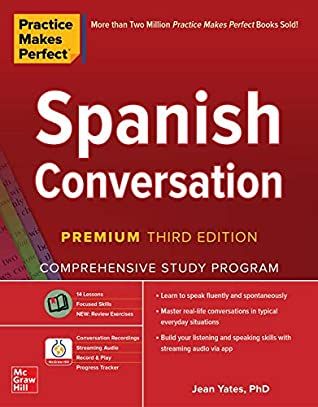
Nova: While grammar is the skeleton, conversation is the soul of a language. Jean Yates has a specific book called Practice Makes Perfect: English Conversation that is widely regarded as one of her best. This is where she tackles the messiness of how people actually talk, which is often very different from how they write.
Atlas: That is a huge point. I remember learning formal French in school and then going to Paris and realizing nobody speaks like a nineteenth-century novelist. It was a total shock. Does Yates help with that transition to informal, everyday speech?
Nova: She does, and she does it by focusing on high-frequency phrases and idioms. She breaks down conversations into functional categories. Like, how do you interrupt someone politely? How do you express disagreement without being rude? These are the social gears of language that textbooks often ignore because they are hard to quantify with simple grammar rules.
Atlas: So she provides actual scripts or templates for these social situations?
Nova: She provides realistic dialogues. You read a conversation between two people in a specific setting, like a job interview or a dinner party. Then, she pauses the action to explain the vocabulary and the cultural nuances of why they chose certain words. After that, you get the exercises to practice those exact phrases. It is incredibly practical. It is basically a survival guide for social interaction in English.
Atlas: I saw that some of the newer editions mention a McGraw-Hill Language Lab app. Is that part of her modern strategy too? Because learning conversation just from a page seems like you might miss the pronunciation part.
Nova: You hit the nail on the head. One of the biggest updates to her series is the integration of audio. Through the app, you can listen to native speakers performing the dialogues from the book. You can record yourself and play it back to compare. This solves that huge problem of being a book smart learner who has no idea how the words actually sound in the wild.
Atlas: That sounds like a game changer. It turns the book into a multimedia experience. You get the visual structure of the text, the tactile practice of the exercises, and the auditory input from the app. It is hitting all the major learning styles at once.
Nova: It really covers all the bases. And Yates is very careful about the type of English she teaches. She focuses on a standard American English that is clear and widely understood, but she does not shy away from common contractions and informalities that make you sound more like a human and less like a translation program. She teaches you that it is okay to say I am gonna instead of I am going to in the right context.
Atlas: I love that. It is about authenticity. It is giving the learner the permission to be natural, which I think is a huge boost for confidence. When you feel like you have to be perfect, you get tense. When you realize that native speakers use shortcuts too, it takes the pressure off.
Key Insight 4
Beyond the Basics
Nova: As learners move into the intermediate and advanced stages, the challenges change. It is no longer about just being understood; it is about nuance and precision. Jean Yates has books that focus specifically on things like pronouns, prepositions, and even verb tenses that people struggle with for years. These are the small things that often separate a good speaker from a great one.
Atlas: Prepositions are the worst! In, on, at, by. It feels like there are no real rules, just a thousand exceptions. How does she tackle the stuff that doesn't follow a logical pattern?
Nova: She tackles them through context and grouping. Instead of just listing every use of the word at, she groups them by function. Are we talking about time? Are we talking about a specific location? She gives you clusters of meaning. This helps your brain categorize the information instead of trying to memorize a giant list of random examples.
Atlas: That makes so much sense. Our brains love patterns. If she can show the pattern behind the chaos, it becomes much easier to digest.
Nova: And she is very honest about the difficulty. She acknowledges that English is a bit of a Frankenstein language with roots all over the place. Her tone is always encouraging but realistic. In her Sentence Builder book, she really shows you how to play with the language. She encourages you to take a basic sentence and expand it using different modifiers. It turns language learning into a creative exercise rather than a chore.
Atlas: Is there a specific level of learner these books are best for? Or is it a start-to-finish kind of deal?
Nova: The beauty of the Jean Yates collection within the Practice Makes Perfect series is that there is something for everyone. She has Beginning ESL titles that start with the very basics of vocabulary, all the way up to advanced grammar guides. Most people find her most helpful at the intermediate level, that dreaded plateau we mentioned earlier. That is where her exercise-heavy approach really shines because it forces you to stop overthinking and start doing.
Atlas: It sounds like she is the ultimate coach for someone who feels stuck. If you have been using an app for six months and you still cannot hold a three-minute conversation, a Jean Yates workbook is probably exactly what you need to kickstart that next level of growth.
Nova: Exactly. She is for the learner who is ready to get serious. It is not always easy, and it takes time to get through those hundreds of exercises, but the results are undeniable. People who stick with her methodology consistently report a massive jump in their confidence because they finally feel like they have a solid foundation under their feet.
Conclusion
Nova: We have covered a lot today about Jean Yates and her transformative approach to English language learning. From her building block architecture to her massive library of practice exercises and her focus on real-world conversation, it is clear why she has become such a titan in the ESL community. She proves that mastery is not some mysterious gift; it is the result of consistent, focused practice.
Atlas: It is a powerful reminder that there are no shortcuts to fluency, but there are definitely better maps. Jean Yates provides a map that is detailed, practical, and, most importantly, achievable. I feel a lot more inspired to pick up a pencil and actually do the work now. It is about making those small, daily gains that eventually add up to a life-changing skill.
Nova: That is a perfect way to put it. Whether you are one of the one point five billion people currently learning English or you are trying to master any other complex skill, the lesson remains the same. Break it down, do the work, and remember that every small exercise is a step toward perfection. If you found this dive into Jean Yates's work helpful, check out her titles in the Practice Makes Perfect series. They might just be the bridge you have been looking for.
Atlas: Definitely worth a look. Thanks for sharing this with us today, Nova. I think I am going to go find my old workbook now.
Nova: This is Aibrary. Congratulations on your growth!