

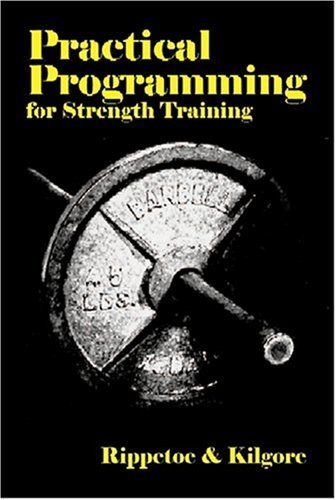
Practical programming for strength training
Introduction
Nova: Have you ever wondered why some people go to the gym for years and look exactly the same, while others seem to transform their entire physique and strength in just a few months? It is not just about genetics or supplements. It is about the difference between exercise and training. Today, we are diving into the book that many consider the definitive guide to that distinction: Practical Programming for Strength Training by Mark Rippetoe and Andy Baker.
Nova: It sounds like semantics, but Rippetoe argues it is the most important distinction you will ever make in your fitness journey. Exercise is physical activity done for the sake of the effect it produces today. You want to sweat, you want to burn calories, you want to feel a pump. Training, however, is physical activity performed for the purpose of satisfying a long-term performance goal. It is a process where every single session is a brick in a wall that you are building over months and years.
Nova: Exactly. And Practical Programming is the manual for that relationship. It takes the guesswork out of how to get from point A to point B, whether you are a total beginner or a seasoned athlete. It is about the biological logic of how our bodies actually get stronger.
Key Insight 1
The Science of Stress
Nova: To understand the book, we have to start with a guy named Hans Selye. He was a scientist who developed the concept of General Adaptation Syndrome, or GAS. Rippetoe uses this as the bedrock of his entire philosophy. The idea is simple: your body wants to stay in a state of balance, or homeostasis. When you lift a heavy barbell, you are essentially attacking that balance. You are creating a stress.
Nova: That is the three-stage process of GAS. First is the Alarm phase. You lift the weight, your body realizes it is not strong enough to handle this easily, and you suffer some minor damage. Then comes the Resistance phase. This is where the magic happens. During recovery, your body doesn't just repair the damage; it over-compensates. It builds back a little bit stronger so that if that same stress happens again, it is prepared. This is called adaptation.
Nova: That is Exhaustion. If the stress is too big, or if you don't give yourself enough time to recover, your body can't adapt. You just break down. The whole goal of Practical Programming is to manage that stress and recovery cycle so you stay in the Resistance phase and avoid the Exhaustion phase.
Nova: That is where the concept of the trainee's rank comes in. Rippetoe categorizes lifters not by how much they lift, but by how long it takes them to recover from a stress and adapt to it. This is a game-changer for most people. A novice, an intermediate, and an advanced lifter are all operating on different biological clocks.
Nova: It is actually the opposite in terms of adaptation. A novice is so far away from their physical potential that almost any stress will trigger an adaptation. They can lift a heavy weight on Monday, recover and get stronger by Wednesday, and do it again. Their cycle is 48 to 72 hours. But as you get stronger and closer to your limit, the stress required to trigger a new adaptation has to be much, much larger. And a massive stress takes much longer to recover from.
Nova: It really is. For an advanced lifter, it might take a whole month of specific, calculated stress to see a tiny increase in strength. But for a novice, every single workout is a chance to set a new personal record. Rippetoe calls this the Novice Effect, and he argues it is the most productive time of your entire lifting career. Most people waste it by doing random exercises instead of a structured program.
Key Insight 2
The Novice Phase
Nova: Let's talk about that Novice Phase. This is where the famous Starting Strength program comes in, which is the precursor to the more complex stuff in Practical Programming. The goal for a novice is simple: Linear Progression. You go to the gym, you do the basic compound lifts like the squat, press, and deadlift, and you add five pounds to the bar every single time.
Nova: You are right, it doesn't last forever. But it lasts longer than you think. Most healthy men can do this for three to six months. By the end, they might be squatting 300 pounds for sets of five when they started with just the empty bar. The beauty of it is its simplicity. You don't need variety. You need a bigger stress every time because your body is adapting that quickly.
Nova: Exactly. When you can no longer recover and adapt between workouts, you have exhausted your novice utility. This is where most people get frustrated and quit, or they start jumping from program to program. But Practical Programming says this is just the signal to change your programming, not your goals.
Nova: Rippetoe would tell you to put the curls away for a minute. The first step is usually the Advanced Novice phase. You might introduce a light day in the middle of the week. Instead of squatting heavy three times a week, you squat heavy Monday, light Wednesday, and heavy Friday. That light Wednesday gives your body a little extra breathing room to recover from the Monday stress while still keeping the movement fresh.
Nova: It does. And that is when you officially become an intermediate trainee. This is the core of the book. The intermediate phase is where the programming gets really interesting because you are now looking at a weekly cycle of stress and adaptation rather than a daily one.
Key Insight 3
The Intermediate Bridge
Nova: The intermediate phase is where we see programs like the Texas Method and HLM, which stands for Heavy, Light, Medium. Let's look at the Texas Method because it is a classic. It was named after a group of lifters in Texas who were working with Rippetoe and Glenn Pendlay. They found that they couldn't handle heavy sets of five three times a week anymore.
Nova: It really is. So the Texas Method breaks the week down. Monday is Volume Day. You might do five sets of five at about ninety percent of your best five-rep max. This is a massive stress. It is designed to completely disrupt your homeostasis.
Nova: Correct. Wednesday is Recovery Day. You do some light squats, maybe some overhead presses, just to keep the blood flowing and the technique sharp, but you aren't adding any new stress. Then comes Friday: Intensity Day. You go for a new personal record, but only for one set of five.
Nova: You nailed it. The whole week is one single GAS cycle. Monday is the Alarm, Tuesday through Thursday is the Resistance, and Friday is the proof of the adaptation. If you hit your PR on Friday, the program worked. Then you add five pounds to the Monday and Friday weights for the next week.
Nova: HLM is a bit more flexible. It stands for Heavy, Light, Medium. You have a heavy day for all your lifts, a light day where you do variations or lighter weights, and a medium day that is somewhere in between. It is often better for older lifters or people with high-stress jobs because it doesn't have that soul-crushing Monday volume session that the Texas Method is famous for.
Nova: The logbook is the most important piece of equipment in the gym, according to Rippetoe. If you aren't tracking your numbers, you aren't training; you are just playing. The logbook tells you if the program is working. If the numbers aren't going up over time, you aren't adapting, and you need to change something. It is objective data about your own biology.
Key Insight 4
The Advanced Athlete and Longevity
Nova: Eventually, even the weekly progress of the intermediate phase slows down. You become an advanced trainee. At this point, you are so strong and so close to your genetic ceiling that a single week isn't enough time to recover from the stress needed to get even stronger.
Nova: It does, because it explains the concept of periodization. For an advanced lifter, the cycle might be a month or even several months. They might spend four weeks building up volume, then two weeks of very heavy, low-volume work, followed by a week of deloading before they try for a new max. It is a complex dance of fatigue management.
Nova: He does. One of the key takeaways from the book is that strength is the foundation for everything else. Whether you want to be a better runner, a better parent, or just live longer, being stronger makes everything easier. He argues that muscle mass and bone density are the best predictors of a high quality of life as we age.
Nova: Rippetoe is very clear that correct form is non-negotiable. The book spends a lot of time on the mechanics of the lifts. He argues that a correctly performed squat is actually protective for the knees because it balances the forces between the hamstrings and the quads. The danger isn't in the weight; it is in the ego and the bad technique.
Nova: Exactly. And the book also touches on nutrition and sleep. You can't adapt if you aren't eating enough protein and getting enough rest. Recovery is an active process. You don't just wait for it to happen; you provide the building blocks for it.
Nova: Often, that is the first place to look. Rippetoe is famous for telling novices to drink a gallon of milk a day if they are struggling to gain weight. It is called the GOMAD diet. It is controversial and probably overkill for most people, but it illustrates his point: you have to eat to grow.
Conclusion
Nova: We have covered a lot of ground today. From the biological stress of Hans Selye's GAS to the relentless five-pound jumps of the novice phase, and finally the complex cycles of the intermediate and advanced athlete. Practical Programming for Strength Training is really a book about logic. It is about understanding that your body is a machine that responds to specific inputs in predictable ways.
Nova: That is the most common trap. The takeaway here is to start a logbook, pick a simple program like the novice linear progression, and focus on adding a little bit of weight every time. Don't worry about variety or fancy machines. Focus on the big compound movements and the data in your notebook.
Nova: Well said, Leo. Strength is a long-term investment, and this book is the blueprint for the portfolio. If you want to dive deeper, I highly recommend picking up the third edition of Practical Programming. It is dense, but it is worth every page for the clarity it brings to your training.
Nova: That is the spirit. This is Aibrary. Congratulations on your growth!