

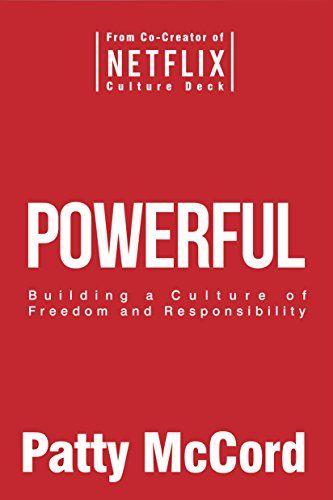
Powerful International Paperback
Building a Culture of Freedom and Responsibility
Introduction: Beyond the HR Manual
Introduction: Beyond the HR Manual
Nova: Welcome to Aibrary, the show where we dissect the ideas that shape our world, one deep dive at a time. Today, we’re ripping up the traditional HR manual and setting it on fire, metaphorically speaking, of course. We’re talking about Patty McCord’s seminal work, "Powerful: Building a Culture of Freedom and Responsibility."
Nova: : That title alone sounds like a corporate oxymoron, Nova. Freedom and responsibility? Usually, one cancels the other out in my experience. I’m ready to be convinced, though. What makes this book, born from her 14 years as Netflix’s Chief Talent Officer, so revolutionary?
Nova: It’s revolutionary because it throws out the safety nets. McCord argues that most companies are built on managing mediocrity with rules, policies, and bureaucracy. She says that if you hire adults, you should treat them like adults. The core thesis is simple: hire brilliant people, give them context, and then get out of their way.
Nova: : That sounds great in theory, but I immediately picture chaos. If you give people total freedom, who is responsible when things go sideways? Is this just a Silicon Valley fantasy that only works when you’re printing money like Netflix was?
Nova: That’s the million-dollar question, and it’s what we’re going to unpack. We’ll look at the controversial mechanisms she used—like the infamous 'Keeper Test' and the 'No Vacation Policy'—to enforce that freedom. This isn't just about being nice; it’s about building what she calls 'Talent Density.' Stick with us, because by the end of this, you might look at your own company’s handbook very differently.
Nova: : I’m already bracing myself for some uncomfortable truths. Let’s dive into the genesis of this philosophy. Where did this radical approach even begin?
Nova: Exactly. Let's set the stage with the foundation of the whole philosophy.
Key Insight 1: The Netflix Culture Deck Foundation
The Genesis: From Rules to Context
Nova: To understand 'Powerful,' you have to understand the Netflix Culture Deck. McCord and Reed Hastings essentially codified their operating system. They realized that as they scaled, they couldn't rely on top-down control. They needed a shared understanding.
Nova: : Right, the Culture Deck. It’s legendary now, but when it first came out, it was shocking. It wasn't a list of 'do's and don'ts,' it was a statement of belief. What was the single biggest shift they made away from traditional HR?
Nova: The shift was from 'control' to 'context.' Traditional HR says, 'Here is the rulebook for vacation, for expenses, for performance reviews.' McCord says, 'Here is the context of our mission, here is the level of performance we demand, and here is the level of trust we place in you. Now, you figure out the best way to operate within those boundaries.'
Nova: : That’s a huge cognitive load for an employee, though. If I’m new, I don’t have the context. How do you teach that context without writing a 500-page manual?
Nova: McCord stresses that context is delivered through constant, high-quality communication, not policy documents. She famously said that if you have to write a rule, it means you haven't hired the right person or you haven't given them enough context. For example, instead of a detailed expense policy, the rule was: 'Act in Netflix's best interest.' That’s context, not a rule.
Nova: : 'Act in Netflix's best interest.' That’s so broad. I’ve seen companies with 50 pages on what constitutes a legitimate business lunch. How did they prevent people from just running wild with that level of freedom?
Nova: Because they paired that freedom with an almost ruthless focus on 'Talent Density.' This is the second pillar. McCord believed that if you have a team full of A-players, they police themselves, and they elevate everyone around them. If you have B-players, they need rules to keep the C-players in line, and the whole system slows down.
Nova: : So, talent density is the secret sauce that makes freedom viable? It’s not just about hiring the best, but actively ensuring that the average performance level is incredibly high?
Nova: Precisely. She often uses the analogy of an Olympic team. You don't need a rulebook telling Michael Phelps how to train for the 100-meter butterfly; you need to ensure every single person on the roster is world-class. If you have a world-class team, they don't need micromanagement. They need clarity on the goal.
Nova: : That makes sense. If everyone is operating at the highest level, the friction caused by ambiguity is less damaging than the friction caused by bureaucracy. But I’m still skeptical about the 'radical honesty' part. That sounds like a recipe for hurt feelings and lawsuits.
Nova: It is controversial, but McCord argues that sugarcoating feedback is the real disservice. She says that if you truly value an employee, you owe them the unvarnished truth so they can improve or move on gracefully. It’s about respect, not cruelty. Let's transition into how that honesty manifests in daily operations, starting with how they handled time off.
Key Insight 2: Trusting Employees with Time Off
Freedom in Practice: The 'No Vacation Policy'
Nova: Let's talk about one of the most talked-about elements: the 'No Vacation Policy.' McCord’s stance was essentially: take the time you think is appropriate for you to recharge and be effective. No tracking, no accrual, no mandatory minimums.
Nova: : Wait, no tracking? That sounds like a dream, but also like a trap. If I never take a vacation because I'm worried about looking uncommitted, I'm actually working than if I had a mandated 15 days I had to use up.
Nova: That’s the critical nuance. McCord acknowledges that risk. The policy only works because it’s nested within the high-performance, high-trust culture we just discussed. If you are an A-player operating with context, you know that if you burn out, you hurt the team. Therefore, taking time off becomes a responsible act, not a selfish one.
Nova: : So, the 'responsibility' part of the title is the guardrail for the 'freedom' part. If you abuse the freedom—say, you take six weeks off in the middle of a product launch—what happens?
Nova: That’s where the radical honesty comes in. You don't get a memo from HR saying you violated policy 4.2. You get a direct conversation with your manager saying, 'Your judgment on time management is concerning, and it’s impacting the team’s performance. We need to address this.' It’s immediate and performance-focused.
Nova: : I see. It shifts the conversation from 'Did you follow the rule?' to 'Is your behavior serving the mission?' That’s a powerful distinction. Did they ever quantify how much time people actually took?
Nova: The data often showed that people took time off than they would have under a traditional system, but they took it in smaller, more strategic chunks. They weren't hoarding days for a big summer trip; they were taking a long weekend when they felt a dip in energy, knowing their team could cover for them because everyone was operating at a high level.
Nova: : It requires a level of mutual respect that most workplaces haven't earned. It’s easy to say 'trust your employees,' but it’s hard to trust them when you’re worried about the bottom line or the optics.
Nova: Exactly. And this trust extends to how they handle departures. If you’re going to have freedom, you must also have the freedom to leave, and the company must have the freedom to let you go when you’re no longer the right fit. Which brings us to the most famous, and perhaps most feared, mechanism in the McCord playbook: The Keeper Test.
Nova: : Ah, the moment of truth. Let’s talk about how they decide who stays and who goes.
Key Insight 3: The Litmus Test for High Performance
The Hard Truth: The Keeper Test and Talent Density
Nova: The Keeper Test is the ultimate expression of talent density. It’s a simple, yet brutal, question managers must ask themselves about every single person on their team: 'If this person told me they were leaving for a similar job at a competitor tomorrow, would I fight to keep them?'
Nova: : 'Fight to keep them.' That implies active resistance, maybe even a counteroffer. It’s not just, 'Oh, that’s too bad.' It’s a measure of indispensable value in the current moment.
Nova: And the second part of that test, which is just as important, is: 'Knowing what I know now about this person’s performance and fit, would I hire them again today?' If the answer to either is no, McCord argues, it’s kinder to let them go quickly.
Nova: : Kinder? That sounds harsh. Isn't that just institutionalizing fear? If I know my manager is constantly asking if they'd rehire me, I'm going to be anxious, not innovative.
Nova: McCord’s counterargument is that the cruelty is keeping someone in a role where they are merely adequate, or worse, where they are actively being managed down because they don't fit the evolving needs of the company. She says that keeping them around out of obligation or fear of the firing process is unfair to them, unfair to their colleagues who have to pick up the slack, and unfair to the company's mission.
Nova: : So, the goal isn't to fire people; the goal is to ensure that every single seat is occupied by the best possible person for that seat. It’s a dynamic assessment, not a static one.
Nova: Exactly. And this is why the 'radical honesty' in feedback is crucial. You can’t pass the Keeper Test if you don’t know you’re failing it. If a manager is hiding performance issues for six months to avoid an awkward conversation, they are setting that employee up for a massive, painful shock when the Keeper Test finally comes due.
Nova: : I’m thinking about the logistics. How do you deliver that feedback without sounding like you’re constantly judging someone’s career viability?
Nova: It’s about separating the person from the performance. McCord insists that feedback should be continuous, not saved up for an annual review. If someone is underperforming, the conversation is, 'Your output on Project X did not meet the standard we agreed upon. Here is what needs to change by next month.' It’s about specific behaviors and results, not character assassination.
Nova: : It sounds exhausting, though. For the manager, constantly having to be the executioner, the coach, and the visionary all at once. Is there a point where this culture becomes too intense for sustained success?
Nova: That’s the perfect segue into our final thoughts. While 'Powerful' offers a compelling blueprint, it’s not without its critics who find the relentless focus on 'density' dehumanizing. We need to weigh the incredible performance gains against the human cost of that constant pressure.
Conclusion: The Cost of Power and Responsibility
Conclusion: The Cost of Power and Responsibility
Nova: We’ve covered a lot of ground today, moving from the abstract concept of 'context over control' to the very concrete, and sometimes harsh, realities of the 'Keeper Test.' The central takeaway from Patty McCord’s 'Powerful' is that high performance requires high trust, and high trust requires radical transparency.
Nova: : It forces us to confront a difficult truth: if we truly want to empower our teams, we have to be willing to let go of people who aren't pulling their weight, and we have to be honest with everyone about where they stand, even if it’s uncomfortable in the short term. The freedom is earned through demonstrated responsibility.
Nova: Absolutely. The 'No Vacation Policy' isn't a license to slack off; it’s a demonstration of faith that you will manage your own energy responsibly. The 'Keeper Test' isn't about being mean; it’s about ensuring the entire team is operating at peak capacity, which is the ultimate respect you can show your top performers.
Nova: : But for listeners running smaller or more traditional organizations, the challenge isn't adopting the policy; it’s building the foundational trust required for these policies to not backfire. It’s a long game of consistent, honest communication.
Nova: Indeed. McCord’s work isn’t a checklist; it’s a mindset shift. It asks leaders to stop being rule enforcers and start being context providers and talent density champions. It’s a challenging model, but one that clearly delivered massive results for one of the world’s most disruptive companies.
Nova: : So, the next time you’re writing a policy, ask yourself: Is this rule protecting us from a bad hire, or is it preventing a great hire from doing their best work? That’s the question McCord leaves us with.
Nova: A fantastic summary. The pursuit of a powerful culture is messy, honest, and ultimately, a continuous act of building trust. This has been Aibrary. Congratulations on your growth!