

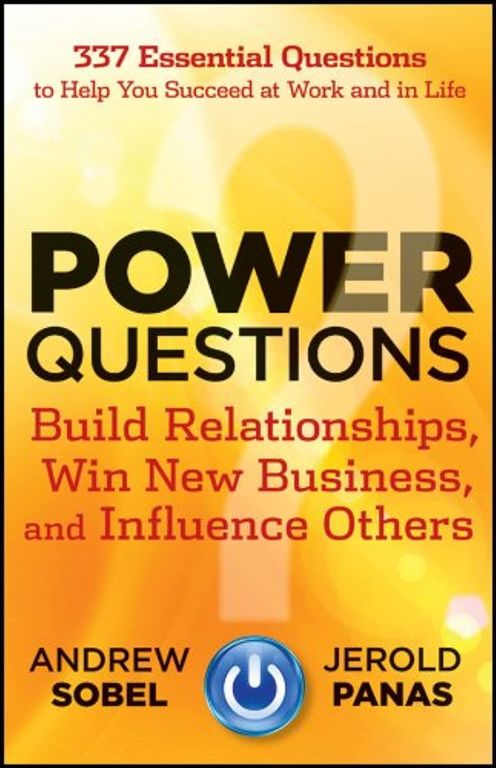
Power Questions
Build Relationships, Win New Business, and Influence Others
Introduction
Nova: Imagine you are sitting across from a world-renowned CEO. He is powerful, he is wealthy, and he is just months away from retirement. You have exactly one hour to make an impression. Most people would spend that hour talking about themselves, trying to prove how smart they are. But a consultant named Andrew Sobel did something different. He asked one question that changed everything: What has been the happiest day of your life?
Nova: In this case, it worked brilliantly. The CEO stopped, his eyes glazed over as he remembered a day decades earlier, and he told a story about his family and a simple moment of joy. By the end of the hour, he felt more connected to Andrew than to consultants he had known for years. That is the core of the book we are diving into today: Power Questions by Andrew Sobel and Jerold Panas.
Nova: Exactly. It is about shifting from telling to asking. Today, we are going to explore how these power questions can build deeper relationships, help you win more business, and frankly, make you a lot more interesting to be around.
Key Insight 1
The Expert Trap
Nova: One of the biggest hurdles to being a great communicator is what Andrew Sobel calls the Expert Trap. It is the urge we all have to prove we are the smartest person in the room by dumping information on people.
Nova: But the book argues that when you are the one doing all the talking, you are actually losing power. You are not learning anything new, and you are not making the other person feel heard. Jerold Panas, the co-author, was one of the most successful fundraisers in history, raising billions of dollars. He found that the more he listened, the more people wanted to give.
Nova: Panas was the opposite. He would go into meetings with wealthy donors and ask things like: How did you get started? or What are you most proud of? He realized that people have a deep, fundamental need to be understood. When you ask a power question, you give the other person the floor. You give them the power.
Nova: A power question is one that makes the other person stop and think. It challenges their assumptions or invites them to share something meaningful. It moves the conversation from the surface level to the heart of the matter. Instead of asking a client, What are your goals? you might ask, If we were sitting here three years from now and you were looking back on a massive success, what would have happened?
Nova: That is where the art comes in. Sobel and Panas emphasize that questions must be asked with genuine curiosity, not as a gimmick. If you are just running through a checklist of power questions, people will feel like they are being interrogated. But if you truly want to know the answer, that sincerity comes through.
Nova: Exactly. And the most powerful leaders are often the ones who ask the simplest questions. One of the examples in the book is the question: What do you think? It sounds so basic, right?
Nova: But in a leadership context, it is transformative. When a CEO asks a junior employee, What do you think?, they are signaling trust. They are saying, I value your perspective. It creates instant engagement. Most leaders are too busy giving orders to ever ask that.
Key Insight 2
The Relationship Builders
Nova: That is actually where some of the most moving stories in the book come from. Sobel talks about how we often live on the surface with the people closest to us. We talk about the weather, the news, or the kids. But we rarely ask the questions that reveal who they actually are.
Nova: One of the big ones is: How did you get started? You can ask this of a mentor, a friend, or even a grandparent. Everyone has a beginning story. Usually, it involves a struggle, a stroke of luck, or a pivotal decision. When people tell that story, they are telling you their identity.
Nova: Exactly. Another one that Sobel highlights is: What is the most important thing you have learned in your life? This is a great one for older family members. It shows respect for their experience. It says, I think you have wisdom that I need.
Nova: Sobel addresses that. When someone is struggling, the power question isn't a deep philosophical one. It is often as simple as: What is the biggest challenge you are facing right now? or What would be most helpful to you today?
Nova: That is a huge point. Power questions are not about fixing; they are about connecting. There is a story in the book about a woman whose husband was terminally ill. People kept telling her, Let me know if you need anything. It felt empty. But one friend asked, What is one thing I can do for you this week that would take a weight off your shoulders? That is a power question because it is specific and actionable.
Nova: Right. And for personal growth, Sobel suggests asking yourself power questions too. Like: Am I spending my time on what is most important, or just what is most urgent? Or: If I could change one thing about my life right now, what would it be? These are the questions that prevent us from living on autopilot.
Key Insight 3
The Business of Asking
Nova: Let us pivot back to the professional world. If you are in sales or consulting, or even just trying to get a promotion, there is one question that Sobel says is the ultimate closer. It is: Is there any reason we should not move forward?
Nova: But that is exactly why it works! If they have a reason, you want to know it now. If they are thinking, Your price is too high, or I don't trust your timeline, you want that out in the open so you can address it. If you don't ask, that objection just sits there and kills the deal quietly.
Nova: Definitely. But Sobel argues that a No is better than a Maybe that drags on for six months. Another great business question is: Why us? When a client chooses you, ask them why. They will literally list your strengths for you. It reinforces their decision and tells you exactly what they value about your work.
Nova: There is a fantastic one: If you could start with a clean sheet of paper, how would you design this? It gets people out of the mindset of, Well, this is how we have always done it. It gives them permission to dream and be creative.
Nova: Exactly. And in a job interview, Sobel suggests a question that almost no candidate ever asks: How will you define success for the person in this role six months from now? It shows you are not just looking for a paycheck; you are looking to deliver results. It changes the dynamic from you begging for a job to you acting like a partner in their success.
Nova: Right. The book is filled with these shifts. It is about moving from a transactional mindset to a relational one. Even in a high-stakes negotiation, asking, What is the one thing you must have in this deal? can cut through hours of posturing.
Key Insight 4
The Art of the Follow-up
Nova: We have talked about the questions themselves, but Sobel and Panas emphasize that the question is only half the battle. The other half is what you do after you ask. You have to actually listen.
Nova: That is the death of a power question. If you ask a deep question and then immediately jump in with your own story, you have just wasted it. You have to leave space. Sobel calls it the power of the pause.
Nova: That is a mistake! If you ask a power question, it should take them a second to think. If they answer instantly, it probably wasn't a very deep question. The silence is where the thinking happens. If you interrupt it, you kill the insight.
Nova: Longer than you think. Often, the best information comes right after that first pause, when the person has had a chance to move past their canned response and give you something real.
Nova: Absolutely. The most basic follow-up is simply: Tell me more. It is incredibly effective. It signals that you are genuinely interested and that you want them to go deeper. Or you can ask: Can you give me an example of that? It moves the conversation from abstract ideas to concrete reality.
Nova: You are spot on. Sobel actually warns against using Why? too much because it can put people on the defensive. It feels like they have to justify themselves. Instead of asking Why?, try asking How? or What? Instead of Why did you choose that path?, ask What led you to that decision? It is the same information, but the tone is much more inviting.
Nova: That is the essence of being a master questioner. It is about creating a safe space for the other person to be honest. When you do that, you build a level of trust that is almost impossible to achieve through talking alone. You become someone people want to be around because they feel better about themselves after talking to you.
Conclusion
Nova: As we wrap up our look at Power Questions, I think the biggest takeaway is that we don't have to carry the burden of having all the answers. In fact, our relationships and our careers will likely flourish more if we focus on becoming master askers.
Nova: Well said. Whether it is asking a CEO about the happiest day of their life, or asking a colleague what they really think about a project, these questions are tools for connection. They break down walls and build bridges in ways that statements never can.
Nova: That is the perfect place to start. Remember, the quality of your life is often determined by the quality of the questions you ask. Don't be afraid to stop, listen, and let the other person take the lead.
Nova: I am glad to hear it. This is Aibrary. Congratulations on your growth!