

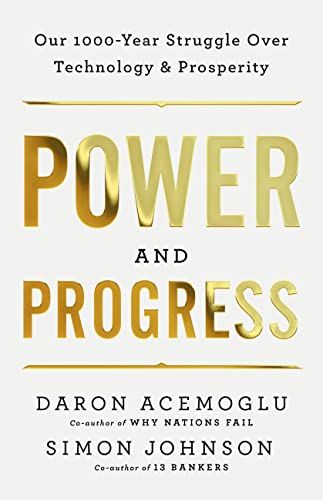
Power and Progress
Our Thousand-Year Struggle Over Technology and Prosperity
Introduction: Is Technology Our Friend or Our Master?
Introduction: Is Technology Our Friend or Our Master?
Nova: Welcome to the show. Today, we are diving deep into a book that throws cold water on the relentless hype machine surrounding Artificial Intelligence and automation. We're talking about "Power and Progress: Our Thousand-Year Struggle Over Technology and Prosperity" by economists Daron Acemoglu and Simon Johnson.
Nova: : That title alone is a challenge, Nova. Most people think progress is inevitable, a rising tide that lifts all boats. Why are they framing it as a "struggle" over a thousand years?
Nova: Exactly. They argue that technological advancement is not some neutral, unstoppable force leading automatically to shared prosperity. Instead, it’s a battleground. For a thousand years, the direction of technology has been shaped by who holds the power—whether it serves the elites or the masses.
Nova: : So, this isn't just a book about AI; it’s a history lesson on power dynamics embedded in every machine we build. What’s the central thesis that separates this from standard techno-optimism?
Nova: The central thesis is this: Technology is not destiny. It’s a choice. If the choices are made by a small group whose primary interest is maximizing their own wealth, the resulting technology will automate labor and suppress wages, even if productivity soars. They are essentially saying, 'Look at the last 40 years of productivity gains—where did the money go?'
Nova: : That’s a powerful framing. It forces us to look past the shiny new gadgets and ask: Who benefits? I’m ready to dig into the history they use to back up this claim. Let’s start there.
Nova: Fantastic. Let's set the stage for this thousand-year struggle.
Key Insight 1: Power Dictates Direction
The Thousand-Year Thesis: Technology is Not Destiny
Nova: Acemoglu and Johnson start by dismantling the idea that technological progress is a smooth, linear path toward a better future for everyone. They point to historical moments where technology could have gone two ways.
Nova: : Give us a concrete historical example where the path wasn't set in stone. Was there a moment where labor could have been augmented instead of replaced?
Nova: Absolutely. Think about the early Industrial Revolution. When the power loom was introduced, it could have been designed to make existing weavers far more productive—augmenting their skill. Instead, the technology that won out was designed to replace the skilled weaver with a low-skilled operator who just monitored the machine. The power structure favored cheap, replaceable labor.
Nova: : That’s fascinating. It reframes the Luddites, who we often see as simply anti-progress, as people resisting a specific, power-driven of progress.
Nova: Precisely. They weren't against machines; they were against machines designed to devalue their human capital. The authors argue that when elites control the innovation agenda, they choose technologies that increase their share of the economic pie, often at the expense of labor's share.
Nova: : So, if the technology is a choice, who is making the choices today? Is it still the factory owners, or has the locus of power shifted?
Nova: It has shifted, but the principle remains. Today, the locus is Silicon Valley—the 'tech billionaires and their agenda,' as the book puts it. They are incentivized to create technologies that automate cognitive and manual tasks because that maximizes their platform's scalability and profit, regardless of the societal cost in terms of job quality or wage stagnation.
Nova: : It sounds like they are arguing that the profit motive, when unchecked by democratic pressure, naturally steers innovation toward displacement rather than empowerment.
Nova: That’s the crux of it. They found that while productivity has skyrocketed since the 1980s, median wages have barely budged. That gap, that divergence, is the evidence that the technology being deployed is not serving the majority.
Nova: : It’s a tough pill to swallow for people who believe in the magic of the market to solve these issues. Are they suggesting that the market is failing to produce the right kind of innovation?
Nova: They are suggesting the market, as currently structured, is failing to incentivize the kind of innovation. If a technology can make a CEO a billionaire by replacing 10,000 workers, the market rewards that choice overwhelmingly. The market doesn't inherently reward creating 10,000 new, better jobs.
Nova: : So, the struggle is about changing the incentives—making the market reward human-complementing tech over human-replacing tech. That leads us perfectly into the historical evidence they marshal to prove this isn't just a modern problem.
Nova: Indeed. Let's look at how this played out before the digital age.
Case Study: The Divergence of Technological Paths
History's Fork in the Road: From Cathedrals to Computers
Nova: To illustrate their 1000-year view, Acemoglu and Johnson use vivid historical contrasts. One striking comparison they draw is between the technological choices made during the medieval period and those made during the early Industrial Revolution.
Nova: : I recall reading something about grand cathedrals being built while the general populace remained impoverished. Is that the comparison?
Nova: That’s right. The medieval era saw massive technological leaps in areas like architecture and engineering—think of the flying buttress or sophisticated clockwork—but these innovations often served the power structure: the church and the nobility. The technology didn't translate into widespread material improvement for the average peasant.
Nova: : So, high-tech for its time, but low-impact on the common good. How does the Industrial Revolution fit into this dichotomy?
Nova: The Industrial Revolution was the first time we saw the potential for broad-based prosperity, but it was immediately contested. The authors show that the early textile machinery, for instance, could have been designed to make the spinners and weavers more productive, allowing them to command higher wages for their specialized knowledge.
Nova: : But they didn't, because the factory owners wanted to break the power of the skilled artisans, correct?
Nova: Exactly. They chose automation that deskilled the workforce. This wasn't an accident of physics; it was a deliberate choice driven by the desire to reduce labor costs and increase the owners' leverage. They chose the path of labor substitution.
Nova: : It’s almost like a recurring historical pattern: when labor has enough political power, technology tends to augment it. When capital has overwhelming power, technology tends to replace it.
Nova: That’s the pattern they identify! They point to periods, often following major social upheavals or wars where labor gained leverage, where technology become more human-complementing. Think of the surge in labor-saving, but also labor-enhancing, technologies in the post-WWII boom in the US.
Nova: : That makes sense. The political balance shifts the economic incentives. So, if we fast-forward to today, what does this historical lens tell us about the current AI boom?
Nova: It tells us that the current AI boom, which is heavily focused on large language models and general automation, is a continuation of the 'power-serving' path. It’s technology designed by and for the people who own the platforms, not the people whose jobs are being redefined.
Nova: : It’s a sobering thought. We are living through a period of immense technological capability, yet the historical precedent suggests that without intervention, we are likely heading toward greater inequality, not shared progress.
Nova: That’s the warning siren they are sounding. The next chapter needs to detail exactly how this plays out in the digital age.
Key Insight 2: The Modern Automation Trap
The Digital Damage: AI and the Productivity-Wage Disconnect
Nova: Let's zero in on the modern era, which the book calls the 'Digital Damage.' We are seeing unprecedented investment in AI, yet the economic returns aren't trickling down. Acemoglu and Johnson call this the 'productivity-wage disconnect.'
Nova: : I see statistics all the time showing productivity growth, but when I look at my paycheck, it doesn't reflect that growth. Why is AI different from, say, the introduction of the personal computer in the 80s?
Nova: The PC era was mixed. There was displacement, but also massive creation of new tasks and new jobs—data entry specialists, software developers, IT support. The authors argue that AI, in its current dominant form, is far more focused on that replaces entire cognitive functions.
Nova: : So, instead of creating a new task for a human to manage the AI, the AI is designed to manage itself and the human out of the loop entirely?
Nova: Precisely. They point out that the vast majority of R&D spending in Big Tech is currently directed toward automation, not augmentation. They found that only about 20% of the new technologies developed in the last few decades were primarily aimed at complementing human labor.
Nova: : Twenty percent! That’s a shockingly low number for a technology that supposedly drives prosperity. What are the tangible effects of this imbalance?
Nova: The effects are clear: wage stagnation for the middle and working classes, increased market concentration among the tech giants who own the automated platforms, and a sense of economic anxiety despite record corporate profits. It’s prosperity concentrated at the very top.
Nova: : It sounds like the tech sector is optimizing for shareholder value in the most direct, labor-suppressing way possible. But isn't there an argument that automation is necessary to keep prices low for consumers?
Nova: That’s the classic defense. And yes, some automation lower consumer prices. But Acemoglu and Johnson counter that this benefit is often outweighed by the massive social cost of eliminating high-quality, middle-class jobs. If everyone is working precarious, low-wage service jobs, the benefit of a slightly cheaper television doesn't compensate for the loss of economic security.
Nova: : It’s a trade-off we haven't consciously agreed to. They must have a strong critique of the current regulatory environment that allows this to happen, right?
Nova: They do. They argue that the regulatory environment—including intellectual property laws and a lack of antitrust enforcement—has allowed a small group of firms to dictate the technological trajectory without accountability to the broader public interest.
Nova: : So, the problem isn't the technology itself, but the of the technology. We need a new social contract for the digital age.
Key Insight 3: Forcing the Right Incentives
Reclaiming Progress: The Policy Prescription
Nova: If the problem is that the incentives are skewed toward displacement, then the solution, according to Acemoglu and Johnson, must be to actively shift those incentives. They aren't calling for a halt to innovation; they are calling for a redirection.
Nova: : What does 'redirection' look like in practice? Are they advocating for massive public funding for specific types of R&D, or something more structural?
Nova: It’s both, but heavily structural. They propose a multi-pronged approach. First, they want to use taxes and subsidies to make human-complementing technologies cheaper to develop and deploy than labor-replacing ones. Make it economically advantageous to build tools that make workers better, not obsolete.
Nova: : That’s a direct intervention in the R&D landscape. What about the power of the existing tech giants? Can subsidies alone overcome that?
Nova: That’s where the second prong comes in: strengthening democratic institutions and labor power. They argue that historically, when labor gained political leverage—through unions, social movements, or progressive legislation—the direction of technology shifted toward augmentation. We need to restore that balance.
Nova: : So, if workers have more bargaining power, they can demand that new technologies be implemented in ways that enhance their jobs, not eliminate them. It’s about collective action shaping the technology.
Nova: Exactly. They also call for stronger antitrust enforcement to break up the monopolies that currently control the AI pipeline. When only a few firms control the foundational models, they control the direction of progress for everyone else.
Nova: : I remember reading that some critics found this part of the book too interventionist, suggesting they were advocating for too much government control over innovation. How do they respond to that charge?
Nova: They respond by pointing back to history. They argue that the —where a handful of private entities dictate the trajectory of the most powerful technology in human history—is already a massive, unchecked intervention. Their proposals are about rebalancing the scales so that democracy, not just shareholder value, has a say.
Nova: : It’s a powerful argument: we are already living in a managed technological system; we just need to manage it for the common good.
Nova: One of their specific, surprising policy ideas involves shifting intellectual property rights. They suggest that if a technology is primarily designed to replace labor, the patent or copyright protections should be weaker, or the tax benefits associated with it should be reduced. This directly targets the financial incentive structure.
Nova: : That’s a radical rethinking of how we reward innovation. It forces us to ask: Is the goal maximum automation, or maximum human flourishing? It seems Acemoglu and Johnson are firmly on the side of flourishing.
Conclusion: Shaping Our Technological Future
Conclusion: Shaping Our Technological Future
Nova: We’ve covered a thousand years of struggle, from the medieval workshops to the algorithms of today. The core message of "Power and Progress" is clear: The future of prosperity is not guaranteed by the next technological breakthrough; it is determined by the political and social choices we make about that breakthrough.
Nova: : It’s a call to action, really. Stop being passive consumers of technology and start being active shapers of it. The key takeaway for me is that technological determinism is a myth used to justify the status quo.
Nova: Absolutely. Whether it’s the steam engine or generative AI, the technology itself is neutral; its is political. If we want shared prosperity, we must fight for the kind of technology that complements human skill, not just replaces it.
Nova: : So, the actionable takeaway for our listeners isn't just to learn about AI, but to engage in the political fight over AI is built and deployed. We need to demand technologies that empower us.
Nova: Precisely. We need to support policies that incentivize augmentation, strengthen labor's voice, and ensure that the incredible productivity gains of this new era don't just end up enriching the few who own the code. The struggle for progress is ongoing.
Nova: : A truly thought-provoking analysis that reframes our entire relationship with innovation. Thank you for guiding us through Acemoglu and Johnson's powerful work, Nova.
Nova: My pleasure. We must choose progress that is shared, or we risk stagnation masked by technological wizardry. This is Aibrary. Congratulations on your growth!