

Personalized Podcast
Content
Content
Orion: -
Orion: -
Golden Hook & Introduction
SECTION
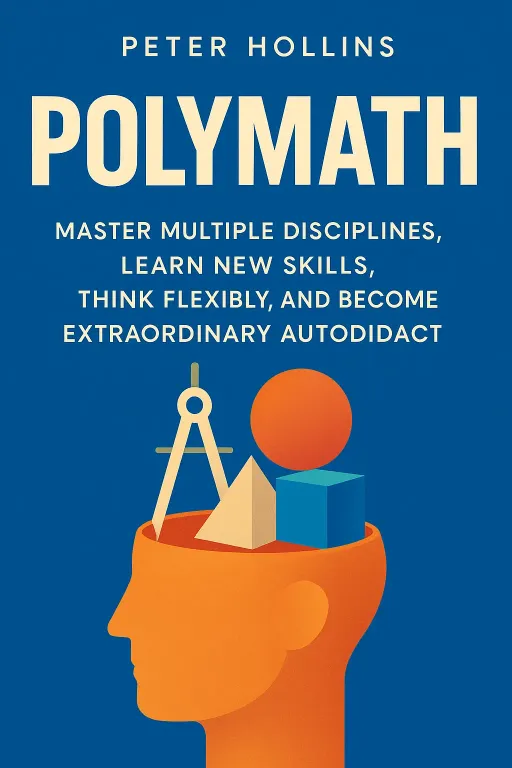
Orion: What if the most dangerous career advice you ever received was to specialize in just one thing? In a world changing at warp speed, the hyper-specialist is highly vulnerable to automation and obsolescence. Today, we are shattering the jack of all trades, master of none myth. We are diving into Peter Hollins' book, Polymath, to show you how to build a highly adaptable, multi-dimensional mind. Today, we will dive deep into this from two perspectives. First, we will explore the architecture of the polymathic mind and the power of strategic skill stacking. Then, we will break down the exact ten-step engine you can use to acquire and synthesize new skills in real time. Joining me today is Garima Mittal, a brilliant analytical thinker who loves exploring new ideas and making connections across different domains. Garima, welcome to the show.
Garima Mittal: Thanks, Orion. I am absolutely thrilled to be here. You know, this book really speaks to me because we often treat polymathy as this rare, historical anomaly, like Leonardo da Vinci or Benjamin Franklin, as if it is something you are either born with or you are not. But Hollins reframes it entirely. He shows that being a polymath is actually a deliberate cognitive strategy, a way of thinking and learning that anyone can cultivate. And in a world that is constantly shifting, having an analytical, cross-disciplinary approach is not just an intellectual luxury anymore. It is a survival mechanism.
Orion: That is an excellent point. Let us start by defining the structural model of knowledge. Most people are familiar with the T-shaped model. The vertical bar of the T represents deep expertise in a single field. The horizontal bar represents a broad but shallow understanding of other areas. Hollins argues that polymaths should aim for a Pi-shaped or even a comb-shaped model. A Pi-shaped model has two deep vertical legs of expertise, connected by a broad horizontal bar. A comb-shaped model has multiple deep legs. Garima, how do you see this structural shift playing out in real time?
Garima Mittal: It is a fascinating shift, Orion. When you look at the Pi-shaped model, it is not just about collecting random skills. It is about the synergy between those deep legs of knowledge. If you only have one deep leg of expertise, you are highly susceptible to what psychologists call the Einstellung effect. This is a cognitive bias where your existing expertise actually prevents you from seeing simpler, more creative solutions. You get trapped in your own mental models. But when you develop a second or third leg of deep knowledge, you force your brain to make atypical connections. You start seeing patterns that a pure specialist would completely miss.
Deep Dive into Core Topic 1
SECTION
Orion: Let us unpack that Einstellung effect because it is a critical concept. Hollins references a classic study from 1942 called the Water Jar Experiment, conducted by Abraham Luchins. In this experiment, participants were asked to measure out a specific quantity of water using three jars of different capacities. The first group was given a series of complex practice problems that could all be solved using a specific, multi-step formula. The second group had no such training. When both groups were presented with a new, much simpler problem that could be solved in one easy step, the first group, the trained experts, completely missed the simple solution. They got stuck trying to apply their complex formula. The untrained group solved it instantly. This experiment proves that prior expertise can act as a mental blindfold.
Garima Mittal: That experiment is such a perfect illustration of the danger of over-specialization. It shows that when you are deeply immersed in only one subject, your brain defaults to a rigid, pre-established pathway. You look at every problem through a single lens. It reminds me of the famous saying, to a man with a hammer, everything looks like a nail. But a polymath has a whole toolbox. By actively learning different disciplines in real time, you keep your mind flexible. You retain that beginner's mindset, which allows you to see the simple, elegant solutions that the hyper-specialist is blind to.
Orion: Exactly. And this brings us to the concept of skill stacking, which is a highly practical way to develop multiple skills in real time. Hollins uses the story of Scott Adams, the creator of the Dilbert comic strip, to illustrate this. Adams was not the best artist in the world. He was not the funniest writer, and he was not the most experienced business executive. But he was above average in all three areas. By stacking these three skills together, he created a unique, highly valuable niche that made him incredibly successful. He did not try to be in the top one percent of artists. Instead, he combined three skills where he was in the top fifteen percent. Garima, how can our listeners apply this strategic skill stacking in their own lives?
Garima Mittal: Scott Adams' story is a masterclass in strategic positioning. The math of skill stacking is incredibly encouraging. Trying to become the absolute best in the world at one specific thing, say, a world-class programmer or a world-class marketer, requires an immense amount of time and often a bit of luck. The competition is brutal. But becoming above average, say in the top fifteen or twenty percent, in three complementary areas is highly achievable. And when you combine them, you become unique. For example, if you combine data analysis, graphic design, and public speaking, you are suddenly a rare asset. You can analyze complex data, design beautiful visualizations, and present them compellingly to executives. You have created your own category.
Orion: Yes, and there is empirical data to back this up. Hollins points to a 2017 study by the Boston Consulting Group. They analyzed companies with varying degrees of skill set and background diversity. The study found that companies with more diverse skill sets and backgrounds produced nineteen percent more revenue overall. This is a massive financial indicator of the value of cross-disciplinary thinking. Diversity of skills leads to better problem-solving and more innovation. It is what Hollins calls the Medici Effect, named after the famous Medici family in Renaissance Florence, who brought together artists, scientists, and philosophers, sparking an explosion of creativity.
Garima Mittal: I love that connection to the Medici Effect, Orion. It shows that innovation happens at the intersections of disciplines. When you develop multiple skills in real time, you are essentially creating a personal Medici Effect inside your own mind. You are letting ideas from psychology mingle with ideas from computer science, or letting concepts from music influence your approach to business. It is about combinatory play. But the big question most people have is, how do we actually do this without burning out? How do we learn these multiple skills efficiently?
Deep Dive into Core Topic 2
SECTION
Orion: That is the perfect transition to our second core topic: the ten-step real-time learning engine. Hollins outlines a highly structured, systematic process for rapid skill acquisition. Let us define these ten steps clearly. Step one is to gain a broad overview of the subject. Step two is to narrow your scope to a manageable subtopic. Step three is to define what success looks like. Step four is to compile your resources. Step five is to create a structured curriculum. Step six is to filter those resources for high-value content. Step seven is to dive in and start learning. Step eight is to explore and experiment. Step nine is to clarify any points of confusion. And step ten is to teach what you have learned to someone else. Garima, which of these steps do you think is the most critical for someone trying to learn in real time?
Garima Mittal: For me, step three is absolutely vital: defining what success looks like. Hollins provides a brilliant template for this: I will have learned blank when blank. Most people fail at learning new skills because their goals are too vague. They say, I want to learn to code, or I want to learn about art history. Those are black holes. You need measurable criteria. For example, Hollins uses the example of learning Renaissance art. A clear success metric would be, I will have learned Italian Renaissance art when I can walk through the Uffizi Museum in Florence and pass as a tour guide, or when I can skip all the lectures of an online class and still get an A on the final exam. When you define success with that level of clarity, you can work backward to build a highly targeted curriculum. It saves you hundreds of hours of wasted effort.
Orion: That is a very logical approach. It prevents cognitive drift. Once you have defined success, Hollins advocates for an iterative learning cycle called LPLT, which stands for Learn, Play, Learn, Teach. This cycle is designed to be repeated for each module of your curriculum. First, you learn the basic theory. Then, you play with it, meaning you experiment and apply it in a low-stakes environment. Then, you learn again to fill in the gaps that your play revealed. Finally, you teach it. To make this learning process highly active, Hollins introduces a four-step note-taking system. Let us define it. Step one is to take detailed notes on the source material. Step two is to summarize those notes in your own words, using simple language. Step three is to connect the information to a broader context or to something you already know. Step four is to summarize the entire section again in a single, concise sentence.
Garima Mittal: That note-taking system is pure gold for active synthesis. It forces your brain to process the information at multiple levels of depth. Hollins uses the example of researching King Henry VIII's diet to illustrate this. The initial note might be that Henry and his court consumed up to twenty different types of meat in one sitting, and serving less was considered an insult to nobles. Step two, the simple summary, would be: Henry VIII's diet was mainly meat because rich people expected variety and felt insulted by small portions. Step three, the connection, would be: This royal diet contrasted dramatically with peasant diets, which were largely composed of fruits, vegetables, and grains they farmed themselves. And step four, the final one-sentence summary, would be: Meat consumption in Tudor England was a direct symbol of wealth and social status. By going through this process, you are not just passively reading. You are actively building a mental model.
Orion: Yes, you are transforming raw information into structured knowledge. And that leads directly to step ten of the learning engine: teaching. Hollins emphasizes that teaching is the ultimate test of understanding. If you cannot explain a concept simply to a beginner, you do not truly understand it yourself. When you teach, you are forced to organize your thoughts, identify your own knowledge gaps, and translate complex ideas into accessible language. It is a highly active cognitive process that solidifies the neural pathways of your new skill.
Garima Mittal: Absolutely. Teaching forces you to resolve any lingering cognitive dissonance. It is like a diagnostic test for your brain. If you stumble while explaining a concept, you instantly know exactly where your understanding is weak. In real-time skill development, you do not have to wait until you are an expert to start teaching. You can write a blog post, explain it to a colleague, or even just record a quick video explaining what you learned that day. It accelerates the feedback loop immensely.
Synthesis & Takeaways
SECTION
Orion: This has been an incredibly rich discussion. Let us synthesize the key takeaways from Peter Hollins' Polymath into three actionable points for our listeners. Point number one: reject the hyper-specialist trap and aim for a Pi-shaped or comb-shaped knowledge model. This protects you from the Einstellung effect and makes you highly adaptable. Point number two: use strategic skill stacking. Do not try to be in the top one percent of a single skill. Instead, combine three or four complementary skills where you are above average to create a unique, high-value niche. Point number three: apply the ten-step learning engine and the LPLT cycle. Define success clearly, use active note-taking to synthesize information, and teach what you learn to accelerate your mastery in real time.
Garima Mittal: Those are excellent, structured takeaways, Orion. I would love to add one final thought on the beauty of what Hollins calls combinatory play. Think about Albert Einstein. When he was struggling with complex physics equations, he did not just stare at the blackboard. He would take a break and play the violin. He believed that the creative, intuitive process of making music helped him approach scientific problems from entirely new angles. He literally used music to solve physics. That is the true power of the polymathic mind. It is not just about being smart in multiple areas. It is about letting those areas talk to each other to create something entirely new.
Orion: That is a beautiful and inspiring example to close on. Garima, thank you so much for sharing your analytical insights with us today.
Garima Mittal: Thank you, Orion. It was an absolute pleasure.
Orion: And to our listeners, here is your call to action for this week. Pick one skill that is completely outside your primary field of expertise. It could be graphic design, public speaking, basic coding, or even cooking. Apply step three of the learning engine: write down, I will have learned this skill when, and define a clear, measurable success metric. Then, take the first step to learn it. Break free from the single-discipline trap and start building your Pi-shaped mind today. Thank you for listening to the show. We will see you next time.









