

The Versatility Advantage in a Changing World
Golden Hook & Introduction
SECTION
Nova: Forget the 10,000-hour rule, forget hyper-specialization. What if the secret to true success, the kind that changes the world, isn't about diving deeper into one thing, but about reaching wider?
Atlas: Whoa, hang on. Are you saying all those years I spent trying to become an expert in my niche were... misguided? That's quite the bombshell to drop on a Monday morning.
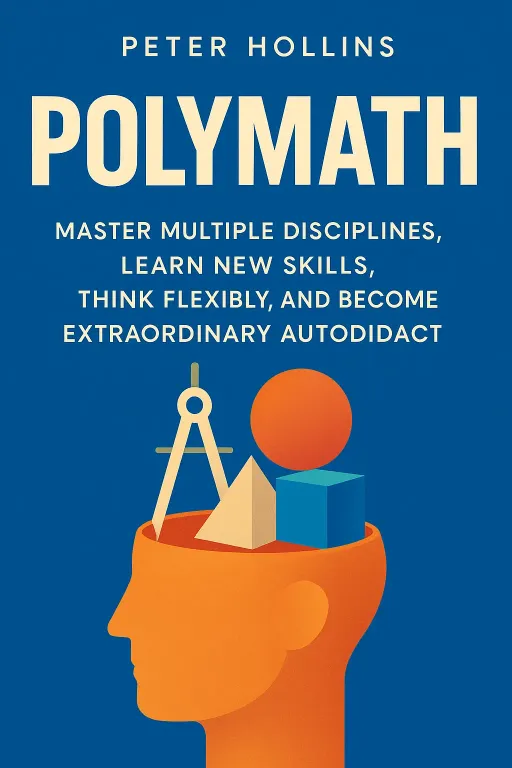
Nova: It might just be. Today, we're diving into a concept that flips modern career advice on its head, drawing insights from Peter Hollins' insightful book 'Polymath' and Bernard Marr's forward-looking 'Future Skills.'
Atlas: Peter Hollins, he's the author who always seems to have a knack for distilling complex psychological ideas into really actionable wisdom, right? And Bernard Marr, he's the futurist who makes sense of all the tech buzzwords. That's a powerful combination.
Nova: Absolutely. Hollins, known for his incisive takes on learning and human potential, challenges our assumptions about mastery, pushing us to reconsider what 'expertise' truly means. And Marr, a celebrated futurist and business strategist, gives us the practical roadmap for navigating tomorrow's job market. Both, in their own ways, are pointing us towards what we're calling the "versatility advantage."
Atlas: The versatility advantage. I like that. So, we're talking about being a jack-of-all-trades, master of none, but in a good way? Because for so long, that phrase has had such a negative connotation.
Nova: Precisely. We're going to reclaim that idea, Atlas. Because what if being a 'jack-of-all-trades' is actually the master key to unlocking unprecedented levels of innovation and resilience?
Atlas: Okay, you've definitely got my attention. Tell me more about this historical perspective. Where do we even begin to challenge the deeply ingrained idea that specialization is king?
The Historical & Cognitive Advantage of Generalism
SECTION
Nova: Well, Peter Hollins, in 'Polymath,' takes us on a fascinating journey through history, arguing that the most successful and impactful individuals weren't narrow specialists. They were generalists. Think of the titans of the Renaissance, the Enlightenment figures. They didn't just excel in one discipline; they connected disparate fields.
Atlas: Like Leonardo da Vinci, I suppose? He's the classic example everyone brings up. But is he an outlier, a genius exception, or does his approach actually hold a universal lesson for us?
Nova: That's the beauty of Hollins' argument. Da Vinci isn't just an outlier; he's a prime example of the of cross-pollination. Consider his work: he was a painter, a sculptor, an architect, a musician, a scientist, an inventor, an anatomist, a geologist, a cartographer, a botanist, and a writer. Now, imagine a specialist in any one of those fields back then. They might make incremental progress.
Atlas: But Da Vinci... he wasn't just incrementally moving forward. He was making huge leaps.
Nova: Exactly. His anatomical studies, for instance, weren't just for medical curiosity. They deeply informed the realism and emotional depth of his paintings. His understanding of fluid dynamics, from observing water, gave him insights into airflow that he applied to flying machine designs. His engineering mind saw structures in art, and artistic vision informed his scientific observations.
Atlas: So, his different interests weren't just hobbies; they were interconnected feedback loops. Each field was feeding insights into the others. That's a completely different way of thinking about knowledge.
Nova: It totally is. And that's the 'cognitive magic' you asked about earlier. When you expose your mind to different domains, you start to see patterns, analogies, and solutions that a specialist, deeply entrenched in their single field, simply wouldn't. You develop what Hollins calls 'conceptual blending.'
Atlas: Conceptual blending. I like that. It's like your brain becomes a super-connector, finding bridges between islands of knowledge. But in today's hyper-specialized world, where you need a PhD to even understand the basics of some fields, how is that even possible for the average person?
Nova: That's a fantastic question, and it's where the nuance comes in. It's not about becoming an expert in. It's about cultivating a that allows for those conceptual leaps. Hollins highlights that these historical polymaths weren't necessarily the deepest experts in every single field they touched, but they were deeply curious and understood enough to see the connections. Their strength was in synthesis.
Atlas: So, it's about connecting the dots, not necessarily drawing every single dot yourself. That makes a lot more sense. It changes the goal from becoming a walking encyclopedia to becoming a master networker of ideas.
Nova: Precisely. It’s about building a mental toolkit from diverse disciplines. When faced with a problem in one area, you might find an elegant solution by drawing on principles from a completely different one. It’s like having a universal remote for your brain.
Atlas: And I imagine that makes you incredibly adaptable. If one field suddenly becomes obsolete, you're not entirely lost because you have other frameworks to draw upon.
Nova: That's a key benefit. This historical perspective from 'Polymath' shows us that generalism isn't a weakness; it's a superpower for innovation and resilience. And that adaptability you just mentioned, Atlas, brings us beautifully to Bernard Marr's work on 'Future Skills,' which essentially describes the modern manifestation of this polymathic mindset.
Modern Versatility: Soft Skills as the New Hard Skills
SECTION
Nova: Bernard Marr, in his book 'Future Skills,' shifts our focus from the historical to the imminent. He argues that in our rapidly evolving, AI-driven world, the skills that will truly drive career success aren't just technical ones, but what he calls critical soft skills.
Atlas: Critical soft skills. I hear that phrase a lot, but what does it really mean in a practical sense? Is it just being 'good with people'? Because that also sounds a bit vague.
Nova: It's far more profound than just being 'good with people,' though that's certainly part of it. Marr identifies skills like emotional intelligence, critical thinking, digital literacy, collaboration, and adaptability as the primary drivers of future success. These are the modern tools for connecting disparate fields.
Atlas: Okay, so the modern version of 'connecting disparate fields' isn't just about different academic subjects, but different of intelligence and skill sets. It's about bridging the gap between the technical and the human, the logical and the intuitive.
Nova: Exactly! Think of it this way: a historical polymath might connect astronomy with philosophy. A modern polymath connects data analytics with empathy, or AI ethics with user experience design. The underlying principle of connecting diverse domains remains, but the domains themselves have evolved.
Atlas: That's a great way to put it. So, emotional intelligence, for example. How does that become a 'future skill' in the same league as, say, knowing how to code?
Nova: Because in a world where machines can handle increasingly complex technical tasks, the uniquely human elements become more valuable. Emotional intelligence allows you to understand team dynamics, navigate conflict, motivate others, and build strong relationships – all things that AI struggles with. It's crucial for effective collaboration, which Marr emphasizes as paramount.
Atlas: So, it's about leading and inspiring, not just executing. And digital literacy, you mentioned that. I imagine many of our listeners might think that just means knowing how to use Microsoft Office or social media. Is that what Marr means by it?
Nova: Not at all. Marr defines digital literacy as understanding the and of digital tools, not just surface-level operation. It's about knowing how to leverage technology to solve problems, how to critically evaluate digital information, and how to adapt as new technologies emerge. It’s a mindset, not just a checklist of software.
Atlas: That makes sense. It's about understanding the of the digital world, not just memorizing a few phrases. And how does adaptability fit into this modern versatility puzzle?
Nova: Adaptability is arguably the most critical 'meta-skill' Marr discusses. The pace of change is so relentless that specialized knowledge can become obsolete quickly. Adaptability, the ability to learn new skills, unlearn old assumptions, and pivot effectively, ensures you remain relevant. It’s the ultimate form of career insurance.
Atlas: So, a specialist might be brilliant in their narrow field, but if that field shifts or disappears, they're in trouble. A versatile individual, armed with these future skills, can retool and thrive.
Nova: Precisely. Marr's research shows that companies aren't just looking for deep technical expertise anymore. They're looking for individuals who can integrate, innovate, and lead across different functions, who can communicate complex ideas to diverse audiences, and who can learn continuously. These soft skills are the glue that holds everything together and drives true innovation.
Atlas: It's like the historical polymaths built bridges between different academic disciplines, and today's versatile professionals build bridges between technology and humanity, between data and decisions.
Nova: That's a perfect analogy, Atlas. Both Hollins and Marr, from different vantage points, are essentially championing the same core idea: don't just specialize; broaden your horizons.
Synthesis & Takeaways
SECTION
Nova: So, bringing it all together, the historical wisdom from 'Polymath' and the future-proofing insights from 'Future Skills' paint a clear picture: versatility is the new specialization. It's not about abandoning depth, but about complementing it with strategic breadth.
Atlas: This sounds incredibly empowering, especially for anyone feeling stuck in a niche or worried about their skills becoming irrelevant. But for someone who's spent years honing a particular craft, it might also feel a bit overwhelming. How does someone actually cultivating this versatility muscle without feeling like they need to go back to school for another five degrees?
Nova: That's the million-dollar question, and the beauty of the takeaway from these insights is its elegant simplicity. You don't need a grand career overhaul. The advice is to pick one skill completely outside your current field and spend just 30 minutes a week exploring its basics.
Atlas: Thirty minutes a week? That's it? That sounds almost too easy. I imagine many of our listeners might be thinking, "What can I possibly learn in 30 minutes a week?"
Nova: It's not about achieving mastery in 30 minutes, Atlas. It's about consistent, low-stakes exploration. It's about sparking curiosity, making new neural connections, and building that 'versatility muscle' over time. Think of it as cognitive cross-training. If you're a software engineer, maybe you spend 30 minutes learning basic drawing techniques. If you're a marketing specialist, perhaps you delve into the fundamentals of philosophy or even gardening.
Atlas: So, it's about exposing your brain to radically different patterns of thought and problem-solving. A coder learning pottery might suddenly see algorithms in the clay, or a writer learning basic carpentry might understand narrative structure in a completely new, tangible way.
Nova: Exactly! It's about creating those conceptual blends we talked about earlier. It’s about cultivating beginner's mind in a new domain, which can make you more creative and adaptable in your primary one. It's a small, consistent investment that yields enormous long-term dividends in terms of creativity, resilience, and sheer intellectual joy.
Atlas: That's actually really inspiring. It reframes learning a new skill not as a daunting task, but as a playful exploration, a way to keep your mind agile and open. It's not about becoming Da Vinci overnight, but about adopting his spirit of boundless curiosity.
Nova: And that spirit, that intentional broadening of your horizons, is what gives you the versatility advantage. It's what allows you to thrive, not just survive, in a world that never stops changing.
Atlas: That's a profound thought to leave us with. The future doesn't belong to the narrowly specialized, but to the broadly curious.
Nova: Indeed. So, what new skill are you going to explore for 30 minutes this week, Atlas?
Atlas: Oh, I'm already thinking about dabbling in... competitive bird watching. You know, for the strategic planning and keen observation skills.
Nova: I wouldn't expect anything less from you. And for all our listeners, we encourage you to pick your own unexpected skill and start building that versatility muscle.
Nova: This has been a truly insightful dive into how we can all become more adaptable and successful. Thank you for joining us.
Atlas: Thank you, Nova, for shedding light on such a crucial topic. We hope this has sparked some new ideas for everyone out there.
Nova: This is Aibrary. Congratulations on your growth!









