The State as a Product: Deconstructing Aristotle's Blueprint for Society
Golden Hook & Introduction
SECTION
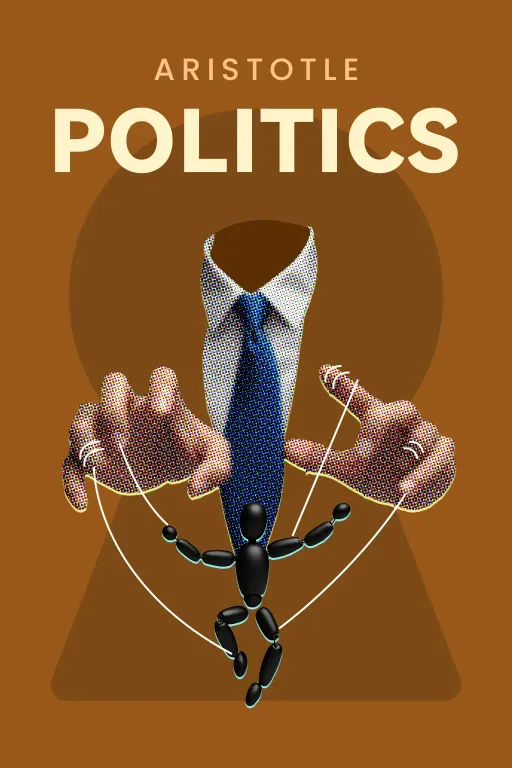
Nova: What if I told you that the best guide to building a successful tech product in the 21st century was written 2,400 years ago? It sounds crazy, right? But Aristotle's isn't just about togas and ancient city-states; it's a masterclass in system design. He asks the fundamental question every product manager, every leader, faces: are we building for mere survival, or are we building for the 'good life'?
Nova: Today, we're going to tackle this ancient blueprint from two angles. First, we'll explore Aristotle's 'product vision' for the state and his definition of the core 'user'—the political animal. Then, we'll dive into the economic 'bugs' and 'exploits' he identified, like monopolies, that threaten to crash the entire system. And here to help us deconstruct this is Honglei, an analytical thinker and product manager in the healthcare tech space. Honglei, welcome!
honglei ios online: Thanks for having me, Nova. That's a fascinating frame. The idea of designing for the 'good life' instead of just, say, basic functionality, is something that really resonates. In healthcare tech, that's the ultimate goal—not just to manage illness, but to promote wellness. So, I'm very curious to see what Aristotle has to say.
Deep Dive into Core Topic 1: The State's 'Product Vision'
SECTION
Nova: I'm so glad you said that, because it's the perfect place to start. So let's begin with that 'product vision.' What is the of the state, according to Aristotle? Why do we even have governments and societies?
honglei ios online: Right, what's the core problem it's trying to solve?
Nova: Exactly. And for Aristotle, it's not just about safety or making sure we have enough food. He says, "Every state is a community... established with a view to some good." But the state, because it's the biggest and most all-encompassing community, aims at the good. It’s the ultimate platform for human flourishing.
honglei ios online: So, it's not just a utility, it's an aspirational product. Its job is to elevate its users.
Nova: Perfectly put. And that leads to his famous definition of the 'user.' He says that "man is by nature a political animal." He doesn't mean we're all secretly politicians. He means we are fundamentally social creatures who can only reach our full potential within a community, a.
honglei ios online: That makes sense. From a design perspective, you can't design for a user in a vacuum. You have to understand their context, their network, their community. So for Aristotle, the user the community. You can't design for one person in isolation; you have to design for the interactions between people.
Nova: You've hit on the core of it. And he takes it a step further with a really powerful, almost chilling, quote. He says, "For man, when perfected, is the best of animals, but, when separated from law and justice, he is the worst of all."
honglei ios online: Wow. Okay, that's a heavy statement.
Nova: Isn't it? It implies that our goodness isn't a given. It's enabled by the system we live in. Without the structure of law and justice—the 'product features' of the state—we revert to our worst instincts.
honglei ios online: That reminds me of designing online platforms or communities. You have to create a framework—rules, moderation, community guidelines, terms of service. You can't just put a million people in a digital room and hope for the best. The structure itself is what enables positive interaction and discourages destructive behavior. It's the framework that enables virtue, not just assumes it.
Nova: Yes! The state is the ultimate set of community guidelines. And if the goal is the 'good life,' then the rules have to be designed to steer people in that direction. But, as we know with any system, users are very, very good at finding loopholes.
honglei ios online: Tell me about it. They will always find a way to do something you never intended.
Deep Dive into Core Topic 2: System Bugs and Exploits
SECTION
Nova: I love that idea of the framework enabling virtue. But Aristotle was also a complete realist. He knew systems could be gamed. This brings us to his ideas on wealth, which feel so incredibly modern it's almost spooky. He basically identified system bugs, or what he called 'unnatural wealth-getting.'
honglei ios online: Unnatural wealth-getting? What does he mean by that?
Nova: He distinguishes between two types. 'Natural' wealth-getting is part of managing a household—growing food, making goods, providing for your family's needs for a good life. It has a natural limit. But 'unnatural' wealth-getting is about acquiring money for the sake of acquiring more money. It's infinite. And he says it's justly censured. To show what he means, he tells this incredible story about a merchant in Sicily.
honglei ios online: Okay, I'm ready. A case study.
Nova: It's a great one. So, we're in ancient Syracuse, under the rule of a tyrant named Dionysius. A certain Sicilian merchant is entrusted with a large sum of money. Now, instead of just trading normally, he has a brilliant, and dangerous, idea. He goes to the iron mines and uses all that cash to buy up the iron. Every last piece.
honglei ios online: He cornered the market.
Nova: Completely. So, when merchants from all over come to Syracuse to buy iron for their businesses, who is the only seller? Our guy. And Aristotle notes, he didn't even have to raise the price outrageously. He just controlled the entire supply, and by doing so, he made a 200% profit on his initial investment.
honglei ios online: That's a perfect example of a monopoly exploit. He didn't add any value to the iron itself. He didn't make it better or transport it more efficiently. He just created an artificial scarcity to extract value. It's pure arbitrage, enabled by a lack of regulation in that market.
Nova: Exactly! And what's so fascinating is the ruler's reaction. When Dionysius finds out, he doesn't punish the merchant or take his money. He lets him keep his profits, but he banishes him from Syracuse.
honglei ios online: Why? If he didn't technically break a law?
Nova: Because, as Aristotle explains, Dionysius recognized that the merchant had discovered a way of making money that was "harmful to the city's interests." It was bad for the overall health of the system.
honglei ios online: That is such a product decision! It's a constant debate. Do you allow users to engage in behavior that benefits them individually but degrades the experience for everyone else? Think about ticket scalpers who use bots to buy up all the concert tickets and resell them. Or traders who use high-frequency algorithms to gain an unfair advantage. The system allows it, but it feels unjust and damages the platform's integrity. The ruler here made a choice to protect the system's health over one user's 'unnatural' gain.
Nova: And it wasn't a one-off! Aristotle tells another story about the philosopher Thales, who was mocked for being poor. To prove a point, he used his knowledge of astronomy to predict a massive olive harvest. In the middle of winter, he quietly put down small deposits on the olive presses in the region. When the bumper crop came and everyone was desperate for a press, he held a monopoly and rented them out at whatever price he wanted, making a fortune.
honglei ios online: So he proved that philosophers get rich, they just chose not to. But the method itself is another example of that 'unnatural' gain. It's not about producing; it's about controlling a chokepoint in the system. It's a vulnerability.
Nova: A vulnerability. That's the perfect word. And Aristotle saw it 2,400 years ago. He identified these economic bugs that could corrupt the state's entire operating system.
Synthesis & Takeaways
SECTION
Nova: So, when we put it all together, we have these two huge, timeless ideas from Aristotle. First, design your system—your state, your company, your product—with a higher purpose in mind: enabling the 'good life' for your users.
honglei ios online: And understand that your 'user' is part of a community, and needs a framework of justice to thrive.
Nova: Exactly. And second, be relentlessly vigilant about the economic 'bugs' and 'exploits'—the loopholes for 'unnatural' gain—that can undermine that very purpose and destabilize the whole system.
Nova: As someone who builds systems in a field as critical as healthcare, how does this ancient wisdom land with you, Honglei?
honglei ios online: It's a powerful reminder, honestly. In the world of tech, it's so easy to get lost in the metrics—user engagement, daily active users, revenue. We focus on the short-term goals and the features. But Aristotle is forcing us to zoom out and ask a much bigger question.
Nova: Which is?
honglei ios online: Is the system we're building—whether it's a government, a company, or an app—truly contributing to the 'highest good'? Are we enabling human flourishing? Or are we, maybe even accidentally, creating loopholes for 'unnatural' gain that might look good on a spreadsheet but are ultimately corrosive to the community we serve? That's a question I'll definitely be taking back to work with me.
Nova: A question for the ages, from a guide for the ages. Honglei, thank you so much for helping us deconstruct this.
honglei ios online: This was fantastic. Thank you, Nova.