

Politics among nations
Introduction
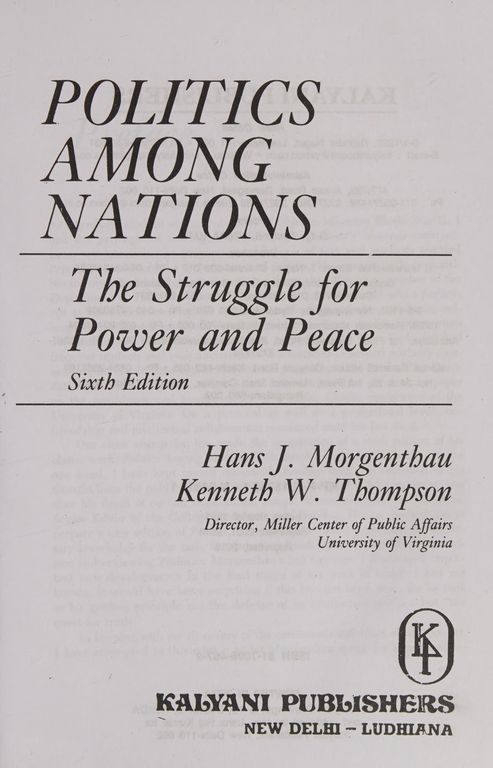
Nova: Welcome to the show. Today we're diving into a book that literally shaped how the United States navigated the entire Cold War. It's called "Politics Among Nations: The Struggle for Power and Peace" by Hans J. Morgenthau, first published in 1948. John Mearsheimer, one of the most famous realists of our time, calls it one of the three most influential realist works of the entire 20th century. And here's the thing — this wasn't just an academic exercise. Morgenthau was an advisor to both the Kennedy and Johnson administrations. His ideas had real-world consequences.
Nova: At its core, Morgenthau argued something deceptively simple: international politics is a perpetual struggle for power. Nations, like people, are driven by self-interest, and in a world with no overarching authority — no global government — every state must pursue its own survival and security above all else. He called this approach "political realism," and it was a radical departure from the idealistic, law-focused thinking that dominated before World War II.
Nova: That's the crude version many critics latched onto, yes. But Morgenthau was more nuanced. He wasn't saying morality doesn't matter — he was saying that the first moral duty of a statesman is to ensure his nation's survival. You can't pursue noble ideals if your country no longer exists. He had this famous quote: the individual may say, "Let justice be done, even if the world must perish," but the state has no right to say that in the name of the people in its care. That distinction between individual ethics and state ethics is absolutely central to the book.
The Intellectual Backbone
The Six Principles of Political Realism
Nova: The heart of "Politics Among Nations" is what Morgenthau called his six principles of political realism. These didn't actually appear until the second edition in 1954, but they became the most famous part of the book. Let me walk through them.
Nova: Principle one: politics is governed by objective laws rooted in human nature. Morgenthau believed human nature is constant and predictable. We are self-interested creatures who seek power, and because nations are run by humans, international politics follows the same pattern. He argued you could develop a rational theory of politics, just like economics, by studying these objective laws through reason and experience.
Nova: Exactly. Principle two builds on this: the concept of interest defined in terms of power. This is the master key. Just as an economist thinks in terms of wealth, the realist thinks in terms of power. Morgenthau says that to understand any foreign policy decision, you ask: what power interest is being served here?
Nova: Yes. He contrasts Neville Chamberlain and Winston Churchill. Chamberlain had wonderful motives — he genuinely wanted peace and happiness for all. But his appeasement policies helped make World War II inevitable. Churchill's motives were much more narrowly about personal and national power, yet his foreign policies were morally and politically superior. Morgenthau's point is brutal: good intentions don't guarantee good outcomes. What matters is intellectual ability to comprehend the essentials of foreign policy, and the political skill to turn that comprehension into successful action.
Nova: That's exactly right. Robespierre was, by his own lights, one of the most virtuous men alive. But his utopian radicalism led him to kill those less virtuous than himself, and it ultimately brought him to the scaffold and destroyed the French Revolution. Principle three then says: this concept of interest defined as power is universally valid, but not fixed. Its meaning changes with the political and cultural context. Power could be military force, economic leverage, cultural influence, or psychological ties — whatever establishes and maintains control of man over man.
Nova: That's principles four and five, and this is where people often misread Morgenthau. Principle four says realism is deeply aware of the moral significance of political action. If a friendly nation is attacked, we might want to help, but realism demands we ask whether we can do so without unacceptable risks. Principle five goes further: realism refuses to equate any one nation's moral aspirations with universal moral laws. So if a country invades another claiming it's God's will, the realist sees that as a mask for power politics, not a legitimate justification.
Nova: The sixth principle says political realism is its own distinct sphere. Politics must be separated from economics, law, and morality as a domain of analysis. The realist thinks in terms of interest defined as power, period. This autonomy of the political sphere is what makes realism a coherent theory rather than a mishmash of other disciplines.
Nova: Right, and that tension has fueled decades of debate. But remember, Morgenthau was writing in the shadow of World War II and the dawn of the nuclear age. He'd fled Nazi Germany himself. He had seen what happens when states fail to think clearly about power.
How States Keep Each Other in Check
The Balance of Power Mechanism
Nova: Let's talk about one of Morgenthau's most influential ideas: the balance of power. He saw it as the driving force of European history — not just a political reality but almost an intellectual and moral principle.
Nova: Exactly. And Morgenthau identified several mechanisms states use to maintain that balance. The first is alliances — think of the Triple Entente versus the Triple Alliance before World War I. States band together to counterbalance a rising threat. The second is arms control and military buildup. The Cold War arms race wasn't just preparing for war — it was about deterrence. Show your strength so clearly that the other side calculates aggression isn't worth it.
Nova: Right. And the third mechanism is economic tools — trade agreements, sanctions, aid packages. States use economic leverage to reward allies and punish adversaries. These mechanisms together create a system where, ideally, war becomes too costly to contemplate because no one can be confident of a quick, decisive victory.
Nova: Very unstable. They shift constantly because nations' goals and relative power change over time. And he argued that in the modern era, things had gotten more precarious. The cultural and moral consensus that once united European nations — a shared Christian civilization, essentially — had broken down. Plus, the bipolar world of the U. S. versus the Soviet Union had rendered traditional multi-state balancing much less effective.
Nova: In some ways, yes. When you only have two superpowers, there are fewer players to mediate disputes and shift alliances flexibly. The margin for error shrinks dramatically. And with nuclear weapons in the mix, the stakes couldn't be higher. Morgenthau wrote that the failure of international law to preserve peace had become an existential issue. The very survival of the human species was on the line.
Nova: That was one of his most controversial positions. He argued that international courts have no way to impose decisions on unwilling nations. There's no shared ethical or moral consensus among states. Even on issues like freedom and peace, what he called "world public opinion" always splits into its national components. The UN Security Council lacks enforcement tools. In his view, the only permanent solution would be a world state — a single global government — but he acknowledged that was impossible under contemporary conditions. So what's left?
Nine Rules for Statesmen
Diplomacy as the Art of Peace
Nova: This brings us to the practical heart of the book. Morgenthau believed that diplomacy was the most reliable tool for preventing wars, and he laid out nine specific rules for doing it right.
Nova: First, the four fundamental rules. Rule one: diplomacy must be divested of the crusading spirit. Don't get dogmatic. Don't turn foreign policy into a religious mission to convert the world to your values. Rule two: the objectives of foreign policy must be defined in terms of the national interest and must be supported with adequate power. For a peace-loving nation, he defined national interest as the integrity of its territory and its institutions. Nothing more, nothing less.
Nova: Exactly. Rule three: diplomacy must look at the political scene from the point of view of other nations. You have to see the world through your adversary's eyes, defined in terms of their national security. Rule four: nations must be willing to compromise on all issues that are not vital to them. If it's not existential, you can negotiate.
Nova: These are wonderfully practical. First: give up the shadow of worthless rights for the substance of real advantage. Don't cling to legalistic or ideological positions that don't actually help you. Second: never put yourself in a position from which you cannot retreat without losing face and from which you cannot advance without grave risks. In other words, always leave yourself an exit ramp.
Nova: Absolutely. Third: never allow a weak ally to make decisions for you. Fourth: the armed forces are the instrument of foreign policy, not its master. The military serves diplomacy, not the other way around. And fifth: the government is the leader of public opinion, not its slave. Leaders should shape public understanding, not just follow the emotional whims of the moment.
Nova: He's saying that statesmanship requires judgment that the public may not immediately grasp. Foreign policy decisions often involve long time horizons, nuanced trade-offs, and classified information. If a leader simply mirrors public emotion — anger after an attack, say — they might make catastrophic decisions. The statesman's job is to think in terms of the national interest and then bring the public along, not the reverse.
Nova: That's precisely the point. Morgenthau also said nations have three tools: persuasion, compromise, and the threat of force. The art is blending them appropriately for each situation. Don't fall in love with any single tool.
Nova: That's part of why the book has endured. The technology changes, the specific players change, but the logic of power politics remains remarkably consistent.
Why the Book Still Matters
Legacy, Criticism, and Enduring Relevance
Nova: "Politics Among Nations" went through seven editions over more than four decades. For much of that time, it was the premiere textbook in international politics. It defined the field. But it also attracted serious criticism.
Nova: Several things. First, that key concepts like "national interest" and "balance of power" were never coherently defined. Scholars pointed to contradictions, ambiguity, and vagueness in the text. Second, critics argued the theory was morally inadequate — that by separating politics from ethics so sharply, Morgenthau created a framework that could justify virtually any action in the name of national interest.
Nova: Yes. Many scholars have noted the frequent misrepresentation of Morgenthau's realism as amoral or even immoral. In fact, Morgenthau spent a great deal of energy complaining that he was being criticized for ideas he never expressed — and even for arguments he had specifically sought to refute. His realism was not about abandoning morality. It was about recognizing that different moral considerations apply at different levels. The morality of the private citizen is not identical to the morality of the statesman responsible for millions of lives.
Nova: Profoundly. The book introduced the concept of political realism to an American audience that was, at the time, steeped in legalistic and idealistic traditions. It provided the intellectual framework for a foreign policy based on power calculations rather than moral crusades. George Kennan invited Morgenthau to join the State Department's policy planning staff. The book was studied by diplomats, military strategists, and policymakers throughout the Cold War.
Nova: That's a fascinating part of the story. By the late 1940s, Morgenthau was actually uneasy about Kennan's containment doctrine because he thought it structured unnecessary enmity between the U. S. and the Soviet Union. He advocated continued diplomatic efforts and negotiation. Later, he became a vocal critic of the Vietnam War. His realism wasn't a recipe for endless confrontation — it was a call for prudence, for knowing your limits, for not confusing your preferences with universal truths.
Nova: Often, yes. If your guiding principle is the national interest defined soberly, you don't go on crusades. You don't try to remake the world in your image. You conserve your power for what actually matters to your survival. That's a lesson that resonates very differently depending on which historical moment you're reading the book in.
Nova: Stephen Walt at Harvard wrote in 2018 that despite government officials claiming to act on realist principles, both Democrats and Republicans have consistently viewed foreign policy through the lens of liberal idealism — framing the world as a battle between virtuous democracies and evil dictatorships. The tension Morgenthau identified between crusading moralism and prudent national interest calculation is as alive as ever. Look at debates about Ukraine, about Taiwan, about the Middle East. In every case, you can see the tug-of-war between the impulse to defend values everywhere and the realist recognition that power is finite and choices have consequences.
Nova: Exactly. And that voice never goes out of style, even if it's not always the one that wins the argument.
Conclusion
Nova: Let's bring it all together. "Politics Among Nations" gave us a framework that has shaped how we think about international relations for more than seven decades. At its core are a few enduring insights. First: politics is governed by objective laws rooted in unchanging human nature. Second: the concept of interest defined in terms of power is the master key to understanding state behavior. Third: the balance of power, though fragile, remains the primary mechanism for preserving peace among sovereign states. Fourth: diplomacy, guided by prudence and a clear-eyed assessment of national interest, is our best tool for avoiding catastrophe.
Nova: He also reminds us that the most dangerous thing in international politics is not power itself — it's power untethered from prudence. Crusading zeal, whether ideological, religious, or moral, has caused more devastation than cold calculation ever has. The statesman who thinks only of justice may burn the world down. The statesman who thinks of survival may preserve the conditions in which justice can someday flourish.
Nova: If you take one thing from Morgenthau, let it be this: know your interests, assess your power honestly, see the world through your adversary's eyes, and never put yourself in a position from which you cannot retreat. That's not cynicism. It's survival.