Systems, Power, and Precision Execution
Golden Hook & Introduction
SECTION
Nova: Entropy is the default state of the universe. Your desk, your company, your government, and even your best-laid plans are all, at this very moment, in the process of falling apart. It is a slow, quiet drift toward disorder.
Atlas: That is a remarkably cheerful way to start the morning, Nova. But you are right. Everything requires energy just to stay where it is. If you stop pushing, the house of cards collapses.
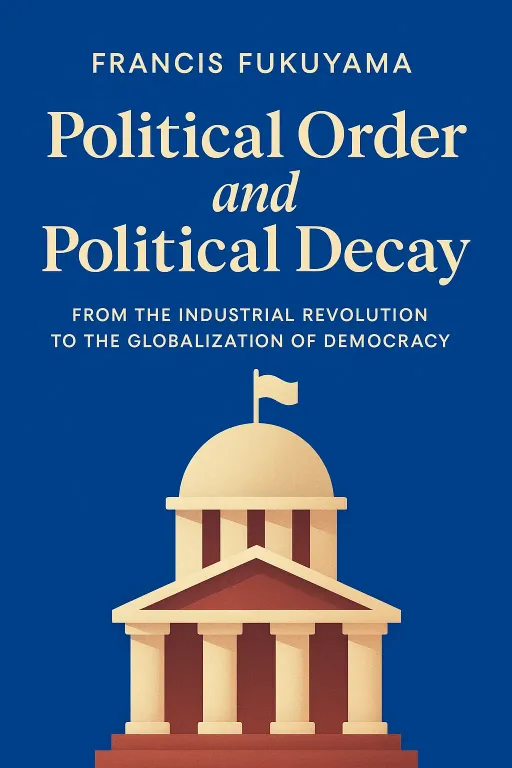
Nova: Exactly. And that is the central challenge we are looking at today. We are exploring the intersection of two very different worlds: the grand, sweeping political structures traced by Francis Fukuyama in his work, Political Order and Political Decay, and the hyper-precise, terrifyingly high-stakes engineering world of Kathryn D. Sullivan in her memoir, Handprints on Hubble.
Atlas: It is a fascinating pairing. One is about the messy, human struggle of keeping a civilization from crumbling, and the other is about the surgical precision required to fix a billion-dollar machine floating in the vacuum of space.
Nova: They are the same problem, seen through different lenses. Fukuyama looks at the macro-systems of governance—how states lose their capacity to function when they get captured by special interests or succumb to bureaucracy. Sullivan looks at the micro-systems of execution—how you keep a project alive when the environment is literally trying to kill you.
Atlas: I love that. We are essentially talking about the mechanics of stability. Whether you are running a country or managing a team, the question is how do you fight off that inevitable decay?
The Entropy of Institutions
SECTION
Nova: Let’s start with that Fukuyama perspective. He argues that for a system to be stable, it needs three things: a strong state, the rule of law, and democratic accountability. When these three are in balance, you get a functioning, resilient institution.
Atlas: But that balance feels incredibly fragile. In my experience, one of those usually wins out. Either the state becomes too powerful and crushes the rule of law, or the accountability mechanisms become so bloated with red tape that nothing actually gets done.
Nova: That is the decay. Fukuyama talks about this concept of patrimonialism. It sounds like a dense academic term, but it is actually a very human instinct. It is the tendency for people in power to treat public resources as their own private property—to hire their friends, to protect their inner circle, to prioritize the tribe over the institution.
Atlas: Oh, I see that everywhere. It is the classic office politics trap. A manager starts hiring people they like, rather than the most competent people, and suddenly the team’s output drops. The institution stops serving its purpose and starts serving the comfort of the people inside it.
Nova: Precisely. And when that happens, the system loses its capacity. It becomes rigid. It cannot adapt to new challenges because the internal logic of the system is now about survival, not about performance. Fukuyama’s analysis is vital because it shows us that this is not just a bug in the system; it is a feature of human nature.
Atlas: So, if the system is designed to decay—if our natural human tendency is to prioritize our friends and our comfort—how do we fight that? Is the solution just more rules?
Nova: More rules often accelerate the decay. That is the paradox. When a system gets weak, the reaction is usually to add more oversight, more checklists, more layers of approval. But that just creates more bureaucracy, which further slows down the state. It is a vicious cycle.
Atlas: That resonates deeply. I have been in organizations where a simple decision takes six months because it has to pass through four different committees. The intention was to increase accountability, but the result was total paralysis.
Nova: And that is where the transition to our second perspective becomes so important. If you cannot fix a decaying system just by adding rules, you have to fix it by changing the nature of the execution. You have to shift from bureaucratic control to what Kathryn Sullivan describes in her work on the Hubble Space Telescope.
The Precision of Execution
SECTION
Atlas: I am glad you brought up Sullivan. Handprints on Hubble is such a visceral read. Most people see the images from the telescope, but they do not realize that the telescope itself was almost a total failure.
Nova: It was a disaster. The primary mirror was ground to the wrong shape. It was effectively blind. And the solution was not to fire everyone or add more committees. The solution was a masterclass in human systems and absolute, rigorous precision. Sullivan details how they had to design a repair mission that was, frankly, impossible. They were working in the vacuum of space, in bulky suits, trying to perform eye surgery on a satellite moving at seventeen thousand miles per hour.
Atlas: And this is where the contrast is so beautiful. Fukuyama describes the rot of large, slow-moving systems. Sullivan describes the antidote: extreme, obsessive clarity. She writes about the checklists. Not just as a piece of paper, but as a binding contract with reality.
Nova: The checklist is the ultimate tool against entropy. When you are in space, you cannot afford to have a "patrimonial" approach to your work. You cannot hire your friend to fix the solar array if they are not the best person for the job. The environment does not care about your relationships. It only cares about whether you followed the procedure.
Atlas: It is a meritocracy of physics.
Nova: Exactly. Sullivan’s leadership during those missions was defined by a concept that I think is missing from most failing institutions: the clarity of the objective. She knew exactly what needed to be done, she knew who was best suited to do it, and she stripped away every ounce of unnecessary friction.
Atlas: I am thinking about how this applies to the listener. If you are a team leader or someone managing a high-stakes project, you are probably dealing with a bit of that "institutional decay" Fukuyama talks about—the drift, the lack of focus. How do you bring the "Hubble" mindset to a messy office environment?
Nova: You start by auditing your own "checklists." Most people think checklists are for beginners. They think, "I am smart enough to remember this." But Sullivan’s experience shows that the smartest, most capable people are the ones who rely on checklists the most, because they know that cognitive load leads to errors.
Atlas: I love that. It is the opposite of the ego-driven way most of us work. We want to improvise. We want to show our genius. But Sullivan is saying that true genius is in the preparation.
Nova: Right. And there is another layer here. Sullivan emphasizes the human element. She talks about the training, the bonding, the trust between the astronauts. They were not just following a manual; they were a high-functioning, integrated unit. They understood that the system was only as strong as their communication.
Atlas: So, you have the macro-level, where institutions rot because of social tribalism—that is the Fukuyama warning. And then you have the micro-level, where you prevent that rot by creating a culture of radical competence and shared, objective reality—that is the Sullivan solution.
Synthesis & Takeaways
SECTION
Nova: That is the perfect synthesis. If you want to stabilize your own projects, you have to act like a governor of your own mini-state. You have to be aware of the "decay" forces—the temptation to let standards slip, to prioritize comfort over competence, to let the system become more important than the mission.
Atlas: And then, you have to be the astronaut. You have to be the one who demands the checklist, who demands the clarity, and who is willing to look at the "mirror" of your project and admit that it is ground to the wrong shape, even if it is painful.
Nova: That is the hardest part. Admitting you are blind. Sullivan had to admit the telescope was broken before she could fix it. Most institutions are in denial. They are pretending the telescope is working fine while they are getting blurry data.
Atlas: So, for our listeners, the takeaway is an audit. Look at your current project. Where is the decay? Is it in the process? Is it in the way you communicate? Is it in your willingness to face the reality of the results?
Nova: And then, build the checklist. Not a bureaucratic one that slows you down, but a "Hubble" checklist—a set of essential, non-negotiable steps that ensure success, regardless of how you feel that day.
Atlas: I think that is the key. It is about removing the "human" element of ego and replacing it with the "human" element of reliability.
Nova: That is how you build an institution, or a project, that doesn't just survive, but actually sees the stars.
Atlas: This has been a fantastic dive. It’s rare to connect political science and space exploration so seamlessly. It really makes you look at your own work differently.
Nova: It is all about the maintenance. You have to maintain the political order, and you have to maintain the machine. If you stop, the entropy wins.
Atlas: Well, I am going to go audit my systems, starting with my inbox. I think I have a bit of "patrimonial" clutter in there that needs cleaning out.
Nova: A great place to start. And to our listeners, take an hour this week to look at your own "Hubble" project. Where do you need more precision? Where are you letting the decay set in? Focus on that.
Atlas: Thanks for joining us for this deep dive into the mechanics of order. It has been a pleasure.
Nova: Always a pleasure. This is Aibrary. Congratulations on your growth!