Systems of Power and Inequality
Golden Hook & Introduction
SECTION
Atlas: History has a very specific, very brutal way of clearing the board when inequality gets too high. It doesn't ask for a committee meeting. It doesn't hold a vote. It sends the Four Horsemen.
Nova: That is a terrifyingly accurate way to frame it, Atlas. And the thing is, most of us assume that if things get too unbalanced, there will be some polite, bureaucratic adjustment—a tax reform here, a policy tweak there—to bring everything back to equilibrium. But history tells a much darker story.
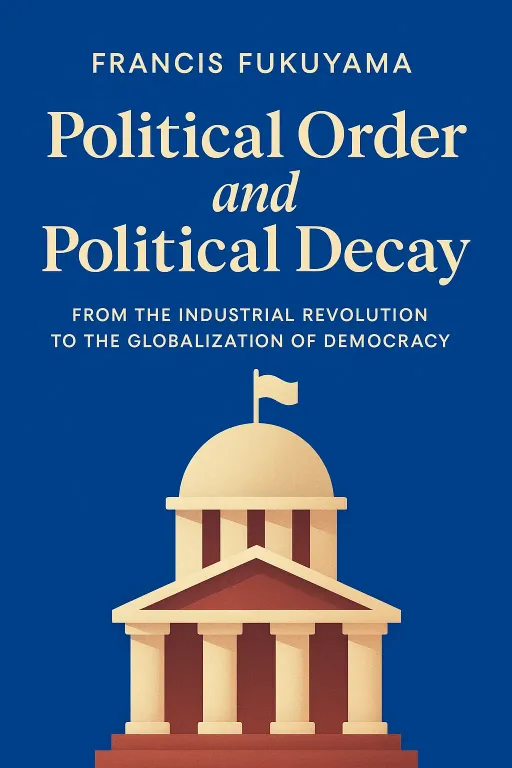
Atlas: Right. And that is exactly why we are diving into these two books today. We are looking at Francis Fukuyama’s Political Order and Political Decay, and Walter Scheidel’s The Great Leveler. We are trying to understand the mechanics of power and why systems seem to have a built-in expiration date.
Nova: It is a heavy pairing. Fukuyama is this towering figure in political science, someone who spent decades trying to map out why some nations succeed and others fail. And then you have Scheidel, a historian who looks at the data of human suffering to explain why inequality eventually crashes. These books together create a kind of blueprint for understanding the rise and fall of the systems we live in.
Atlas: I am ready to dig into this. I think for anyone who is trying to build a career or a business, understanding the lifecycle of a system is like having a cheat code. If you know how systems die, you might actually be able to keep yours alive. Let’s start with the decay part, because that feels like the immediate problem for any organization.
The Mechanism of Institutional Decay
SECTION
Nova: It is the most immediate problem. Fukuyama’s central argument is that a stable political order requires a delicate three-part balance. You need a strong state, you need the rule of law, and you need democratic accountability. If you have all three, you have a functional, modern society.
Atlas: Okay, that sounds like the ideal setup. A strong state to enforce rules, law to keep it fair, and accountability to keep it honest. So where does the decay come in? Why doesn't that just stay in balance forever?
Nova: Because of what he calls institutional sclerosis. Imagine you build a beautiful, intricate machine—your organization, your government, your career path. At first, it is efficient. But over time, the people inside that machine start to protect their own interests rather than the machine’s purpose. They build layers of bureaucracy. They create rules that benefit them, not the system.
Atlas: That sounds like corporate middle management. You start with a clear mission, and three years later, you have fifteen meetings a week just to decide who is allowed to send an email. Is that the decay?
Nova: Exactly. It is the calcification of the system. Fukuyama points out that as institutions age, they accumulate these layers of complexity. They become what he calls a vetocracy. Everyone has the power to block change, but nobody has the power to drive progress. The system becomes so obsessed with its own internal rules and preservation that it loses the ability to adapt to the outside world.
Atlas: That is a fascinating way to put it. A vetocracy. It’s like the system becomes an immune system that starts attacking its own healthy cells because it can’t distinguish between a threat and a necessary change. But wait, if that is the natural lifecycle—we build, we succeed, we become rigid, and then we decay—is there any way to break the cycle?
Nova: Fukuyama argues it is incredibly difficult because the people who benefit from the current, rigid system are the ones with the power to change it. They have no incentive to do so. They are the beneficiaries of the sclerosis. So, the system keeps growing more complex and less effective until it hits a wall.
Atlas: Which leads us to the other side of the coin. If the system is too rigid to change, and the people in charge won't let it change, what happens when it hits that wall? That brings us to Scheidel.
The Great Leveler and the Four Horsemen
SECTION
Nova: This is where the conversation gets a bit grim. Walter Scheidel, in The Great Leveler, looks at the long, violent history of inequality. He analyzed thousands of years of data, from the Stone Age to the present day. And his conclusion is quite stark: extreme economic inequality has historically only ever been significantly reduced by four specific forces.
Atlas: The Four Horsemen. I remember reading about this. It is not exactly a hopeful list.
Nova: No, it is not. The Four Horsemen are mass-mobilization warfare, transformative revolution, state collapse, and lethal pandemics.
Atlas: That is a staggering list. You are saying that the only way to reset the balance—to lower inequality—is through massive, systemic violence or catastrophe? What about peaceful reform? What about legislation?
Nova: Scheidel’s data suggests that peaceful reform, while it happens, is rarely enough to significantly disrupt the concentration of wealth. When you look at the historical record, major reductions in inequality are almost always tied to the total destruction of the existing order.
Atlas: Okay, let’s break that down. Why does mass-mobilization warfare, for example, act as a leveler? That sounds counterintuitive. War usually destroys everything.
Nova: It destroys the existing capital and the power structures that protect it. In a total war, the state needs everyone. It needs the labor of the working class and the resources of the elite. To get that, the state has to make concessions. It has to promise social safety nets, higher wages, and a more equitable distribution of the burden. It forces a reset of the social contract.
Atlas: So it is a forced redistribution of power. The elite are forced to share because their survival depends on the cooperation of the masses. And the same logic applies to revolution or state collapse?
Nova: Precisely. In a revolution, the old elite are literally removed or their assets are seized. In a state collapse, the entire legal and financial framework that protects wealth vanishes. The slate is wiped clean. It is a violent, brutal, and incredibly costly way to achieve equality, but it is, historically, the most effective way.
Atlas: And the fourth horseman, pandemics. We have seen this recently, right? How does that fit in?
Nova: Look at the Black Death in the 14th century. It killed so much of the population that labor became scarce. Suddenly, the people who were at the bottom of the hierarchy had leverage. They could demand higher wages. They could demand better conditions. The scarcity of human life forced a change in the economic value of that life. It is cold, hard, and tragic, but it is a mechanism of leveling.
Atlas: It is a chilling thought. You have Fukuyama saying we are prone to internal decay because our systems get too rigid and self-serving, and then you have Scheidel saying that the only way to break that rigidity is through catastrophe. It creates a very bleak picture for the future of any stable society. Is there no middle ground? Are we just waiting for one of the Horsemen to arrive?
The Synthesis and the Architect's Dilemma
SECTION
Nova: That is the deep question. How do we build robust systems that adapt to societal shifts without succumbing to institutional decay or requiring a catastrophe to reset the board? If we look at the Strategic Architect’s profile—someone who wants to build a future, not just react to the past—we have to find a way to engineer that adaptability.
Atlas: I am thinking about this in terms of my own professional life. If I am running a team or a business, I don't want to wait for a "market collapse" to force me to innovate. I want to build a system that innovates on its own. How do we apply this?
Nova: We need to design for what we might call productive friction. Fukuyama talks about the need for a balance of power. In a healthy system, you need to deliberately introduce mechanisms that prevent any one group from becoming too entrenched. You need to rotate leadership, you need to encourage dissent, and you need to keep the feedback loops short.
Atlas: So, instead of waiting for the system to become a vetocracy, you actively dismantle the vetocracy? You create a culture where being challenged is part of the job description?
Nova: Exactly. Think of it as institutional anti-fragility. You are not trying to create a perfectly stable system, because a perfectly stable system is a dead system. You are trying to create a system that thrives on change. You want to make it easy to remove bad leaders and easy to kill bad ideas.
Atlas: That is hard. That is really hard. Because human beings are wired to seek comfort and protection. If I am in a leadership position, my instinct is to build a moat around my authority, not to invite people to challenge it.
Nova: That is the fundamental human challenge. The Strategic Architect has to consciously fight against that instinct. You have to realize that the moment you feel comfortable, the moment you feel like you have finally solidified your position, that is the moment decay begins. You have to be your own disruptive force.
Atlas: I love that. Be your own disruptive force. It is almost like you have to schedule your own "mini-leveling" events. You have to force change before the system forces it on you.
Nova: Right. Look at how tech companies do "pre-mortems." They gather their smartest people and ask, "If our company were to go out of business in three years, what would have caused it?" They are essentially simulating a state collapse to identify where their systems are decaying. They are inviting the Horsemen to the table in a controlled environment so they can fix the problems before the real Horsemen show up.
Atlas: That makes so much sense. It is a way of getting the benefits of the reset—the clarity, the focus, the agility—without the violence of the actual catastrophe.
Nova: It is. It is the only way to avoid the cycle. You have to accept that systems are not permanent. They are temporary structures that need constant renovation. If you treat your career, your business, or your community as a static object, it will decay. If you treat it as a process that needs constant, intentional disruption, you have a chance to keep it evolving.
Atlas: This changes how I look at my own growth. I used to think the goal was to build a solid foundation and then just maintain it. But you are saying the goal is to build a foundation that is designed to be rebuilt.
Nova: That is the hallmark of a true architect. You are not building for today; you are building a system that knows how to reinvent itself for tomorrow.
Synthesis & Takeaways
SECTION
Atlas: This has been a heavy, but incredibly eye-opening conversation. We started with the idea that our institutions are naturally prone to decay because they prioritize self-preservation over adaptation. And then we looked at the brutal historical truth from Scheidel that when that rigidity becomes too much, the only thing that breaks it is often catastrophe.
Nova: It is a sobering look at how the world works. But the takeaway for us isn't to be fatalistic. It is to be proactive. The lesson here is that we are the architects of our own systems. Whether it is a company, a team, or our own personal habits, we have to build in the mechanisms for change. We have to be the ones who introduce the friction, who challenge the status quo, and who force the evolution before the external environment forces it on us.
Atlas: I think the most powerful realization for me today is that comfort is the enemy. If you are comfortable, if your system is running smoothly without any pushback, you are likely in the early stages of decay. You need to be looking for the cracks. You need to be asking, "What would break this?" and then fixing it yourself.
Nova: That is exactly right. Resilience doesn't come from being unbreakable. It comes from being able to bend, to break, and to reform without losing your core purpose. As you move forward, look at your systems—your professional environment, your daily routines, your long-term goals—and ask yourself: "Where am I calcifying?" And then, have the courage to break those parts yourself.
Atlas: It is a bold way to live, but it is the only way to stay relevant and effective in a world that is constantly shifting.
Nova: And that is the true path to securing your own independence and influence. It is not about building a fortress. It is about building a living, breathing, adapting organism.
Atlas: I think that is a perfect place to leave our listeners. Building for adaptation, not just for stability.
Nova: Always keep building, and always keep evolving. This is Aibrary. Congratulations on your growth!