Power, Liberty, and Institutional Decay
Golden Hook & Introduction
SECTION
Nova: You spend roughly forty percent of your waking hours operating within systems designed by people who are either retired, deceased, or entirely unaware of your current reality. We treat these organizational rules, cultural norms, and bureaucratic hurdles as if they are the laws of physics, immutable and eternal. But in truth, most of them are merely legacy code running on outdated hardware.
Atlas: That is a staggering way to frame it. I think about my own calendar, my company’s approval processes, even the way we structure our team meetings. We follow these steps because we were told to, or because that is how it has always been done. We rarely stop to ask if the system is still actually serving the purpose it was built for, or if it is just consuming energy to maintain its own existence.
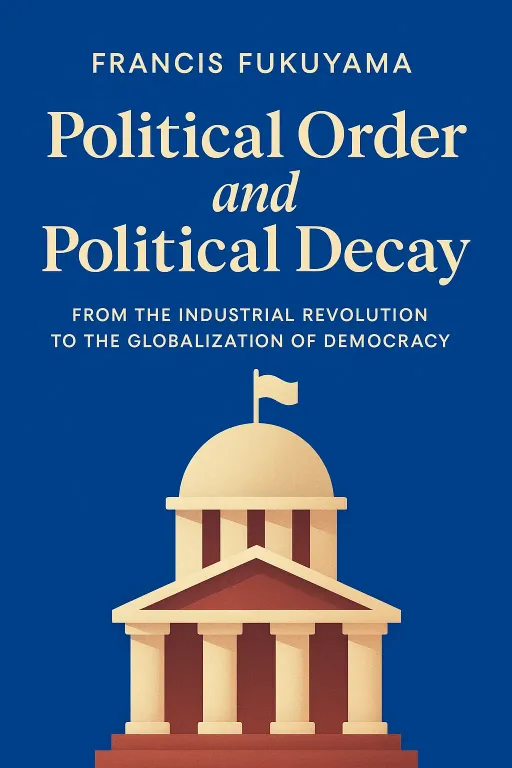
Nova: Exactly. And that brings us to the two thinkers we are exploring today, who approach this problem from completely different ends of the spectrum. We are looking at Francis Fukuyama’s Political Order and Political Decay, and Murray N. Rothbard’s For a New Liberty. Fukuyama is the political scientist who famously analyzed the rise and fall of states, while Rothbard is the economist who pushed for a radical, market-driven overhaul of society.
Atlas: I have always found it fascinating how these two sit together. Fukuyama is often seen as the measured academic observing the slow, grinding machinery of government, while Rothbard is the firebrand, the guy looking at the machine and asking why we don’t just dismantle it for parts. It is a perfect tension for anyone who feels stuck in a system that is no longer working.
Nova: That tension is exactly what we need to unpack. Fukuyama’s work is deeply rooted in his background as a scholar who spent decades studying why some nations thrive and others crumble. He points out that institutions are built to solve problems, but once the problem is solved, the institution doesn’t just disappear. It hardens. It grows claws. It starts to protect its own existence rather than serving the public.
Atlas: That makes perfect sense. I see that in every organization I have ever been part of. The department that was created to fix a crisis five years ago becomes the department that creates new crises just to justify their budget.
Nova: Precisely. And then you have Rothbard. He takes that observation and turns the dial to eleven. He argues that if a system has become inefficient or coercive, the solution is not to reform it, but to let the market solve the problem through individual liberty. He was a central figure in the Austrian School of economics, and his writing is relentless in its logic. He wants us to look at every single state-managed function and ask, could the market do this better?
Atlas: So, we have the analyst who explains why the decay happens, and the radical who suggests we should stop trying to fix the decay and start over. For our listeners who are navigating their own professional or personal lives, this is the ultimate toolkit for auditing their own reality.
The Anatomy of Institutional Decay
SECTION
Nova: Let’s start with that idea of decay. Fukuyama describes this process as institutional rigidity. Think of a startup. When you are two people in a garage, you have no rules. You communicate by yelling across a desk. That is efficient. But as you grow to twenty, then two hundred, then two thousand, you need rules. You need HR, legal, standardized reporting. These are necessary to keep the ship from sinking.
Atlas: I can see the necessity there. Without those rules, you get chaos.
Nova: Right. But the decay starts when those rules become the goal. Fukuyama talks about how institutions develop "veto players." These are individuals or departments that have the power to stop a decision but no responsibility for the outcome. Once you have enough veto players, you reach a state of paralysis. Nothing new can happen because someone, somewhere, has the power to say no, and they use that power to protect their own corner of the empire.
Atlas: That sounds exactly like the "middle management trap." I imagine a lot of our listeners are nodding along, thinking about that one person in their company who has to sign off on everything, yet has no idea what the project is actually about. How does Fukuyama suggest we identify if we are in that state?
Nova: He suggests we look at the gap between the original intent and the current output. If you ask, "Why do we do this?" and the answer is "Because that is the policy," or "Because we have always done it that way," you are looking at decay. The rule has become detached from the reality it was meant to govern.
Atlas: That is such a clear litmus test. I use that sometimes when I am reviewing our internal workflows. I will ask someone, "What happens if we delete this step?" And if the answer is, "Nothing happens, but we’d get in trouble with the compliance team," then I know that step is a legacy structure. It is not adding value; it is just adding weight.
Nova: And that is the danger. Fukuyama’s work shows that this isn't just a corporate problem; it is a civilizational one. When the state becomes too rigid, it loses the ability to respond to changing social realities. It becomes a fossil. The question for our listener—the Strategic Seeker—is to look at their own environment and ask, "Where am I acting as a veto player, or where am I being blocked by one?"
Atlas: That is a tough question to ask yourself. It is much easier to blame the system than to look at your own habits. But what if the system is so bloated that you cannot change it from the inside? That is where I feel the weight of Fukuyama’s analysis. If the decay is systemic, are we just rearranging deck chairs on the Titanic?
Nova: That is the pivotal moment where we need to bring in the perspective of Murray Rothbard. If Fukuyama is the doctor diagnosing the disease of institutional rigidity, Rothbard is the surgeon suggesting a radical amputation. He would argue that the paralysis you are describing is the inevitable result of centralizing power or process. He would say that the solution is to decentralize.
The Radical Alternative
SECTION
Atlas: Okay, but let’s be practical. If I work in a massive, regulated industry—let’s say healthcare or finance—I cannot just "decentralize." I cannot just opt out of compliance. How does Rothbard’s philosophy actually help someone who has to operate within the constraints of a rigid system?
Nova: You are right that you cannot snap your fingers and dismantle a government or a massive corporation. But you can adopt the mindset of a market-driven actor. Rothbard’s core argument in For a New Liberty is about the sovereignty of the individual. He suggests that we should constantly be asking, "Does this interaction create value, or does it merely extract it?"
Atlas: I like that distinction. Value creation versus value extraction.
Nova: Think about it. When you are stuck in a meeting that serves no purpose, you are witnessing value extraction. You are losing your time—your most precious resource—to support a structure that is not producing anything. Rothbard would encourage you to be a "market actor" in your own life. That means negotiating your boundaries, opting out of non-essential rituals, and finding ways to deliver results that bypass the bureaucratic friction.
Atlas: That is a powerful reframe. It changes the way you look at a meeting invite. Instead of seeing it as a mandatory obligation, you see it as a transaction. If the transaction has a negative return on investment, you have a moral right—or maybe even a duty—to decline it.
Nova: Exactly. Rothbard would argue that you are the owner of your own labor and your own time. When you let an inefficient system consume those things, you are essentially subsidizing the decay. You are keeping the zombie institution alive with your own life force.
Atlas: That is a bit harsh, but I see the logic. It is the difference between being a cog in the machine and being a free agent who happens to work within a machine. But does this not lead to friction? If I start acting like a free agent in a rigid, Fukuyama-style institution, I am going to get fired.
Nova: That is the risk. And this is where the two thinkers actually complement each other. Fukuyama teaches us to recognize the decay so we are not surprised by it. Rothbard teaches us to maintain our individual agency so we are not consumed by it. The goal is not to burn the building down; it is to ensure that you are not trapped in the basement when the fire starts.
Atlas: That makes sense. It is about cognitive resilience. You acknowledge the system, you understand its flaws, but you refuse to let those flaws define your internal reality. You maintain a "market" mindset where you focus on what you can control—your output, your decisions, your relationships—rather than wasting energy fighting the parts of the system that are calcified.
The Mindful Architect
SECTION
Nova: Let’s ground this for the listener. You are a Strategic Seeker. You want to align your daily output with your inner values. So, how do you audit your life using these two perspectives?
Atlas: I think it starts with an audit of "rules." I want to take a week and write down every single thing I do because "that is how we do it." Every report I write, every meeting I attend, every email I copy five people on. Then, I am going to apply the Fukuyama test: Is this rule serving a real purpose, or is it just a legacy structure?
Nova: And then apply the Rothbard test: If this were a free market, would I pay for this service? If I were a consultant charging for this meeting, would the client pay me for the value provided? If the answer is no, you have identified a piece of institutional decay.
Atlas: That is a brilliant way to put it. If I were a consultant, would the client pay for this? Most of the time, the answer would be a resounding no. It is a waste of time. And the beauty of this approach is that it is not about being rebellious or difficult. It is about being efficient. It is about being a "Mindful Architect" of your own life.
Nova: Yes. And remember, decay isn't about bad people. Fukuyama makes this clear. It is about good people doing things that made sense in a different context. The people who created that report you hate? They probably did it to solve a genuine problem five years ago. They aren't villains. They are just ghosts. You are being haunted by the solutions of the past.
Atlas: I love that. "Haunted by the solutions of the past." That is exactly what institutional decay feels like. It is a haunting. We are living in a house built by people who didn't know we were moving in.
Nova: So, the action item here is simple but profound. Commit to a thirty-minute block daily. Use that time to prune. Not to add, not to accumulate, but to prune. Look at your processes, your habits, your communication styles. Ask yourself, "Is this a necessary structure, or is this a legacy decay?"
Atlas: And if it is decay, you have to be brave enough to stop doing it. You have to be willing to bear the cost of being slightly less "compliant" in exchange for being significantly more effective. That is the essence of influence dynamics, isn't it? Being able to navigate the friction without losing your direction.
Nova: It is. And it is also the essence of cognitive resilience. When you stop trying to justify the inefficiency, you stop feeling the burnout that comes from carrying it. You reclaim your focus.
Synthesis & Takeaways
SECTION
Atlas: This has been a really helpful way to connect these two very different thinkers. I feel like I have a clearer lens now. I can look at my organization and see the "veto players" and the "legacy structures" that Fukuyama warned about, and I have the "market-actor" mindset from Rothbard to protect my own time and energy.
Nova: That is the goal. You are not just a passive observer of the system anymore. You are an active participant, capable of distinguishing between the architecture that supports you and the cage that constrains you.
Atlas: I think the biggest takeaway for me is that we are all architects. Whether we realize it or not, we are constantly building the systems we live in. The question is whether we are building for the current reality or just repairing the ruins of the past.
Nova: That is perfectly stated. We are building the future, one decision at a time. If we want that future to be efficient, creative, and vibrant, we have to be willing to let the old structures fall away.
Atlas: I’m going to start my audit tomorrow morning. I think I have a few "legacy" meetings to cut from my calendar.
Nova: That sounds like a perfect place to start. Remember, progress is your only true metric. Don't worry about being perfect; just focus on being a little more intentional than you were yesterday.
Atlas: I love that. It is all about the daily, incremental pruning. Thank you for walking through this with me. This really helps clarify how to navigate the complexity of modern life without getting lost in the machinery.
Nova: It was my pleasure. It is always a joy to dissect these ideas and see how they can actually change the way we live our days. To our listeners, take that thirty-minute block. Look at your systems. Prune what doesn't belong. You will be surprised by how much room you have to grow once you clear out the decay.
Atlas: We hope this episode helps you see the rules in your life for what they really are. Until next time, keep questioning the structures.
Nova: This is Aibrary. Congratulations on your growth!