

The Strategic Orchestrator's Guide: Unifying Your Diverse Business Visions
Golden Hook & Introduction
SECTION
Nova: Juggling multiple successful businesses isn't a badge of honor; it's often a silent confession of strategic fragmentation. The more you 'succeed' in silos, the more you might actually be undermining your true, unified potential.
Atlas: Whoa, Nova, that's a bold way to kick things off! For anyone out there running a portfolio of ventures, or even just multiple complex projects, that hits right at the heart of it. It’s not just about keeping the balls in the air, but making sure they’re all flying in the same direction, right?
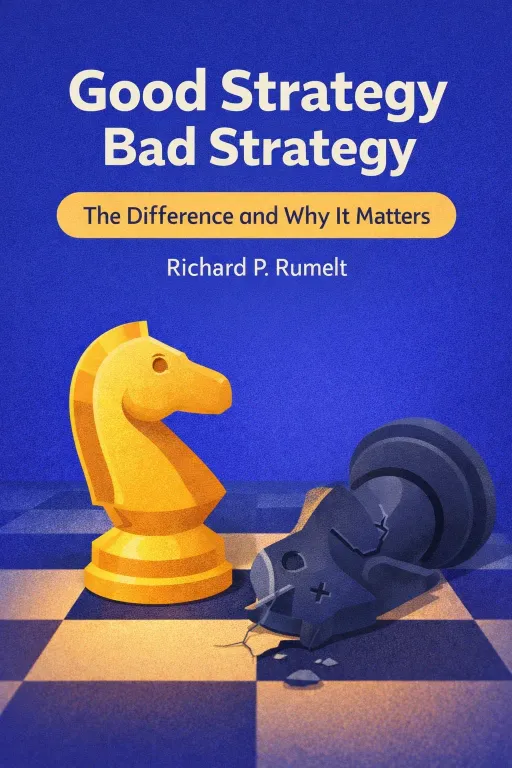
Nova: Exactly, Atlas. We’re talking about moving beyond mere management to strategic orchestration. And to truly master that, we need to lean on some titans of strategic thought. First up, the legendary Richard Rumelt, author of "Good Strategy/Bad Strategy." He’s often called the 'strategist's strategist' for his uncanny ability to cut through corporate jargon and reveal the fundamental truths of effective strategy.
Atlas: And then we pair that with the practical brilliance of A. G. Lafley and Roger L. Martin, who gave us "Playing to Win." Lafley, of course, famously turned around Procter & Gamble by applying these very principles, proving that these aren't just academic theories, but battle-tested blueprints for success.
Nova: Absolutely. And when you bring these two perspectives together, you get a powerful lens for unifying your diverse business visions, ensuring each part strengthens the whole. So, let’s start with Rumelt and unpack what makes a strategy truly.
The Anatomy of Good Strategy & Avoiding Fragmentation
SECTION
Nova: Rumelt argues that every good strategy has what he calls a 'kernel.' It’s made up of three essential parts: a diagnosis, a guiding policy, and coherent actions. Think of it like a doctor treating an illness. First, they diagnose the problem. Then, they decide on a guiding policy – say, 'reduce inflammation.' Finally, they prescribe coherent actions – medication, diet changes, rest – all aligned with that policy.
Atlas: That makes sense. But doesn’t that just sound like common sense? I mean, who diagnose a problem before acting? What’s the real trap here, especially for leaders juggling, say, four or five different companies or major initiatives?
Nova: That's where 'bad strategy' creeps in, Atlas. It often looks like strategy, but it's not. Common pitfalls include mistaking goals for strategy – 'we want to grow revenue by 20%' isn't a strategy, it’s a goal. Or using vague, fluffy language that sounds profound but means nothing. Or, crucially for multi-venture leaders, having a jumble of disjointed initiatives that don't.
Atlas: Oh, I know that feeling. It’s like you have five different teams, all running hard, all hitting their individual targets, but when you step back, they’re all pulling in slightly different directions, or even worse, tripping over each other.
Nova: Precisely. Let's imagine a leader, we'll call her Sarah, who oversees a portfolio of three distinct tech ventures: one in AI, one in sustainable energy, and one in digital education. On paper, each venture is moderately successful, hitting its own metrics. But because Sarah’s overarching 'strategy' for the portfolio is a vague 'innovate and grow,' there's no clear diagnosis of the unique challenges or opportunities. The AI venture is building its own data infrastructure, the energy venture is trying to recruit top AI talent independently, and the education platform is exploring its own data analytics.
Atlas: So, they're all operating in their own little universes.
Nova: Exactly. The guiding policy is missing for the. And the actions – the hiring, the tech development, the market approaches – are not coherent across the portfolio. The outcome? Wasted resources, duplicated efforts, and a diluted brand presence. They're successful in silos, but the overall enterprise isn’t realizing its full potential because of this strategic fragmentation.
Atlas: Wow, that’s kind of heartbreaking. It sounds like the solution isn’t simply more control, or even just better individual strategies, but something deeper, a true orchestration. Is it about making them all do the thing, then?
Nova: Not at all. It's about ensuring they work in concert. A good strategy acknowledges the inherent complexity and then provides a clear path through it. Rumelt's kernel gives us the framework to the collective challenges, articulate a for the entire portfolio, and then ensure across all units. This isn't about micromanagement; it's about creating a unified strategic narrative.
Defining 'Where to Play' and 'How to Win' for Cohesive Growth
SECTION
Nova: And that naturally leads us to the second key idea we need to talk about, which often acts as the engine for those coherent actions: Lafley and Martin's concept of 'where to play' and 'how to win.' A good strategy needs clear choices.
Atlas: Okay, so 'where to play' and 'how to win.' With five different ventures, isn't 'where to play' just... everywhere? And 'how to win' simply 'be better'? How do you make that specific unifying, without stifling individual innovation?
Nova: That’s the critical question, Atlas. 'Where to play' isn't just about market size; it's about specific segments, customer needs, geographic areas, or even specific value chains where you choose to compete. And 'how to win' is about your unique competitive advantage in that chosen space – is it cost, innovation, customer intimacy, speed? It has to be specific.
Atlas: So, for our leader Sarah from before, with her AI, energy, and education ventures, how does she apply this to create synergy, not just individual success?
Nova: Let’s take Sarah’s portfolio. Instead of just ‘innovate and grow,’ her strategic narrative might be: 'To empower human potential through intelligent, sustainable solutions.' Now, for each venture, she applies ‘where to play’ and ‘how to win’ but.
Nova: Her AI venture might ‘play’ in developing ethical, explainable AI for complex data analysis in industrial settings, winning by superior accuracy and transparency. Her sustainable energy venture might ‘play’ in providing decentralized, community-based renewable solutions, winning by hyper-local integration and affordability. And her digital education platform might ‘play’ in personalized upskilling for the green economy, winning by adaptive learning paths and industry-recognized certifications.
Atlas: Oh, I like that. Suddenly, they’re not just three separate businesses. They're all contributing to ‘empowering human potential through intelligent, sustainable solutions.’ The AI provides the ‘intelligent,’ the energy provides the ‘sustainable,’ and the education provides the ‘human potential.’ It’s an ecosystem!
Nova: Exactly! Each venture has its own distinct ‘where to play’ and ‘how to win,’ ensuring it’s competitive in its niche. But these choices are designed to create powerful interdependencies and shared capabilities across the portfolio. The AI venture's data insights might inform the energy venture's predictive maintenance, which in turn creates course material for the education platform.
Atlas: That’s a great example. It suddenly makes the whole greater than the sum of its parts. So, for our listeners who are juggling multiple plates right now, what’s a tiny step they can take to start applying this today?
Nova: Here’s your tiny step: choose just one of your ventures. Clearly articulate its ‘where to play’ and ‘how to win’ statement in one concise sentence. Then, step back and see how that specific choice aligns with your overarching, bigger-picture vision for your entire enterprise. Does it strengthen the narrative? Or does it pull it in a different direction?
Synthesis & Takeaways
SECTION
Nova: Ultimately, strategic orchestration isn't about stifling individual units; it's about empowering them to contribute to a larger, more powerful story. It's about understanding Rumelt's kernel to build a robust foundation, and then using Lafley and Martin's framework to make precise choices that create a cohesive, synergistic whole. The impact of a truly unified strategic narrative is exponential, far beyond what siloed successes can achieve.
Atlas: That’s actually really inspiring. It’s not just about managing complexity, but about transforming it into an advantage. It’s about building a symphony where every instrument has its unique part, but together, they create a masterpiece. And that tiny step you mentioned? That’s something you can do right now, even if you only have one hour this week for unstructured creative thinking. Trust your intuition, as our user profile suggests, and see where that connection takes you.
Nova: Absolutely. Take that one venture, define its unique contribution, and then see how it locks into the grand vision. That simple act of strategic alignment can unlock incredible efficiency and growth.
Atlas: That’s a powerful thought to leave with.
Nova: This is Aibrary. Congratulations on your growth!