

Strategy is Not a Plan: It's an Evolving Commitment.
Golden Hook & Introduction
SECTION
Nova: Most strategic plans are dead on arrival. They’re elaborate documents gathering dust, not living maps. What if the very act of "planning" your strategy is what's holding your business back?
Atlas: Whoa, Nova. That's quite a statement. Are you saying we should just... wing it? Because for a lot of leaders out there trying to build something sustainable, that sounds like a recipe for chaos, not success.
Nova: Not at all, Atlas! It’s precisely the opposite. I'm saying we need to redefine what strategy. We’re conditioned to think of strategy as this fixed blueprint, something you set once a year and then execute. But the world moves too fast for that. True strategy is a dynamic process, an evolving commitment, a cohesive response to challenges as they unfold, not just a static list of goals.
Atlas: So, it’s less about predicting the future with perfect accuracy, and more about navigating it with agility?
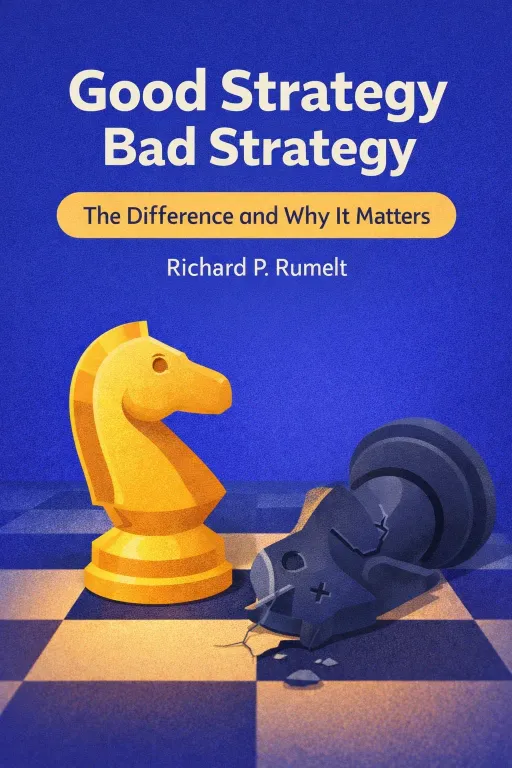
Nova: Exactly! And this isn't just my take. We're drawing on the groundbreaking work of brilliant minds like Richard Rumelt, whose book "Good Strategy/Bad Strategy" fundamentally changed how we talk about this, and A. G. Lafley and Roger L. Martin, with their influential "Playing to Win." These aren't just academics; these are people who've been in the trenches, revolutionizing how companies actually define and execute strategy effectively. They shifted the conversation from abstract theories to actionable frameworks.
Atlas: Right, so they're not just giving us theory, they're giving us a roadmap for navigating the world.
Nova: Precisely. And to truly grasp what good strategy is, we first need to shine a light on its shadow: bad strategy.
The Myth of Static Strategic Planning & Rumelt's 'Bad Strategy'
SECTION
Nova: Think about it, Atlas. Many leaders, often under immense pressure, confuse strategic planning with creating a rigid, often verbose document. It’s like they feel they need to produce a thick binder to prove they’ve thought strategically. But as Rumelt argues, bad strategy is often fluffy, full of buzzwords, and crucially, it.
Atlas: Fluffy? You mean like, "Our strategy is to leverage synergies for unparalleled stakeholder value in an agile, disruptive ecosystem"?
Nova: You're hired! That's a perfect example. It sounds impressive, but what does it actually for the people on the ground? What specific problem are you solving? What specific actions are you taking? Bad strategy often fails to identify a clear diagnosis. It's like a doctor prescribing medicine without first understanding the illness.
Atlas: I imagine a lot of our listeners, especially those in fast-paced environments, have sat through meetings where these kinds of vague "strategies" are unveiled. It feels like a performance, not a plan that anyone can actually execute.
Nova: It absolutely is. I remember a case study about a large tech company that, for years, kept announcing its "strategy to be the market leader in innovation." Everyone cheered, but then they'd just sprinkle money across a hundred different projects without any clear guiding policy. There was no real diagnosis of they weren't innovating effectively, no specific policy to address that, and certainly no coherent actions. The result? They bled talent, wasted billions, and ultimately lost significant market share to nimbler competitors.
Atlas: That sounds rough, but it makes so much sense. The "cold fact" you mentioned earlier really hits home here: true strategy is a cohesive response to challenges. If you haven't even identified the challenge clearly, how can you possibly respond cohesively?
Nova: Exactly. Bad strategy avoids making tough choices. It tries to please everyone by being everything to everyone. But strategy, by its very nature, choice. It demands focus. It demands saying "no" to a lot of good ideas so you can say a resounding "yes" to the few great ones that truly move you forward. It's about understanding your constraints and figuring out how to work within or around them.
Atlas: So, it’s almost like a performance, not a plan that anyone can actually execute. You're saying leaders often fall into this trap because there's pressure to decisive, even if the substance isn't there?
Nova: Precisely. There’s a comfort in ambiguity for some, or perhaps a fear of alienating stakeholders by making a definitive stand. But that comfort is a mirage. It leads to paralysis, wasted resources, and ultimately, a lack of progress. The teams are left guessing, pulling in different directions, without a clear North Star. It undermines the very goal of building sustainable systems and empowering teams.
Atlas: That makes me wonder, then, if bad strategy is so pervasive, what does strategy actually look like? How do we move beyond the fluff and into something truly effective?
Strategy as Dynamic Choices and Coherent Action & Lafley/Martin's 'Playing to Win'
SECTION
Nova: That’s the critical question, Atlas. If bad strategy is about avoiding tough choices, good strategy is fundamentally about them. It’s not about predicting the future; it's about making smart choices today that create a defensible position for tomorrow. Rumelt gives us the "kernel" of good strategy: first, a of the challenge; second, a to address that challenge; and third, that align to that policy.
Atlas: Diagnosis, guiding policy, coherent actions... that sounds like a framework a "Resilient Builder" or "Empowering Leader" could really use. Can you break that down with an example for someone trying to get a competitive edge?
Nova: Absolutely. Let's take a small, local coffee shop. Their might be: "We're in a highly competitive market, surrounded by big chains, and our current customer base is dwindling because we lack a unique selling proposition." Their isn't just "make good coffee." It's "become the go-to spot for ethically sourced, artisanal single-origin coffees, providing a curated, educational experience for connoisseurs." That's a specific choice. And then, their would be: sourcing beans directly, investing in specialized brewing equipment, training baristas as educators, hosting tasting events, designing the space for intimate conversations, and perhaps even offering workshops. Every single action aligns with that guiding policy.
Atlas: I see. So the guiding policy isn't just a mission statement; it's a commitment to a specific path that informs every decision. That clarity must be incredibly empowering for the team, right? Everyone knows their role in achieving that specific vision.
Nova: Precisely. And this leads us beautifully to A. G. Lafley and Roger L. Martin's "Playing to Win" framework, which complements Rumelt's ideas perfectly. They argue that strategy is a set of integrated choices about and. It's about designing a unique position that allows you to outperform your rivals.
Atlas: "Where to play and how to win." That sounds incredibly direct. But "tough choices"... that's where the rubber meets the road for leaders. How do these integrated choices lead to a 'sustainable advantage' rather than just short-term gains?
Nova: Because these choices aren't isolated. They're deeply intertwined. "Where to play" involves defining the specific markets, customer segments, product categories, and geographic locations where you'll compete. "How to win" is about creating a unique value proposition and configuring your activities to deliver that value better than anyone else. Think of a company like Procter & Gamble, which Lafley led. They made tough choices to divest from categories where they couldn't realistically win, even if those categories were profitable. They focused on areas like diapers and detergents, deeply understanding those markets, and then systematically built superior brands, distribution, and innovation capabilities.
Atlas: So, they weren't trying to be great at everything. They identified where they had the best shot at being, and then poured all their resources into dominating those specific areas. That clarity in "where to play" and "how to win" must empower the entire team, rather than leaving them guessing or spread thin across too many initiatives.
Nova: Absolutely. It creates focus, alignment, and a clear understanding of what success looks like. It transforms strategy from a vague aspiration into a series of actionable, integrated choices that build a defensible position over time. It’s about building those sustainable systems that your user profile values so much, Atlas. It's about making deliberate, often difficult, choices that accumulate into a dominant position.
Atlas: That’s actually really inspiring. It shifts strategy from this overwhelming, almost mystical exercise to a series of concrete, interconnected decisions. It makes it feel like something you can actually, day in and day out, not just a document you file away.
Synthesis & Takeaways
SECTION
Nova: And that, Atlas, is the core insight. Strategy isn’t a one-time event; it’s an ongoing, evolving commitment. It’s a continuous cycle of diagnosing challenges, formulating guiding policies, and executing coherent actions, all while making integrated choices about where and how to win. It requires constant engagement and adaptation because the world around us never stops changing.
Atlas: So, for our listeners who are ready to shift from static plans to dynamic commitment, especially those who are "Resilient Builders" and "Empowering Leaders" focused on growth, what's one immediate, tiny step they can take right now to begin this transformation?
Nova: The tiny step is powerful in its simplicity: Articulate the core challenge your business faces right now. Not a generic challenge, but specific, most pressing one. Then, outline a single guiding policy to address it. Just one. This forces clarity and focus from the outset.
Atlas: That's brilliant. It's about starting small, but starting with genuine strategic intent. It's building that foundational piece before trying to construct the whole skyscraper.
Nova: Exactly. It's about trusting your inner wisdom, recognizing that you have the answers within, and then acting on them with clarity and commitment. Celebrate that small win of articulating a clear challenge and guiding policy, because that's the true beginning of an evolving, impactful strategy.
Atlas: That’s a hopeful way to look at it. Thank you, Nova. This has been incredibly insightful.
Nova: My pleasure, Atlas. This is Aibrary. Congratulations on your growth!