

Strategy is a Story: Why Great Plans Start with a Compelling Narrative.
Golden Hook & Introduction
SECTION
Nova: Most of what you call 'strategy' isn't really strategy at all. It's just a wish list, a set of vague aspirations, and frankly, a recipe for failure.
Atlas: Oh, I know that feeling! It’s like saying, “My strategy is to be rich and happy.” Great goal, terrible plan. Especially when you’re trying to build something as complex as a self-optimizing Agent system. You can’t just it into existence.
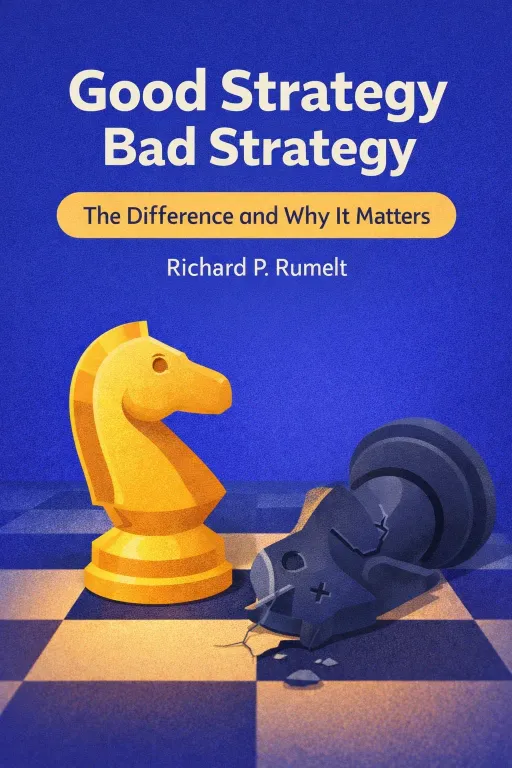
Nova: Exactly! And that's why today, we're dissecting a foundational text that cuts through all that fluff: by the brilliant Richard Rumelt.
Atlas: Rumelt, a long-time professor and consultant, became renowned for his blunt assessment of why so many corporate strategies fail. He saw firsthand the chaos caused by vague objectives and realized we needed a much clearer framework. It wasn't just theory for him; it was observed reality.
Nova: Absolutely. His work, especially his earlier book, "Good Strategy/Bad Strategy," is widely regarded as a seminal piece that fundamentally shifted how we even define strategy. He basically said, "Stop dreaming, start thinking."
Atlas: So, he’s the guy who tells us to put down the rose-tinted glasses and face the music. That sounds like something every architect or engineer trying to push the boundaries of Agent tech needs to hear. Because in our world, a fluffy strategy doesn't just fail; it wastes compute cycles, developer hours, and potentially, entire business opportunities.
Nova: Precisely. And that leads us to our first deep dive: why so many so-called 'strategies' are doomed from the start.
Beyond the Wish List: Why Most 'Strategies' Fail
SECTION
Nova: Rumelt's core argument is that bad strategy isn't just ineffective; it's prevalent. He identifies four hallmarks. The first is "fluff." This is jargon-filled, abstract language that sounds profound but means nothing. Think mission statements like, "We will be the leading innovator in synergistic, future-proof solutions."
Atlas: Oh, I’ve seen entire project charters written like that! It’s like trying to navigate a dense fog – you feel like you’re moving, but you have no idea where you’re going, or if you’re even going in the right direction. How does that manifest in an Agent system context?
Nova: In Agent systems, it might be a strategy that says, "Our Agent will achieve optimal intelligence through advanced self-learning paradigms." Sounds great! But what’s optimal? What specific self-learning paradigms? Without that clarity, your engineers are left guessing, building in circles.
Atlas: That makes sense. It’s not just about sounding smart, it’s about being actionable. What’s the next hallmark of bad strategy?
Nova: The second is a "failure to face the problem." Bad strategy often skips directly to goals without acknowledging the actual challenges. It's like a doctor saying, "My strategy is to make you healthy," without first diagnosing your illness. You can't solve a problem you haven't clearly defined.
Atlas: So, are you saying that simply having a vision isn't enough for an Agent system? What does 'facing the problem' truly mean in a complex, distributed Agent environment? Because sometimes the problem itself is distributed and amorphous.
Nova: It means going beyond "users want X." It means diagnosing users want X, what current limitations prevent X, what the system's current bottlenecks are, or what competitive pressures exist. For an Agent system, a bad strategy might be "Our Agent will automate customer support." A good diagnosis would be: "Our customer support agents are overwhelmed by repetitive queries, leading to 40% burnout, and our existing chatbot only resolves 10% of issues due to a lack of contextual understanding and reasoning capabilities." That's a problem you can actually.
Atlas: Wow, that’s a crucial distinction. It’s not just about identifying a need, but understanding the of the problem preventing that need from being met. Otherwise, you’re just throwing technology at symptoms.
Nova: Precisely. The third hallmark is "mistaking goals for strategy." A goal is an objective, but it’s not the plan to achieve it. "We will increase market share by 20%" is a goal. It says nothing about.
Atlas: So, "Our Agent will outperform all competitors in task completion" is a goal, not a strategy. It sounds ambitious, but it leaves all the critical 'how-to' questions unanswered for the team building it.
Nova: Exactly. And the fourth, which ties into the others, is "bad strategic objectives." These are objectives that are either impossible, incoherent, or simply don't address the problem. An example might be, "We will simultaneously reduce costs by 50% and double product features with the same team." That’s incoherent.
Atlas: That sounds rough, but it's a reality check. I imagine a lot of our listeners, especially those in high-pressure tech environments, have seen projects struggle because the underlying "strategy" was really just a collection of hopes and dreams. It makes you wonder, if this is bad strategy, what does strategy actually look like?
The Strategic Kernel: Building Coherent Action Plans for Agent Systems
SECTION
Nova: So if that's bad strategy, what does strategy actually look like? Rumelt gives us a powerful framework he calls "the kernel." It has three essential components.
Atlas: Okay, so a kernel. Like the core, the essential seed. I like that. What's the first part?
Nova: The first part is a. This is the critical step we just touched on. A good diagnosis defines the nature of the challenge. It explains why the situation is difficult, identifies the critical issues, and simplifies the complexity. It's like a doctor's diagnosis – you can't treat it if you don't understand what's wrong. For an Agent system, this might be diagnosing that your current LLM-based Agent frequently hallucinates or struggles with multi-step reasoning, leading to unreliable outputs in critical business processes.
Atlas: That makes sense. It’s about stripping away the noise to find the actual pain point. So, once you have that clear diagnosis, what’s next in the kernel?
Nova: That leads to the second component: a. This is the overall approach chosen to overcome the obstacles identified in the diagnosis. It’s not a specific action, but a principle that steers your decisions, sets boundaries, and guides resource allocation. Think of it as the overarching logic. For our Agent system diagnosis of hallucination and multi-step reasoning failures, a guiding policy might be: "We will prioritize Agent reliability through a multi-agent orchestration architecture and rigorous, human-in-the-loop validation, even if it initially slows down deployment."
Atlas: That’s a fundamentally different approach than just saying "make the Agent smarter." It sets a clear philosophical direction. So it’s less about you're doing, and more about you're going to approach the problem?
Nova: Exactly. It's the "how to think about solving this" part. And this is where Lafley and Martin's "Playing to Win" adds another layer of depth. They talk about "Where to Play" and "How to Win." Your guiding policy directly informs these choices. "Where to Play" helps you define the arena – which specific problems, user segments, or technical domains your Agent will focus on. "How to Win" clarifies your competitive advantage – how your Agent will be uniquely superior or more effective within that arena, which is essentially your guiding policy in action.
Atlas: So, for an architect deciding between different Agent orchestration frameworks, "where to play" might mean focusing on internal enterprise automation versus external customer-facing Agents, and "how to win" might involve a guiding policy of "optimizing for explainability and auditability" due to regulatory concerns.
Nova: Precisely! Now, the final component of the kernel is. These are specific, coordinated steps designed to implement the guiding policy. They are the concrete tasks, the code sprints, the deployment pipelines, the tooling choices. They are actions that are consistent with each other and directly support the guiding policy. If your guiding policy is "prioritize reliability through multi-agent orchestration and human-in-the-loop validation," then your coherent actions might include: developing modular Agent components, implementing specific validation protocols, designing intuitive human oversight dashboards, and investing in advanced monitoring tools.
Atlas: That’s a perfect example. It's not just a list of tasks; it’s a list of tasks that are all pulling in the same direction, guided by that core policy. It makes the entire strategy feel like a story, with a clear plot.
Nova: And that's exactly what Rumelt means by "Strategy is a Story." It’s a compelling narrative of how you will overcome a challenge. It gives purpose and direction to every action.
Synthesis & Takeaways
SECTION
Nova: So, what we've really explored today is the profound difference between a mere wish list and a true strategy. A good strategy, as Rumelt highlights, isn't about grand aspirations; it's about a sharp diagnosis, a principled guiding policy, and a set of coherent, integrated actions that tell a clear story of how you're going to tackle a specific, diagnosed challenge.
Atlas: That’s going to resonate with anyone who’s ever been handed a vague directive and told to "make it happen" in a complex system. It’s not just about delivering a feature; it’s about understanding the and the on a foundational level, especially in Agent engineering where complexity can easily lead to strategic drift.
Nova: Absolutely. And this isn't just academic; it's about making your Agent systems, your projects, and your career more effective. It transforms you from someone merely executing tasks into a true architect and value creator, someone who can articulate a clear, actionable vision.
Atlas: So, for our listeners, especially those building Agent systems, the real challenge is to take your current Agent project's goal. Can you clearly articulate the diagnosis of the challenge, your guiding policy, and the coherent actions you'll take? Can you tell that story in a way that everyone understands and can rally behind?
Nova: It's a tiny step, but a powerful one. If you can answer those questions with clarity, you're not just building a system; you're crafting a strategic narrative that will lead to breakthrough results.
Atlas: What an insightful journey into the heart of effective strategy. Thank you, Nova.
Nova: And thank you, Atlas. This is Aibrary. Congratulations on your growth!