

Stop Guessing, Start Predicting: The Guide to Anticipating Market Shifts.
Golden Hook & Introduction
SECTION
Nova: Forget everything you think you know about "vision statements" and "mission control." Most of what passes for strategy today is just wishful thinking in a fancy PowerPoint.
Atlas: Oh, I know that feeling! It’s like, you sit through these long meetings, everyone nods, and then… nothing really changes. The "strategy" ends up being a list of things we will happen, not a plan for them happen.
Nova: Exactly! And that’s why we’re diving into a crucial shift today: moving from just reacting to the market to proactively shaping it. We’re talking about "Stop Guessing, Start Predicting: The Guide to Anticipating Market Shifts."
Atlas: That title alone speaks to anyone who’s ever felt like they’re constantly playing catch-up.
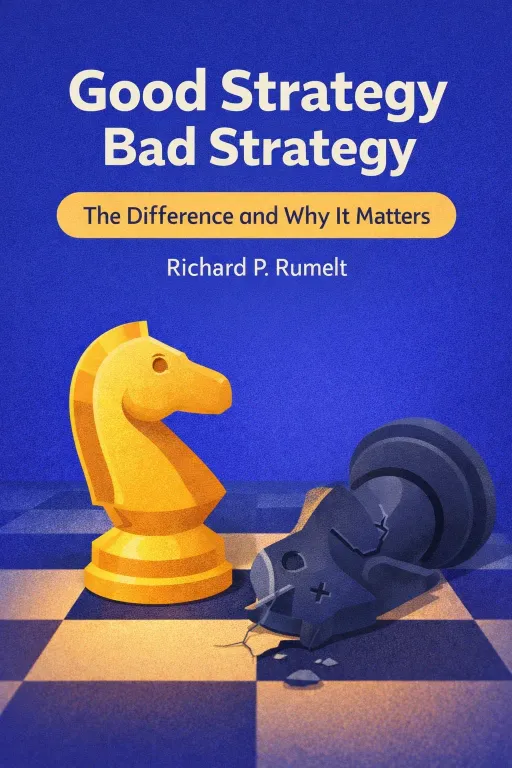
Nova: Absolutely. And to cut through that fluff, we’re tapping into the minds of two strategic giants: Richard Rumelt, with his groundbreaking work on "Good Strategy/Bad Strategy," and A. G. Lafley and Roger L. Martin, authors of the influential "Playing to Win." These aren't just academics; these are the architects of how winning companies actually think and act.
Atlas: I can see how that would be valuable. For our listeners who are managing high-pressure teams, or trying to stay ahead in their industry, the idea of "true leadership" coming from anticipating trends is huge. But where do we even begin? Why do so many strategies fail in the first place?
Nova: That’s the perfect question, Atlas, because it brings us directly to Rumelt’s core insight. He argues that bad strategy isn't just about having the wrong plan; it's often about not having a strategy at all. It confuses ambition with actual plans.
Diagnosing the Strategic Challenge: The Rumelt Approach
SECTION
Nova: Rumelt’s framework for good strategy has three parts: first, a of the challenge. Second, a to address that challenge. And third, a set of that implement the policy. Bad strategy, on the other hand, often skips the diagnosis, makes vague goals, and then just hopes for the best.
Atlas: That makes sense, but what does a "diagnosis" actually look like in the real world? It sounds like you could spend forever analyzing, and for someone trying to move quickly in a fast-moving market, that could feel paralyzing.
Nova: That’s a common pitfall, but a good diagnosis isn't about endless analysis; it’s about identifying the challenge, not just listing symptoms. Think of it like a doctor. If you walk in with a cough, a bad doctor might just give you cough syrup. A good doctor diagnoses the – is it allergies? A virus? Something more serious?
Atlas: Right, like treating the fever instead of the infection.
Nova: Precisely. Let me give you an example that many of our listeners will recognize. Think about Blockbuster. Their "strategy" in the early 2000s essentially boiled down to "becoming the leading entertainment provider." Sounds great, right? But what was their diagnosis? Where was the guiding policy?
Atlas: I mean, they had stores everywhere! They were the king.
Nova: They were, for a time. But their diagnosis was missing the critical challenge: changing consumer habits and the rise of digital distribution. Their "guiding policy" was basically to open more stores and charge late fees, which was actively customers.
Atlas: Wow. So their actions were coherent with their strategy, but not with the reality of the market.
Nova: Exactly! Now, contrast that with a nascent company at the time, Netflix. Their diagnosis was clear: customers hated late fees, and they wanted more selection delivered conveniently. Their guiding policy? A subscription model with mail-order DVDs, then streaming. Their coherent actions? Building a massive DVD library, investing in recommendation algorithms, and eventually, pioneering streaming technology. They didn't just to Blockbuster; they a fundamental shift and built a strategy to meet it.
Atlas: That’s a perfect example. They didn't just say, "we want to be the best video rental company." They diagnosed the pain points. So, how do you you’ve got the diagnosis? It sounds like a critical step that many leaders might gloss over.
Nova: It requires deep, honest engagement with the problem, often stepping back from the day-to-day. It’s about asking things are happening, not just is happening. And once you have that diagnosis, the guiding policy isn’t a list of goals; it’s a framework for how you’re going to overcome that specific challenge. It's like navigating a ship – you need to know not just where you want to go, but also the specific currents and obstacles you need to contend with.
Making Integrated Choices: The Playing to Win Framework
SECTION
Nova: So, once you've diagnosed the challenge, how do you actually? This is where Lafley and Martin's "Playing to Win" framework comes in, shifting from diagnosis to decisive action. They argue that strategy is a set of integrated choices: "Where will you play?" and "How will you win?"
Atlas: I’ve heard those terms before, but what does "integrated choices" really mean? It sounds a bit abstract for someone who wants to apply concrete skills.
Nova: It’s surprisingly concrete, Atlas. It means your choices aren't isolated; they reinforce each other. "Where to play" defines the specific markets, customer segments, product categories, or geographies where you will compete. "How to win" defines the unique value proposition and the capabilities you’ll build to succeed in those chosen areas. The power comes from their integration.
Atlas: So it's not just about picking a market, but also figuring out how you’ll actually beat the competition there?
Nova: Precisely. Let’s look at Procter & Gamble under A. G. Lafley. When he took over, P&G was a sprawling conglomerate trying to be good at everything. Lafley's diagnosis was that they were spread too thin. His "where to play" choice was specific: focus on specific, high-potential categories like beauty, health, and fabric care. He decided to exit many other businesses.
Atlas: That sounds like a huge gamble. What if you choose the wrong "where to play"?
Nova: It’s not a gamble if it’s backed by a clear "how to win." For P&G, their "how to win" in those chosen categories was relentless consumer understanding, superior product innovation, and powerful branding. They built specific capabilities—like advanced R&D for detergents or deep market research for beauty products—that were tailored to chosen battlegrounds. They weren't just guessing; they were building a future where they could dominate in specific areas.
Atlas: Okay, so by making those clear choices, they weren't just to market shifts, but actually their own winning space. That clarifies the "anticipating" part.
Nova: Exactly! You're not just predicting the future; you're actively building a future where your chosen strategy thrives. It's about creating competitive advantage that future needs. If you choose to play in a nascent market, and you build unique capabilities to win there, you can actually that market.
Atlas: That’s actually really inspiring. It’s about being proactive, not just predictive. But what if the market shifts again? How do these "integrated choices" remain relevant?
Nova: That's where the "integrated" part is key. Your capabilities and management systems must be dynamic. It's not a static plan, but a dynamic, integrated system of choices that evolve with market shifts. Lafley and Martin emphasize continuous learning and adapting your capabilities. It's about building an organization that can to predict and adapt, not just execute a single plan.
Synthesis & Takeaways
SECTION
Nova: Ultimately, these two books, "Good Strategy/Bad Strategy" and "Playing to Win," show us that anticipating market shifts isn't some crystal ball exercise. It's disciplined thinking. First, you diagnose the true challenge, cutting through the fluff and ambition. And then, you make integrated, deliberate choices about where and how you will win, aligning your entire organization to those choices.
Atlas: So, it's about moving from that vague "we need to innovate" to "here's the specific problem we're solving, and here's exactly how we're going to win in specific space." It's about moving from reacting to really shaping the future. It gives concrete skills to those who want direct impact.
Nova: That’s the profound insight. Bad strategy is often just a list of ambitions or a jumble of goals. Good strategy is a coherent set of actions based on a deep diagnosis and clear, integrated choices. The impact? Instead of guessing, you're building the future you want to predict. You're moving from a reactive stance to a proactive, strategic posture.
Atlas: For our future-focused listeners, that’s incredibly valuable. So, what’s one tiny step someone can take today to apply this?
Nova: Pick one current business challenge you're facing. Don't jump to solutions. First, apply Rumelt's diagnosis framework: what's the here, truly? Not just the symptoms. Then, draft a clear, guiding policy for it. That tiny step can transform your entire approach to problem-solving and strategic thinking.
Atlas: That’s a practical, actionable step that can make a real difference. Thanks, Nova.
Nova: My pleasure, Atlas.
Nova: This is Aibrary. Congratulations on your growth!