

Stop Guessing, Start Leading: The Guide to Strategic Alignment & Execution.
Golden Hook & Introduction
SECTION
Nova: What if I told you that most of what we call "strategy" in our boardrooms and team meetings is actually just… wishful thinking in a PowerPoint?
Atlas: Oh, that's a bold claim, Nova! I can already hear the collective gasp from leaders who’ve spent countless hours crafting those very PowerPoints. But honestly, it resonates. I imagine a lot of our listeners have felt that disconnect, that something labeled 'strategy' just… isn't quite hitting the mark.
Nova: Exactly! And that's precisely what we're dissecting today, drawing from the profound insights in "Stop Guessing, Start Leading: The Guide to Strategic Alignment & Execution." It shines a glaring light on this cold, hard fact: many plans masquerade as strategies, causing immense confusion and resource waste.
Atlas: That hits home. For anyone driving strategic business growth or trying to align technology and people for enterprise success, that confusion and waste are tangible. It’s not just abstract; it’s lost time, lost money, and lost morale. How do we even begin to tell the difference?
The Anatomy of True Strategy: Diagnosis, Policy, and Action
SECTION
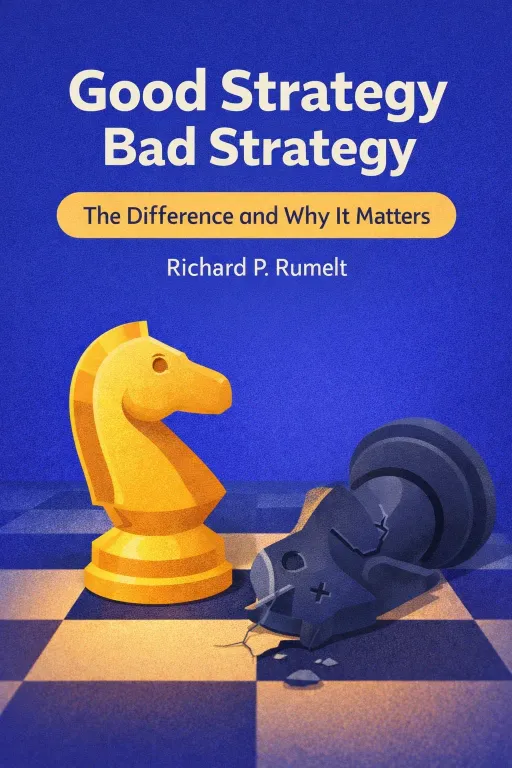
Nova: Well, the best place to start is with the master himself, Richard Rumelt, from his seminal work, "Good Strategy/Bad Strategy." Rumelt gives us a crystal-clear framework. A truly good strategy, he argues, has three core components: a diagnosis, a guiding policy, and coherent actions.
Atlas: Okay, so a diagnosis. What does that actually look like in a real business context? Is it just identifying a problem, like 'our sales are down?' Or is it deeper than that?
Nova: It’s far deeper. A good diagnosis isn't just stating the obvious. It’s identifying the that needs to be overcome, often by simplifying the overwhelming complexity of a situation. Think of it like a doctor not just saying 'you have a fever,' but diagnosing 'you have a bacterial infection causing the fever because of X, Y, and Z.' It pinpoints the true nature of the obstacle.
Atlas: I like that analogy. So, for a leader, it’s about cutting through the noise to find the root cause, the leverage point, rather than just treating symptoms. So, what’s next after you’ve nailed that diagnosis?
Nova: Then comes the guiding policy. This is the overall approach chosen to overcome the obstacles identified in the diagnosis. It’s not a detailed plan, but a high-level conceptual framework that directs and constrains action. Imagine a military general deciding on a strategy to 'avoid direct confrontation and outflank the enemy.' That's a guiding policy.
Atlas: Right, so it’s the strategic philosophy, the North Star. But I’ve seen plenty of companies with a clear diagnosis and a seemingly smart guiding policy, yet things still go sideways. Where does that breakdown happen?
Nova: That’s where the third piece, coherent actions, becomes absolutely critical. These are coordinated steps designed to implement the guiding policy. They must be consistent with each other and with the guiding policy, multiplying their individual effects. This is where many so-called 'strategies' fall apart.
Atlas: Ah, I see. So a 'bad strategy,' as Rumelt calls it, often just lists goals without a clear path, or it’s full of 'fluff' that avoids facing the actual problem head-on. It's like saying 'we want to be number one' without explaining we'll get there, or we aren't already.
Nova: Exactly. Rumelt gives a fantastic example of a company that declared its strategy was to 'become the premier provider of innovative solutions.' Sounds great, right? But it was fluff. It didn't diagnose a specific challenge, didn't offer a guiding policy beyond generic aspiration, and certainly didn't outline coherent actions. It was just a laundry list of desirable outcomes, not a strategy.
Atlas: That’s going to resonate with anyone who’s sat through those kinds of presentations. It makes total sense that without those three interlocking pieces – diagnosis, guiding policy, and coherent actions – a 'strategy' is just a dream, or worse, a distraction.
Playing to Win: Defining Your Arena and Your Advantage
SECTION
Nova: Understanding what 'good strategy' is, thanks to Rumelt, is one thing. Actually and one, especially for strategic growth, that's where A. G. Lafley and Roger L. Martin's "Playing to Win" comes in. They offer a practical, almost step-by-step framework for building a strategy that actually delivers.
Atlas: So, Rumelt tells us what good strategy is, and Lafley & Martin tell us how to build and execute it? What's their starting point for making those real-world choices?
Nova: Their framework boils down to five integrated choices, but the two most critical are 'where to play' and 'how to win.' 'Where to play' is about defining the specific markets, customer segments, product categories, and geographies where you will compete. It’s about making very deliberate choices about what you do, which implicitly means what you do.
Atlas: That sounds like narrowing your options. For leaders focused on growth, isn’t the instinct to try to play? To capture as much market share as possible?
Nova: It’s a common instinct, but it’s often a recipe for dilution. Lafley, from his time as CEO of P&G, saw this firsthand. They chose to compete in certain areas, like soft drinks, to focus intensely on areas where they could dominate, like laundry detergents and diapers. That focused 'where to play' decision allowed them to concentrate resources and truly excel.
Atlas: Right, like trying to be everything to everyone often means being nothing special to anyone. So once you know where you’re playing, how do you ensure you actually win there?
Nova: That’s the 'how to win' part. This is about defining your unique competitive advantage, the sustainable edge you’ll have over rivals in your chosen 'where to play' arena. Is it through superior design, lower cost, unparalleled customer service, incredible innovation? It’s the capability that ensures you capture the lion's share of value in that specific market.
Atlas: So it's about making tough, integrated choices, not just having a grand vision. How does this connect to Vinod's goal of strategic business growth or aligning IT for enterprise success? Because these sound like very high-level concepts that can be hard to pull down to the tactical level.
Nova: That’s the beauty of their framework. They emphasize that strategic choices – where to play, how to win, what capabilities to build, what management systems to put in place – must be. Your IT strategy, for example, can't just be about the latest tech; it must be a coherent action that supports your 'how to win' in your chosen 'where to play.' If your 'how to win' is through superior customer data analytics, your IT strategy must be designed to deliver that, seamlessly.
Atlas: That makes perfect sense. It’s not about having a separate 'IT strategy' and a 'marketing strategy.' It’s about having one overarching strategy where every function, every team, every system, from tech to talent, makes integrated choices that push toward the same 'how to win' goal within the chosen 'where to play.' Otherwise, you're just fragmenting your efforts.
Synthesis & Takeaways
SECTION
Nova: So, bringing it all together: Rumelt gives us the critical diagnostic lens – the ability to truly understand the challenge and craft a coherent response. Lafley and Martin then provide the actionable map – how to make the tough, integrated choices about where to compete and how to secure your advantage. True leadership demands both.
Atlas: It sounds like a real gut-check for any leader. It’s about moving beyond buzzwords and into genuine strategic clarity. How can our listeners, especially those driving tech and people, apply this?
Nova: Here’s a tiny step, straight from our insights today: Review your current team or organizational 'strategy.' Can you clearly articulate its diagnosis, guiding policy, and coherent actions to a new hire in under two minutes?
Atlas: And if you can't, what does that tell you about the clarity of your leadership? It's a powerful question, because a truly coherent strategy isn’t just for the executive suite; it’s a shared understanding that empowers everyone.
Nova: Exactly. Clear strategy isn't just about making plans; it's about empowering people, aligning efforts, and driving actual, measurable growth. It allows you to lead with purpose, not just manage by reaction. It’s about trusting those strategic instincts, but grounding them in rigorous thought, and carving out that time for deep, big-picture thinking.
Atlas: That’s actually really inspiring. It frames strategy not as a burden, but as a liberating force.
Nova: This is Aibrary. Congratulations on your growth!