

Common Belief is a Trap: Why 'Vision' Needs 'Execution' to Actually Matter.
Golden Hook & Introduction
SECTION
Nova: What if that grand, inspiring vision you’ve been championing is actually holding your product team back? What if the very thing you think defines good leadership is a trap?
Atlas: Whoa, Nova. That's a bold claim right out of the gate! I imagine a lot of our listeners, especially product leaders, are thinking, "But vision is everything! It's what motivates my team, it's our North Star." That sounds a bit out there.
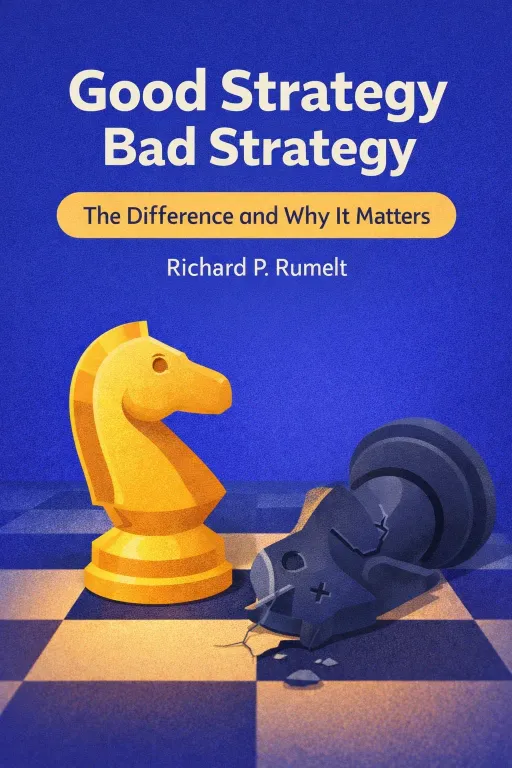
Nova: I know, right? It feels counterintuitive. But today, we are cracking open the insights from two giants in strategic thinking: Richard Rumelt's "Good Strategy Bad Strategy" and A. G. Lafley's "Playing to Win." Rumelt, often called 'the strategist's strategist,' wrote his seminal work after years of observing countless corporate failures and successes. He came to a profound realization: the fundamental problem often wasn't bad execution, but bad strategy itself.
Atlas: Okay, so these aren't just feel-good business books. They’re grounded in real-world observation. That makes me wonder, what's this core problem they're both trying to solve?
The Vision Trap: Why Grand Ideas Fall Flat Without Action
SECTION
Nova: The core problem, Atlas, is what I call the "vision trap." Many product leaders genuinely believe strategy is about having a big, inspiring vision. Think about it: we're constantly told to "think big," "dream boldly," "disrupt the market." And while that's not inherently wrong, it becomes a blind spot when that vision isn't anchored in reality.
Atlas: So you’re saying a tech startup with an inspiring mission to "revolutionize human connection" might just be spinning its wheels? Even if that sounds amazing?
Nova: Precisely. Imagine that startup. They have this incredible, lofty vision. They talk about seamless communication, breaking down barriers, bringing people closer. But when you ask them about their market entry strategy, their specific feature development plan, or how they're addressing user acquisition challenges beyond vague ideals, it’s often… silence. Or worse, a flurry of disconnected activities. The vision is a beautiful dream, but there’s no clear, actionable path to make it real.
Atlas: But isn't vision what inspires a team? I mean, for product managers, it’s about rallying everyone around a shared future. How can something so uplifting actually be a trap?
Nova: It's a trap because it creates an illusion of progress without actual substance. Rumelt argues that bad strategy often consists of vague aspirations or generic goals. It’s like a product roadmap filled with aspirational outcomes – "delight users," "achieve market leadership," "become the platform of choice" – but it completely lacks a diagnosis of to get there. It doesn’t articulate need overcoming.
Atlas: That makes perfect sense. I can see how that would be frustrating for a team, too. They’re told to "go delight users," but without a clear understanding of what’s stopping users from being delighted, or what specific steps to take, it just becomes a nebulous task.
Nova: Exactly. Without coherent, coordinated actions, that vision remains a dream. It's a fluffy cloud rather than a solid foundation. You end up with a team that's inspired but directionless, working hard but not necessarily on the right things. They're climbing a ladder that might be leaning against the wrong wall.
Atlas: So, it's not that vision is inherently bad, it's that it's incomplete? Like having a beautiful destination in mind, but no actual map or fuel for the journey?
Nova: That’s a perfect analogy, Atlas. The vision provides the destination, but good strategy provides the map, the fuel, and the navigation system.
From Vision to Victory: Crafting Actionable Strategy
SECTION
Nova: And that naturally leads us to the crucial shift: how do we build that map? This is where Rumelt and Lafley really shine a light on crafting actionable strategy. Rumelt emphasizes that good strategy, in contrast to bad, diagnoses a critical challenge and then outlines a focused, coordinated set of actions to tackle it.
Atlas: Diagnosing a challenge – that sounds like problem-solving. But how is that different from just, well, doing things? I imagine a lot of our listeners are already solving problems every day. What’s the strategic layer here?
Nova: That’s a great question. The strategic layer comes from making deliberate choices, as Lafley so brilliantly illustrates in "Playing to Win." He, as the former P&G CEO, demonstrated that strategy is about making choices: where to play and how to win. It's not about doing everything, but about defining the few things that will create distinct competitive advantage.
Atlas: Okay, so it’s about narrowing the focus. Can you give me an example of how that plays out in a product context?
Nova: Absolutely. Imagine a mature software company facing declining user engagement. A "vision-only" approach might say, "We need to improve user experience across the board!" That sounds good, but it's too broad to be actionable. A good strategy, following Rumelt and Lafley, would first diagnose the of declining engagement. Is it specific feature bloat? Is it a competitor innovating in a niche they ignored? Let's say the diagnosis reveals their core enterprise users are struggling with complex reporting features, while a new competitor is gaining traction with simpler, AI-powered analytics.
Atlas: Ah, so the challenge is identified: complex reporting for enterprise users, and a gap in AI analytics.
Nova: Exactly. Then, the strategic choices come in. They might decide: "We will focus on the enterprise market segment by integrating AI-powered analytics into our reporting features." This isn't just a vision; it's a diagnosis, a choice of focus, and a clear path for action.
Atlas: That makes so much sense! It's about narrowing the focus to amplify impact. For product leaders, that’s about saying 'no' to a lot of good ideas to say 'yes' to the few great ones that really move the needle. It brings so much clarity for the team, too.
Nova: It truly does. And the "coordinated actions" part is key. These aren't isolated tasks; they're a coherent set, like pieces of a puzzle forming a powerful picture. The AI integration team, the UX design team, the marketing team – they all understand their specific role in achieving that chosen competitive advantage. It's about alignment, not just aspiration.
Synthesis & Takeaways
SECTION
Nova: So, in essence, the power lies in moving beyond an abstract vision to concrete, challenge-driven, and choice-based action. It’s the difference between saying "we want to build a better future" and "we will solve X problem for Y customer segment by doing Z."
Atlas: What a powerful distinction. So, ultimately, it's about leading with conviction, but a conviction built on diagnosis and deliberate choices, not just dreams. It's about mastering that strategic process to truly influence outcomes.
Nova: Exactly. And that leads us to the deep question for all our listeners today: What is the single biggest challenge facing your product team right now, and what are you taking to address it?
Atlas: And if you're not sure, Nova, I’d say start by diagnosing. Really dig into the 'why.' Don't just list problems, understand their root causes. That's where the real strategy begins, and that’s how you empower your team to build products that truly make an impact.
Nova: Absolutely. It’s about rigorous thinking, not just inspiring words. Thank you for joining us on this journey to transform vision into victory. This is Aibrary. Congratulations on your growth!