

Scaling Your Vision: Mastering Go-to-Market Strategy
Golden Hook & Introduction
SECTION
Nova: Atlas, I want you to imagine a world where the very first automobile was invented, but instead of envisioning a future of highways and road trips, everyone was still thinking about faster horses.
Atlas: Whoa. That's a pretty wild thought experiment. So, like, the inventor is trying to sell this amazing new machine, but the entire market is just asking if it can eat oats and pull a plow?
Nova: Exactly! It sounds absurd, right? But that's precisely the challenge many visionary entrepreneurs and disruptors face. They build something truly innovative, yet the world struggles to see it as anything more than a slightly better version of what already exists.
Atlas: Oh, I get it! And that, I'm guessing, is where our discussion today comes in. We're talking about how to make people see the highway, not just the faster horse.
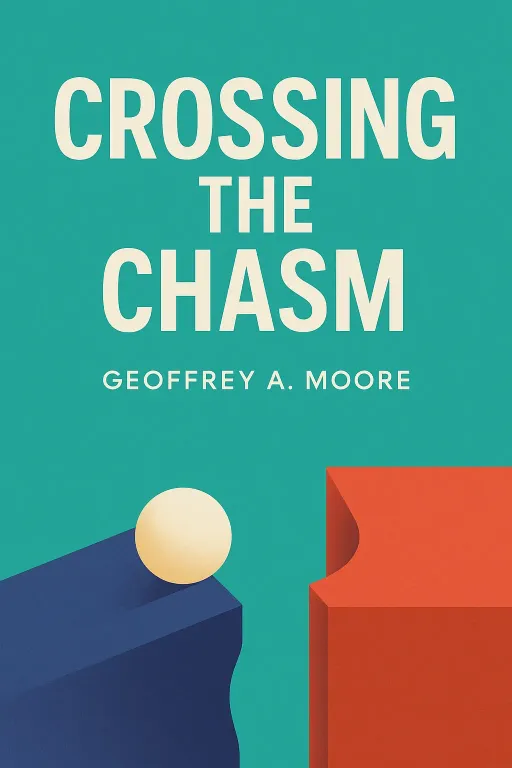
Nova: You've got it. Today, we're diving into the strategic genius behind scaling a vision, drawing heavily from two foundational texts: 'Crossing the Chasm' by Geoffrey A. Moore, and 'Play Bigger' by Al Ramadan, Dave Peterson, Christopher Lochhead, and Kevin Maney. Moore’s book, particularly, was a groundbreaking work that really illuminated why so many high-tech innovations failed to move beyond niche markets, offering a critical framework that still resonates decades later.
Atlas: That makes me wonder, Nova, what’s the big secret? Is it purely about marketing, or is there something deeper at play when you're trying to shift an entire mindset? Because for our listeners who are building something truly new, this isn't just about selling a widget; it's about building a whole new world around their product.
Nova: You've hit on the core of it, Atlas. It's far deeper than just marketing. It's about a strategic understanding of market dynamics and, more profoundly, about category creation. And that brings us to our first major insight: the chasm and the power of owning a category.
The Chasm & Category Creation
SECTION
Nova: Geoffrey Moore’s 'Crossing the Chasm' introduced this incredibly potent metaphor. Imagine the market as a bell curve, segmented by different types of adopters: the innovators, the early adopters, the early majority, the late majority, and the laggards.
Atlas: Right, I've seen that curve. The early adopters are those adventurous souls who will try anything new, often just for the sake of novelty, or because it solves a very specific, acute pain point.
Nova: Precisely. And what Moore observed was that many high-tech products would succeed wildly with innovators and early adopters, generating a lot of hype and initial sales. But then, they’d hit a wall. A giant, gaping chasm between the early adopters and the early majority.
Atlas: So, it's like a product gets all this buzz in a small, passionate community, but then it just… stops. It can't seem to break out into the mainstream, no matter how good it is?
Nova: Exactly! The early majority are pragmatists. They're not interested in novelty; they want proven solutions, social proof, and a complete product ecosystem. They look at the early adopters and think, 'Those people are crazy. I'll wait until it's safe and reliable.' The chasm is this fundamental disconnect in expectations and motivations.
Atlas: That sounds rough. So, a visionary could have the most brilliant, world-changing invention, but if they don't understand how to bridge that chasm, it just dies in obscurity? That's kind of heartbreaking.
Nova: It is. And this is where 'Play Bigger' comes in, picking up where Moore leaves off, in a way. It argues that the companies that truly win aren't just crossing chasms; they're creating entirely new categories. Think about Salesforce creating the 'cloud CRM' category, or Airbnb defining 'home-sharing.' They didn't just compete; they redefined the playing field.
Atlas: So, instead of trying to be a faster horse, they invented the automobile and then convinced everyone that roads were the future? That’s a huge leap in thinking.
Nova: It is. And it's not just about a product; it's about a point of view. A category creator doesn't just launch a product; they evangelize a new way of thinking, a new problem definition, and a new solution. They effectively 'category design' the market around their offering. They become the acknowledged leader of that new category, often before anyone else even realizes a new category exists.
Atlas: Wow. So, for our listeners who are pushing the boundaries, who want to create something truly new, this is less about incremental improvement and more about a paradigm shift. It’s about not just solving a problem, but making people realize they had a problem they didn't even know existed, and then offering the definitive solution. That's a huge undertaking.
Nova: It is, but it's also where the biggest rewards lie. The 'Play Bigger' authors found that category kings capture the vast majority of the market value. They don't just get a slice of the pie; they bake a whole new pie and get to eat most of it.
Atlas: That’s a powerful image. It makes me think about companies that started small, maybe even seemed niche, but then exploded because they understood this. Like, what’s a classic example of a company that really owned its category from the ground up?
Nova: Well, consider Tesla. Before Tesla, electric cars were often seen as glorified golf carts or science experiments. Tesla didn't just make a better electric car; they created the category of 'premium, high-performance electric vehicles.' They designed the narrative, the charging infrastructure, the experience. They forced the world to see electric cars differently. They were not just a car company; they were an energy company, a tech company, a lifestyle company.
Atlas: That’s a fantastic example because it wasn't just about the technology, it was about the entire story and experience they built around it. They made 'electric' cool and desirable, not just 'eco-friendly.' It’s about creating a new standard, a new expectation.
Strategic Launch & Reshaping Thought
SECTION
Nova: And that brings us perfectly to our second core idea: launching with impact, which is really about precision and reshaping thought. For a visionary, the launch isn't just a marketing event; it's the first strategic move in category creation.
Atlas: So, it's not about a big, splashy, general launch? Because I imagine, for a truly new product, just shouting about it to everyone might not work if they don't even understand what you're talking about.
Nova: Exactly! Moore highlights the concept of the 'beachhead market.' Instead of trying to conquer the entire continent, you focus all your resources on a single, defensible beachhead. This is a very specific, often niche, market segment that has an acute, undeniable need for your new, disruptive product.
Atlas: Okay, so you find that one group of people who need what you have, even if they don't know it yet, and you go all-in on them?
Nova: Precisely. You tailor your initial messaging, your sales strategy, your support, everything, specifically for their unique needs. The goal here isn't mass adoption; it's total domination of that specific segment. You want to make your product the logical choice for that beachhead. This provides the social proof and reference base you need to then expand.
Atlas: That makes so much sense. It’s like, instead of trying to convince everyone in the world that they need an automobile, you first convince a very specific group of long-distance merchants that this new machine will absolutely revolutionize their trade. And once they’re successful, others will notice.
Nova: That’s a great analogy. And the 'Deep Question' from our core content really drives this home: How can your product not just solve a problem, but fundamentally reshape the way customers think about and solve that problem, thereby creating a new category? It's about moving from 'problem-solution' to 'paradigm shift.'
Atlas: So, it's about identifying the current way people think, and then offering a completely different lens, almost a new operating system for their minds, that makes their old way of thinking obsolete.
Nova: Yes, and that often involves reframing the problem itself. Take Zoom, for instance. Before Zoom, video conferencing was clunky, expensive, and often reserved for big corporate boardrooms. Zoom didn't just make a slightly better video conference tool; they re-framed it as 'easy, accessible, ubiquitous video communication for everyone.' They created a category where video calls became a default, not an exception. They made it so seamless, so intuitive, that it fundamentally changed how people connected, worked, and even socialized.
Atlas: That's a perfect example of category creation and reshaping thought. They made the complex simple, and in doing so, they opened up a whole new world of possibilities. For our listeners, who are often visionaries with disruptive ideas, this is about identifying that initial, almost surgical strike point, and then telling a story that changes how people perceive reality.
Nova: Exactly. It's about being the first to articulate the new problem and then offering the definitive solution. It’s about defining the future, not just participating in the present. This gives you an immense strategic advantage. Because once you own the category, you dictate the terms. You become the benchmark.
Synthesis & Takeaways
SECTION
Nova: So, whether we're talking about Moore's chasm or 'Play Bigger's' category kings, the underlying message for visionaries is clear: scaling your vision isn't just about building a great product. It's about strategically positioning that innovation to create and ultimately own its market category.
Atlas: And that means being incredibly disciplined about identifying your beachhead market, tailoring your message, and relentlessly focusing on how your product fundamentally reshapes the way people think about a problem. It’s not just selling features; it's selling a new future.
Nova: A future where your solution isn't just an option, but the new standard. And that, in essence, is the journey from concept to category king. It requires courage, clarity, and a profound understanding of market dynamics. It's about trusting your vision but also being strategic about how you unfold that vision to the world.
Atlas: That’s actually really inspiring. It’s a reminder that true innovation isn't just about the 'what,' but the 'how' and the 'why.' It’s about being bold enough to redefine the game.
Nova: Absolutely. And for those of you out there with a disruptive idea, remember: the path will unfold, and you are capable. Trust your vision, but also practice active listening, both to your market and your team, because they hold insights that will help you bridge that chasm and claim your category.
Atlas: What a powerful thought to leave on. For anyone wrestling with how to get their groundbreaking idea out there, this episode offers a compelling roadmap.
Nova: We hope this discussion sparks some critical thinking for you. We always love hearing your insights and how these ideas resonate with your own experiences. Share your thoughts on social media – what category are you trying to create?
Atlas: And with that, we're wrapping up another insightful journey.
Nova: This is Aibrary. Congratulations on your growth!