

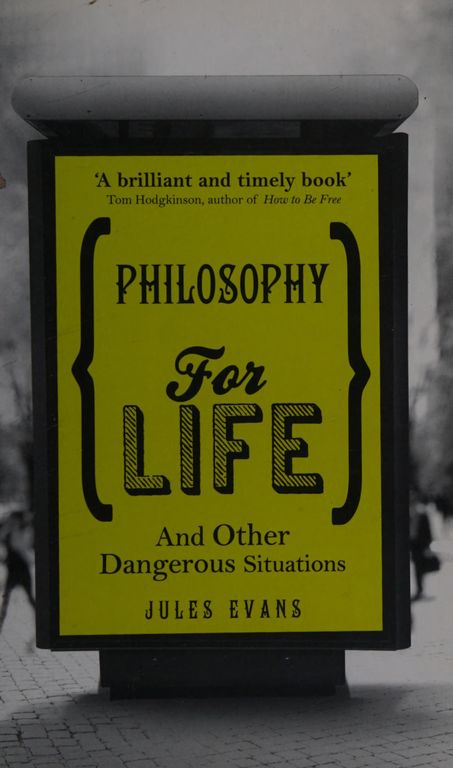
Philosophy for Life
Introduction: Philosophy as Emergency Medicine
Introduction: Philosophy as Emergency Medicine
Nova: Welcome back to the show. Today, we’re diving into a book that argues philosophy isn't just for dusty lecture halls—it’s for the emergency room of the mind. We’re talking about Jules Evans’s "Philosophy for Life and Other Dangerous Situations."
Nova: : Wait, "dangerous situations"? That sounds intense. I always thought philosophy was about abstract debates over metaphysics, not surviving a crisis. What’s the hook here, Nova?
Nova: That’s exactly the point! Evans’s entire premise is that ancient wisdom is the original self-help, and it saved his life. He suffered from a post-traumatic disorder, and the therapy that pulled him out—Cognitive Behavioral Therapy, or CBT—is essentially applied Stoicism in a modern, clinical wrapper.
Nova: : CBT being applied Stoicism? That’s a massive claim. So, you’re telling me Marcus Aurelius was basically the first cognitive therapist?
Nova: In essence, yes! Evans argues that the core techniques—identifying and challenging irrational thoughts, focusing only on what you can control—those are straight out of the Stoic playbook. This book isn't a history lesson; it’s a user manual for ancient mental software designed to run on modern hardware.
Nova: : A user manual. I like that framing. So, this isn't about memorizing Plato’s cave allegory, it’s about using philosophy to handle, say, a panic attack or a terrible boss?
Nova: Precisely. Evans wants to strip away the academic jargon and show us how to use these philosophies—Stoicism, Epicureanism, Cynicism—as practical tools for resilience, happiness, and navigating the chaos of the 21st century. It’s about making philosophy something for you.
Nova: : If it’s so practical, why did it take a personal crisis for Evans to realize this connection? Why aren't we taught this in school?
Nova: That’s Chapter One’s territory. Let’s explore the personal story that forged this book and why he believes philosophy is the ultimate defense against modern anxiety.
Key Insight 1: Philosophy as a Lifeboat
The Personal Crucible: From Trauma to The Stoic Toolkit
Nova: Let’s start with Evans’s own story. He describes a period where he was dealing with severe post-traumatic stress. He found himself in a place where traditional coping mechanisms weren't cutting it. The breakthrough came through CBT.
Nova: : And that’s where the lightbulb went on, right? He saw the ancient connection.
Nova: Exactly. He realized that the therapist was essentially guiding him through Socratic questioning and Stoic logic. For example, the Stoic practice of —premeditating evils—is a structured way to reduce anxiety about the future by mentally rehearsing potential setbacks. CBT does something very similar by exposing patients to feared scenarios in a controlled way.
Nova: : So, when a Stoic like Epictetus says, "It is not events that disturb people, but their judgments concerning them," that’s the foundational principle of cognitive restructuring?
Nova: It is! Evans highlights that this isn't just abstract thought; it’s a specific mental exercise. He notes that the ancient philosophers weren't just sitting under olive trees contemplating; they were actively trying to engineer better emotional states. They were biohackers of the soul, long before we had smartwatches to track our moods.
Nova: : That’s a fantastic analogy. Biohackers of the soul. But how deep does the Stoic influence go? Is it just about controlling your reactions, or does it cover things like social anxiety, which Evans mentions in his TEDx talk?
Nova: It covers a huge spectrum. For social anxiety, the Stoics offered techniques like 'the view from above'—imagining your current problem from a cosmic perspective to shrink its perceived importance. Evans frames this as a way to de-catastrophize everyday social interactions. He found that understanding the philosophical underpinnings gave him a much deeper, more robust framework than just following therapy instructions blindly.
Nova: : I can see that. If you know the technique works—because it’s rooted in a 2,000-year-old system for understanding reality—it feels more permanent than just a temporary fix.
Nova: Absolutely. He emphasizes that philosophy provides the, while therapy often focuses on the. The book is about merging those two. He even discusses how the Socratic method—constantly questioning your own assumptions—is the engine that drives this self-improvement.
Nova: : So, the first major takeaway is that the most effective modern mental health tools have ancient philosophical blueprints. It reframes therapy from something you to something you.
Nova: Precisely. And this practice is what leads us into the next section: exploring the full philosophical toolkit he presents, which goes beyond just the Stoics to include some surprisingly hedonistic advice from the Epicureans.
Key Insight 2: Choosing Your Ancient Operating System
The Philosophical Buffet: Stoics, Epicureans, and Skeptics
Nova: Evans doesn't just preach Stoicism, which is often the default when people talk about ancient self-help. He presents a buffet of ancient schools, encouraging the reader to try them on like different coats to see which fits their personality and situation best.
Nova: : That makes sense. If I’m naturally inclined toward pleasure and tranquility, maybe pure Stoic duty isn't my first stop. What does he say about the Epicureans? They always get a bad rap as just being about wild parties.
Nova: That’s the first myth he tackles! For Epicurus, the goal wasn't debauchery; it was —freedom from disturbance. It’s about minimizing pain and maximizing simple, sustainable pleasures, like good conversation and friendship. Evans suggests this is the perfect philosophy for dealing with modern consumerism and the constant pressure to 'achieve more.'
Nova: : So, the Epicurean exercise might be: deliberately choosing a simple meal with friends over a stressful, expensive night out chasing status. It’s about strategic subtraction.
Nova: Exactly. Then you have the Cynics, like Diogenes, who practiced radical self-sufficiency and contempt for social convention. Evans uses them to challenge our obsession with status symbols and material wealth. He might ask, what essential things could you live without right now? It’s a shock treatment for materialism.
Nova: : That’s where the "dangerous situations" part of the title comes in, I suspect. Cynicism can be quite confrontational. How does he balance that with the measured approach of the Stoics?
Nova: He uses them as counterpoints. The Stoic tells you to accept your role and do your duty within society, while the Cynic tells you society’s rules are often absurd and should be ignored if they compromise your integrity. Evans doesn't mandate one; he shows you the tension between them. He even dedicates time to Skepticism, which is perhaps the most underrated tool for modern life.
Nova: : Skepticism? In a world drowning in misinformation, that seems vital. What does ancient Skepticism offer that modern critical thinking doesn't?
Nova: The ancient Skeptics aimed for —suspension of judgment. When faced with two equally plausible arguments, instead of stressing out trying to find the absolute truth, you simply withhold judgment. Evans points out how this can be a powerful antidote to the constant outrage cycle on social media. You don't have to take a definitive side on every single thing immediately.
Nova: : So, the book is structured like a philosophical toolbox. You pull out the Stoic hammer for emotional regulation, the Epicurean wrench for simplifying desires, and the Skeptic’s level to check if your current beliefs are actually straight.
Nova: That’s a perfect summary. He’s teaching us philosophical pluralism—the idea that no single system has a monopoly on wisdom, and true resilience comes from knowing which tool to apply to which specific problem. It’s about intellectual agility, not rigid adherence.
Key Insight 3: From Ancient Journals to Modern Apps
The Practice of Philosophy: Tracking the Soul in the Digital Age
Nova: The real meat of "Philosophy for Life" is moving these ancient ideas from theory into daily practice. Evans is fascinated by how we can modernize the philosophical 'exercises.'
Nova: : I remember reading about his idea of self-tracking. It sounds very contemporary, almost like quantified self-movement, but rooted in something much older, right?
Nova: Exactly. The Stoics kept detailed journals—Epictetus’s, Seneca’s letters—where they reviewed their day, noted where they failed, and planned improvements. Evans suggests that our modern mood-tracking apps, our fitness trackers, our spending logs—these are the digital descendants of those ancient self-examinations.
Nova: : So, instead of just logging my steps, I should be logging my judgments? Like, 'Today, I judged that traffic jam as a personal insult, which was an error in judgment according to Epictetus.'
Nova: That’s the level of detail he encourages! He wants us to be rigorous auditors of our own minds. He even discusses the Socratic method of self-examination: constantly asking, 'What do I really believe here, and why do I believe it?' It’s about making the invisible processes of the mind visible and subject to rational critique.
Nova: : That requires discipline. It sounds exhausting to be that self-aware all the time. How does Evans make this accessible without turning everyone into an anxious philosopher constantly second-guessing themselves?
Nova: He balances the rigorous self-critique with the concept of philosophical 'retreats.' Not necessarily going to a monastery, but carving out mental space. He talks about the importance of stepping back from the immediate noise—the news cycle, the social media feed—to gain perspective. This is where the 'view from above' exercise becomes crucial again.
Nova: : It’s interesting how much of this relies on. Distance from the event, distance from your immediate emotional reaction, distance from societal expectations. It’s about creating space between stimulus and response.
Nova: That space is where freedom lives, according to many of these schools. And Evans ties this directly into modern well-being research. He points out that while modern psychology is excellent at diagnosing problems, ancient philosophy often offered a more holistic, proactive framework for —a concept that goes beyond just symptom management.
Nova: : I’m starting to see why this book resonated so widely. It validates the modern search for meaning by showing us that the answers aren't new; they’re just forgotten. It’s a powerful argument for intellectual humility—admitting that people 2,000 years ago figured out some fundamental truths about human nature that we’re still struggling with today.
Nova: Absolutely. It’s a call to intellectual archaeology. We have to dig up these tools, dust them off, and see if they still fit our hands. And that brings us to our final thoughts on the lasting impact of Evans's work.
Conclusion: The Enduring Relevance of Practical Wisdom
Conclusion: The Enduring Relevance of Practical Wisdom
Nova: So, after exploring Jules Evans’s journey and his philosophical toolkit, what is the single biggest takeaway for our listeners who might be feeling overwhelmed by modern life?
Nova: : For me, it’s the normalization of philosophy as a necessary survival skill. It’s not an elective course; it’s core curriculum for being a functional human being in a complex world. The idea that our anxieties are often rooted in faulty judgments, which we have the power to correct, is incredibly empowering.
Nova: I agree. The synthesis here is that resilience isn't about being tough; it’s about being philosophically informed. Evans successfully bridges the gap between the academic study of philosophy and the messy reality of daily existence. He shows us that Stoicism isn't about suppressing emotion; it’s about understanding the mechanism of emotion so you can respond wisely.
Nova: : And the pluralism is key. We don't have to become one-track Stoics. We can borrow the Epicurean appreciation for simple joys when we’re burnt out, and use the Skeptic’s pause when we’re overwhelmed by news.
Nova: Exactly. The actionable takeaway is to start auditing your judgments. Pick one area of stress this week—maybe it’s your commute, maybe it’s a difficult colleague—and ask yourself: What is the ancient philosophical perspective on this? Can I apply? Can I apply the dichotomy of control?
Nova: : It turns life into a series of low-stakes philosophical experiments. I think that’s a much more engaging way to approach self-improvement than just trying to force yourself to be 'positive.' It’s about being and.
Nova: It is. Evans reminds us that wisdom is a practice, not a destination. It’s a set of mental calisthenics we must perform daily to keep our minds fit for the inevitable dangerous situations life throws our way.
Nova: : A fantastic deep dive into a book that truly lives up to its title. Thank you, Nova.
Nova: Thank you for exploring this with me. If you’re looking for a guide to turn ancient wisdom into modern strength, "Philosophy for Life" is essential reading. This is Aibrary. Congratulations on your growth!