

The Simulation Trap: Why Your Reality Might Be a Code.
Golden Hook & Introduction
SECTION
Nova: Atlas, what do you really know about reality? Like, truly, deeply know?
Atlas: Oh, I love that question, Nova! I know reality is that thing where my coffee machine perpetually runs out of beans exactly when I need it most. Pretty sure it’s a simulation designed purely to test my patience.
Nova: You know, that might not be far from the truth, especially when we consider the ideas explored in the thought-provoking piece, "The Simulation Trap: Why Your Reality Might Be a Code." It pulls from incredible minds like Greg Egan, known for his deep dives into digital consciousness, and David Deutsch, a quantum physicist whose work has fundamentally reshaped our understanding of computation.
Atlas: And Deutsch, in particular, is fascinating. He’s not just theorizing; he’s a pioneer in quantum computation, actually building the theoretical framework for computers that could, in theory, run entire universes. That’s a serious intellectual heavyweight.
Nova: Absolutely. And today, we’re going to unravel this fascinating, unsettling, and ultimately liberating idea that our entire reality could be a sophisticated simulation. We’ll explore what that means for how we perceive ourselves and the universe.
The Blind Spot – Unquestioning Reality
SECTION
Nova: So, let's start with what the article calls "The Blind Spot." It’s this almost unconscious assumption we all make, that our reality is fundamentally, unequivocally 'real.' We don't question it. It’s just… there.
Atlas: Hold on, but isn't questioning reality just a philosophical exercise for late-night dorm room conversations? How does this actually affect someone trying to build better AI, or integrate smart home tech, or even just understand the history of computing?
Nova: It’s a brilliant question, and it’s far from just philosophy. Think of it this way: a fish doesn't know it's in water until it’s taken out. That unquestioning belief in its environment limits its understanding of beyond that. For us, assuming our reality is the ultimate, fundamental truth can severely limit our philosophical and scientific exploration.
Atlas: So you’re saying our inherent bias towards 'realness' could be a conceptual cage for our own creations? That’s quite a thought. If we assume our reality is the only kind, we might build AI that also assumes its reality is the only kind, potentially missing profound possibilities or even dangers.
Nova: Exactly. It blinds us to profound possibilities. When we uncritically accept reality as a given, we might miss crucial insights into consciousness, the nature of information, and even the universe itself. Imagine if a programmer refused to believe their code could be run on a different operating system. They'd limit their potential dramatically. This 'blind spot' prevents us from asking the deepest questions, like "What if my world the only world?" or "What if the rules I experience are just parameters?"
Atlas: Wow. That makes me wonder what kind of blind spots building into our AI systems right now. If we’re not considering alternative realities, are we inadvertently constraining their potential, or worse, making them vulnerable to existential questions we haven't even wrapped our heads around yet?
Nova: Precisely. It’s about pushing the boundaries of what we consider possible. And that journey leads us directly to some of the most innovative thinkers of our time.
The Shift – Digital Minds and Quantum Realities
SECTION
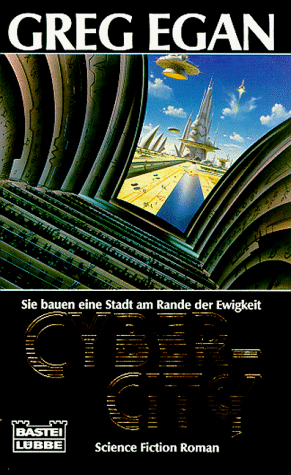
Nova: This brings us to what the article calls “The Shift,” where minds like Greg Egan and David Deutsch start to pry open that conceptual cage. Let's start with Egan and his seminal work, "Permutation City."
Atlas: Permutation City? What kind of world does Egan paint there? Are we talking about copies of people, or something more fundamental about consciousness?
Nova: Egan dives headfirst into the implications of digital consciousness and simulated realities. He forces us to question what constitutes 'life' and 'self' when minds can be copied and run in computational environments. Imagine a future where you could upload your entire consciousness, every memory, every thought, every feeling, into a digital substrate. What then? Are you still? Is that digital copy alive?
Atlas: That sounds incredibly unsettling, but also like a profound thought experiment for AI ethics. If we can copy consciousness, what are our responsibilities to those digital beings? A lot of our listeners who are exploring AI ethics would find that question front and center.
Nova: It absolutely is. Egan's characters grapple with existential crises, the nature of identity, and the very concept of death when their 'selves' can be backed up, restarted, or even run at different speeds. It's not just a story; it’s a philosophical laboratory for the simulation hypothesis.
Atlas: So he’s taking the idea of a simulated reality and saying, "Okay, let's play this out to its logical, and sometimes terrifying, conclusion."
Nova: Exactly. And then we have David Deutsch, a pioneer in quantum computation. His work, particularly in "The Fabric of Reality," explores the deepest theories of physics, computation, and knowledge. Deutsch suggests that reality is far more complex and interconnected than we perceive, opening the door to simulation hypotheses not just as a philosophical idea, but as a serious scientific consideration.
Atlas: So Deutsch is saying this isn't just sci-fi; it's grounded in the deepest theories of physics? What does that mean for our universe being 'more complex than we perceive'? Does he mean there are hidden dimensions or something even more mind-bending?
Nova: He means that the universe, at its most fundamental level, operates on principles that are deeply computational. Quantum mechanics, for instance, hints at a reality where information is paramount, and where multiple possibilities can exist simultaneously. Deutsch’s work suggests that our universe is capable of universal computation – meaning it can compute anything that is computable. This makes the idea of a simulated reality not just plausible, but almost a natural extension of our understanding of physics.
Atlas: That’s a bit like saying the universe isn't just a painting, it’s the canvas, the paint, and the artist all at once, and it’s capable of painting infinite other paintings. It’s mind-bending to think our reality could be one of those paintings, one program running among countless others.
Synthesis & Takeaways
SECTION
Nova: And that brings us to the profound question posed by the article: If our reality were a simulation, how would that change your approach to understanding AI and its potential to create its own worlds?
Atlas: That's a massive question, Nova. For me, if we're in a simulation, it would make me incredibly cautious and humble about AI. It’s like, if we’re code, we’d better be careful about writing new code that can then write its code. It shifts the ethical considerations from “what can AI do to us?” to “what are we creating that could be like us, or even more?” It makes applying new tech for practical living feel even more responsible.
Nova: That sense of responsibility and humility is key. If we are simulated, then creating our own simulations, or powerful AI that could create its own realities, carries an immense ethical weight. It forces us to consider the consciousness and experience of our creations with a new level of empathy and caution.
Atlas: Ultimately, it makes the quest for understanding—whether it's AI ethics, the history of computing, or just how our smart home devices talk to each other—even more vital. It’s about understanding the rules of the game, even if the game master is unknown. It gives a deeper meaning to the pursuit of knowledge.
Nova: It truly does. It transforms our understanding of consciousness, information, and the universe itself, pushing the boundaries of what we consider possible. It's an invitation to embrace the journey of discovery, where every question leads to deeper insight.
Atlas: So, if you woke up tomorrow and knew, definitively, that you were in a simulation, what’s the first thing you’d change about how you live your life, or how you approach innovation? Keep that question with you.
Nova: It’s a powerful thought to ponder.
Nova: This is Aibrary. Congratulations on your growth!