

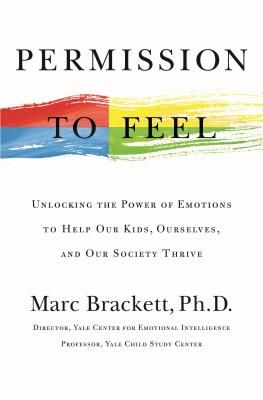
Permission to Feel
Unlocking the Power of Emotions to Help Our Kids, Ourselves, and Our Society Thrive
The Origin Story: Why We Need Permission
The Origin Story: Why We Need Permission
Nova: Welcome to the show. Today, we are diving into a book that argues the most powerful tool for success isn't IQ or technical skill, but something we often try to suppress: our feelings. We’re talking about Marc Brackett’s, "Permission to Feel."
Nova: : That title alone is provocative. In a world that constantly tells us to 'suck it up' or 'keep calm and carry on,' the idea that we need official permission to experience our internal state feels almost revolutionary. What’s the core message, Nova?
Nova: The core message is that emotions are data, not directives. And the man behind this movement, Dr. Marc Brackett, the Director of the Yale Center for Emotional Intelligence, didn't just arrive at this conclusion in a lab. His entire framework is rooted in a deeply personal story of childhood trauma, bullying, and abuse.
Nova: : That’s heavy. So, what was the turning point for him?
Nova: It was his Uncle Marvin. Brackett describes being a kid who was constantly told he was 'too sensitive.' Marvin was the first adult who didn't dismiss him. He looked at young Marc, saw the pain, and instead of offering platitudes, he asked one simple, life-altering question: 'How are you feeling?'
Nova: : 'How are you feeling?' That’s the permission slip right there. It validates the internal experience.
Nova: Exactly. Marvin didn't try to fix it; he just acknowledged it. That act of validation became the foundation for everything Brackett built—the RULER framework. He realized that without permission, we can't even begin to use our emotions intelligently.
Nova: : So, before we get into the five steps, I think we need to establish why this matters beyond just feeling better. Does this framework have teeth in the real world?
Nova: It absolutely does. Brackett’s research shows that emotional intelligence, when systematically taught, predicts academic success, better physical health, and stronger relationships. This isn't soft skills fluff; it's a hard skill set for life. Let's break down the architecture of that skill set: RULER.
Key Insight 1: Deconstructing the Five Pillars
The RULER Framework: Emotion as Data
Nova: RULER is an acronym for five essential skills. Let's start at the top: R is for Recognize. This is about noticing the emotion in yourself and others. It’s about moving beyond just 'fine' or 'bad.'
Nova: : Recognizing seems simple, but I bet it’s not. If I’m stressed about a deadline, I might just feel a tight chest. I don't immediately think, 'Ah, this is anxiety mixed with frustration.'
Nova: That’s where the next step, U, Understanding, comes in. Recognizing is seeing the signal; Understanding is reading the manual. Why am I feeling this way? Did that email trigger me? Is this a pattern from my past? Brackett emphasizes that understanding the is crucial for intelligent response.
Nova: : Okay, so Recognize the signal, Understand the cause. Then comes L: Labeling. This is where the vocabulary comes in, right? I remember reading that having a rich emotional vocabulary is a superpower.
Nova: It is the superpower! If you can only say you are 'mad,' you can only react with anger. But if you can label it as 'disappointed,' 'irritated,' or 'betrayed,' you open up entirely different pathways for response. Brackett notes that people who can name their emotions precisely are better at regulating them.
Nova: : So, if I’m feeling 'bad,' I’m stuck. If I can label it as 'melancholy,' I can seek quiet reflection. If I label it as 'furious,' I know I need distance before speaking. That makes sense.
Nova: Precisely. Then we move to E: Expressing. This is about communicating those feelings appropriately. It’s not about venting wildly; it’s about strategic sharing. For example, expressing 'I feel unheard when you interrupt me' is far more constructive than yelling.
Nova: : And finally, R: Regulating. This is the big one everyone wants—the ability to manage the intensity or duration of an emotion. But I worry here. Does regulating mean suppressing the feeling if it’s negative?
Nova: That is the critical distinction, and it’s where many traditional approaches fail. Brackett is adamant: Regulation is not suppression. Suppression is stuffing the data away, which, as we know, leads to burnout or explosive reactions later. Regulation is using skills—like deep breathing, cognitive reframing, or changing your environment—to shift the intensity of the feeling to a more productive level.
Nova: : So, RULER is a five-step process for turning raw emotional energy into actionable intelligence. It’s a system, not just a feeling.
Nova: It’s a system designed to be taught, practiced, and integrated. And the Yale Center has developed tools to help people master these steps, most famously, the Mood Meter.
Key Insight 2: Moving Beyond Good and Bad
The Mood Meter and Precision in Feeling
Nova: Let’s talk about the Mood Meter, which is the visual anchor for the RULER framework. It’s a two-axis grid. One axis measures the level of energy—from low to high. The other measures the quality of the feeling—from unpleasant to pleasant.
Nova: : That creates four quadrants: Blue for low energy/unpleasant, Red for high energy/unpleasant, Yellow for high energy/pleasant, and Green for low energy/pleasant.
Nova: Exactly. And the goal isn't to live only in the Green quadrant. That’s an impossible, and frankly, boring existence. The goal is to be of which quadrant you are in, and then use the 'L' and 'R' skills to move to a quadrant for the task at hand.
Nova: : Give me an example of that desired shift. Say I'm in Red—high energy, unpleasant. I'm furious about a project failure.
Nova: If you have a high-stakes negotiation coming up in ten minutes, being furious is too high energy and too negative. You need to regulate down to Yellow or Green. You might use a breathing technique to shift from furious to perhaps 'determined' or even 'calm' if you need to listen carefully.
Nova: : But what if the task that high energy? Say I need to confront someone about a serious ethical breach. Wouldn't being in Red be advantageous?
Nova: That’s a brilliant challenge. Brackett would argue that you need to shift from Red to Yellow. You want the high energy of activation, but you want to channel it through the lens of 'assertive' or 'firm' rather than 'out of control rage.' The precision of the label determines the effectiveness of the expression.
Nova: : It forces a level of self-awareness that most of us skip. We just react from the Red quadrant without ever checking the coordinates on the Mood Meter.
Nova: And that’s why the vocabulary is so important. Brackett points out that children who are taught 200 feeling words are significantly better at managing conflict than those taught only 50. It’s like having a better toolbox. You don't just have a hammer; you have a screwdriver, a wrench, and a level.
Key Insight 3: Evidence-Based Implementation
From School Halls to Corporate Towers
Nova: We’ve established the theory, but where is RULER actually being used? Brackett’s work originated at Yale, focusing heavily on education, specifically K-8 settings. They developed comprehensive curricula to embed these skills.
Nova: : And what kind of results are they seeing in schools? Are kids actually getting better at handling recess disputes?
Nova: The evidence suggests yes, and more. Studies on RULER implementation often point to improvements in school climate, reduced disciplinary incidents, and better teacher well-being. When adults are trained first—the leaders, the teachers—the students benefit from a more emotionally intelligent environment.
Nova: : So the adults have to learn to regulate before they can teach regulation. That’s a huge undertaking for any school district.
Nova: It is, but the payoff is systemic. Now, the framework isn't just for the classroom. Brackett and his team have adapted RULER for the corporate world. Think about high-pressure environments—finance, tech startups, healthcare.
Nova: : In the workplace, 'Expressing' emotions constructively is where most teams fail. People either avoid conflict entirely or they blow up in emails.
Nova: Exactly. In a corporate setting, 'Understanding' and 'Labeling' lead to better feedback sessions. Instead of, 'Your report was sloppy,' it becomes, 'I feel concerned about the accuracy of these figures, and I need to understand the process that led to them.' It shifts the focus from personal attack to collaborative problem-solving.
Nova: : I can see how that reduces stress. If I know my manager is going to approach my mistake with curiosity rather than immediate anger, my physiological response changes immediately. That’s the regulation benefit kicking in before the conversation even starts.
Nova: It’s about building what Brackett calls 'emotional agility.' Companies that prioritize this see tangible benefits, like improved team dynamics and reduced turnover, because people feel seen and heard, which is the legacy of Uncle Marvin’s simple question.
Key Insight 4: Overcoming Cultural Conditioning
The Resistance: Why We Fight Our Own Feelings
Nova: We’ve covered the 'how-to' and the 'where-to-use,' but let’s pivot to the biggest hurdle: the 'why-not.' If this framework is so effective, why aren't we all doing it naturally?
Nova: : Because we are culturally conditioned to believe that certain emotions are 'bad' or 'unprofessional.' We’re taught that vulnerability is weakness, and that feeling deeply is a liability, especially for men in leadership roles.
Nova: Brackett addresses this head-on. He talks about the 'feeling rules' we internalize from childhood. If your parents reacted with anger every time you cried, you learn that crying is dangerous. You learn to suppress the sadness, even if you don't have the vocabulary for it.
Nova: : So, the challenge isn't just learning the RULER steps; it’s actively unlearning decades of societal programming that equates emotional expression with instability.
Nova: Precisely. And this is where the 'Regulation' step gets tricky. If you’ve been suppressing trauma or chronic stress, simply being told to 'regulate' can feel impossible. You can’t regulate something you haven't fully recognized and labeled. It’s like trying to tune a radio when you don't know where the dial is.
Nova: : I’ve also seen discussions around emotional intelligence frameworks in general—sometimes they are criticized for being too subjective or for potentially being used to manipulate others if the 'Expressing' and 'Regulating' steps are weaponized.
Nova: That’s a valid concern that Brackett seems to preempt by grounding the entire system in authenticity. The goal isn't to become a perfect emotional robot; it's to become an authentic, effective human. If you are truly recognizing and understanding your feeling, your expression will be genuine, not manipulative.
Nova: : So, the framework demands a high degree of self-honesty. If I try to label my intense jealousy as 'healthy ambition,' the framework breaks down because the 'Understanding' step fails.
Nova: Exactly. The system requires you to be brutally honest with yourself first. It’s a journey inward before you can effectively engage outward. It’s messy, it’s uncomfortable, but Brackett argues that the discomfort of emotional literacy is far less damaging than the long-term cost of emotional illiteracy.
Conclusion: The Ongoing Practice of Feeling
Conclusion: The Ongoing Practice of Feeling
Nova: We’ve covered a lot of ground today, moving from a childhood moment of validation to a comprehensive framework for modern life. The key takeaway from "Permission to Feel" is that emotions are not the enemy; ignorance of them is.
Nova: : I think the most actionable insight for me is the power of the 'L'—Labeling. We need to stop using vague terms like 'stressed' and start digging for the precise word. That precision unlocks the ability to regulate effectively.
Nova: And remember the distinction: Regulation is not suppression. It’s about managing the intensity so you can respond wisely, not reacting impulsively. Whether you are a teacher managing a classroom or a CEO managing a merger, RULER gives you the language to navigate the human element.
Nova: : It’s a powerful reminder that emotional intelligence isn't a fixed trait; it’s a muscle we must exercise daily. We have to keep asking ourselves, and others, that simple question: How are you feeling?
Nova: And more importantly, we have to be prepared to truly listen to the answer. It’s the first step toward unlocking genuine connection and effectiveness in every area of life.
Nova: : A fantastic deep dive into a necessary topic. Thank you, Nova.
Nova: Thank you for exploring this with me. This is Aibrary. Congratulations on your growth!