

Unlocking Your True Potential: Beyond Talent and Towards Purpose
Golden Hook & Introduction
SECTION
Nova: What if I told you the secret to unlocking your peak performance isn't about pushing harder, but about strategically doing less?
Atlas: Whoa, doing? That flies in the face of everything we're taught about achieving greatness, especially for anyone driven to excel. It sounds almost… counter-intuitive, even a little bit scary to someone who prides themselves on their grind.
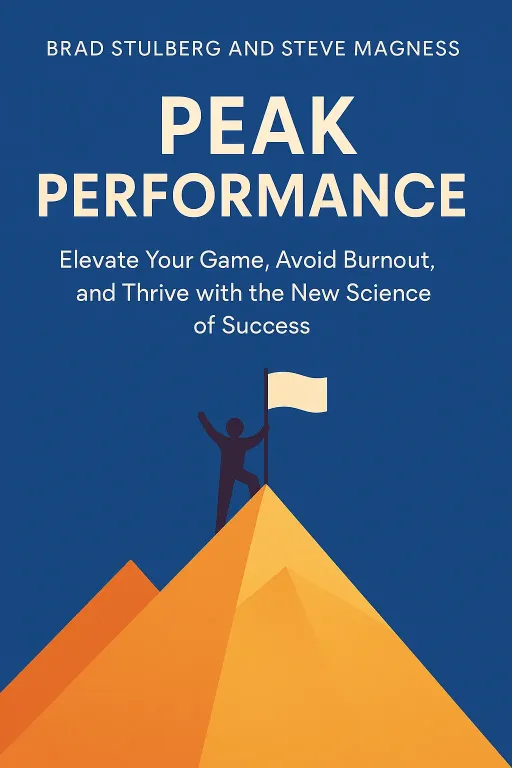
Nova: Absolutely, Atlas. It's a concept that challenges the very foundation of what many believe about achievement. And it’s one of the profound insights we pull from "Peak Performance: How Great Athletes Perform at Their Best While Staying Healthy" by Brad Stulberg and Steve Magness. Stulberg, a former elite athlete and acclaimed author on human performance, combined forces with Magness, a world-renowned coach, to really unearth the science behind sustained success. Their combined expertise brings both the lived experience and the data to the table.
Atlas: So they're saying there's a smarter way to train, a smarter way to live, than just constantly hitting the gas? I'm curious how this applies to someone who's already pushing themselves to the limit in their sport.
The Science of Sustainable Excellence: Balancing Stress, Rest, and Deliberate Practice
SECTION
Nova: Precisely. They argue for what they call the "stress + rest = growth" equation. Think of it like this: your body and mind are designed to adapt and grow, but only when they’re given both the challenge the recovery. Imagine a muscle. You lift weights, you create micro-tears, which is the stress. But the actual growth, the strengthening, happens during the rest period when your body repairs itself.
Atlas: Okay, that makes sense for muscles. But for someone driven, the idea of can feel like giving up, like you're losing ground to your competition. How do you tell the difference between necessary recovery and just being lazy? Isn't mental toughness about pushing through discomfort?
Nova: That's a powerful distinction, Atlas, and it's where "Peak Performance" offers such clarity. It's not about being lazy; it's about recovery. It's understanding that pushing through discomfort is essential, but there’s a critical difference between productive struggle and simply beating yourself into the ground without purpose. They introduce the concept of "adaptive cycles." You apply stress, your body adapts, you recover, and then you’re ready for the next, slightly higher level of stress. This isn't passive rest; it's an active part of the growth process. It's like a finely tuned instrument needing both tension and release to create beautiful music; too much tension, and the strings snap.
Atlas: That’s a great analogy. So, it's about wisely managing your energy, not just pushing through pain mindlessly. For someone striving for mental toughness, it sounds like the real strength is in understanding and honoring these cycles, rather than just brute-forcing everything.
Nova: Exactly. They illustrate this with countless examples, from top athletes to intellectual performers. Those who sustain excellence over the long haul aren't the ones who never stop, but the ones who master this rhythm. They also emphasize deliberate practice – not just mindlessly putting in hours, but practicing with intense focus, immediate feedback, and constant adjustment. It’s about quality over sheer quantity. It's the difference between hitting a thousand golf balls without thought, and hitting fifty with a coach analyzing every swing.
Atlas: I see. So, for an aspiring athlete, it's not just about the sweat, but about the of the sweat, and then the of the recovery. That helps build confidence, knowing you're following a proven path, not just hoping for the best.
The Power of Purpose: Starting with 'Why' to Fuel Performance and Connection
SECTION
Nova: And speaking of what truly sustains us and builds that deep confidence, that brings us to an even deeper question that Brad and Steve touch upon, and that Simon Sinek masterfully unpacks: the profound power of 'why'. We're talking about his seminal work, "Start With Why: How Great Leaders Inspire Everyone to Take Action." Sinek, a renowned leadership expert, became a global phenomenon after his incredibly popular TED Talk on this very subject, making his framework accessible and impactful far beyond traditional business circles.
Atlas: Okay, so we've talked about the 'how' of sustainable performance. Now we're moving to the 'why.' For an athlete, isn't the 'why' pretty obvious? Win the game, get the medal, achieve the goal?
Nova: That's the common assumption, but Sinek urges us to look deeper. He introduces the Golden Circle: 'What,' 'How,' and 'Why.' Most people and organizations can articulate 'what' they do and 'how' they do it. But truly inspiring leaders and, I'd argue, truly fulfilled individuals, start with 'why.' It's your purpose, your cause, your belief. It's the fundamental reason you do anything. For an athlete, it could be inspiring the next generation, proving something to yourself, or fostering community through sport.
Atlas: Huh. So it's not just about the scoreboard, but about the story behind why you even to be on that scoreboard? That makes me wonder, how do you even that deeper purpose when everyone around you, all the external pressures, are so focused on just winning? It sounds like a really personal, maybe even difficult, journey.
Nova: It absolutely can be a journey, Atlas, and it requires introspection. But Sinek shows that when your 'why' is clear, your 'what' and 'how' become infinitely more powerful and resilient. When you face setbacks, if your 'why' is just "to win," then losing can be devastating. But if your 'why' is "to push the limits of human possibility," or "to inspire my community," then a loss becomes a learning opportunity, a stepping stone on a larger journey. This intrinsic 'why' is a powerful anchor for self-confidence, because your worth isn't solely tied to external outcomes.
Atlas: That’s actually really inspiring. So it's not just about personal resilience; it also impacts how you connect with others, right? If your 'why' is bigger than just personal achievement, does that change team dynamics? Many athletes crave that sense of belonging.
Nova: It fundamentally changes everything. When you lead with your 'why,' you attract others who believe what you believe. Think about sports teams where the bond goes beyond just playing together; they share a profound purpose. This fosters true belonging, transforms a group into a community, and elevates collective performance. Your 'why' becomes a beacon, drawing together people who resonate with your deeper values, creating connections that are far more meaningful and enduring than those based solely on shared goals or achievements. It's how social dynamics become truly enriching.
Atlas: So it's not just about what you, but what you? That's a huge shift in perspective for many, especially when the focus is so often on individual metrics. It means finding that deeper purpose isn't just for yourself, but it’s how you truly connect and build something bigger.
Synthesis & Takeaways
SECTION
Nova: Exactly. Both "Peak Performance" and "Start With Why," in their own unique ways, point to a holistic view of potential that transcends superficial achievement. It's the sustainable practice of you train, coupled with the profound clarity of you do it. These two forces, balanced and understood, unlock a wellspring of resilience, confidence, and genuine connection.
Atlas: So, for someone feeling that intense drive, but also that underlying sensitivity, that desire for true connection, what's one practical step they can take today to start applying these ideas?
Nova: Take five minutes today, Atlas, to reflect. Beyond the metrics, beyond the immediate goal, what is the reason you dedicate yourself to your sport, or your craft, or whatever endeavor you're pursuing? What feeling, what impact, what core belief does it embody for you? Jot it down.
Atlas: And then, think about how sharing that 'why,' even in small ways, might not just fuel you, but also strengthen your connections with teammates, coaches, or even just fellow enthusiasts. It’s about building a life around that purpose, not just a career.
Nova: Precisely. Because true potential isn't just about reaching the summit; it's about how you climb, and why you started the journey in the first place.
Nova: This is Aibrary. Congratulations on your growth!









