

Beyond Natural Talent: How Deliberate Practice Reshapes the Science of Learning
Golden Hook & Introduction
SECTION
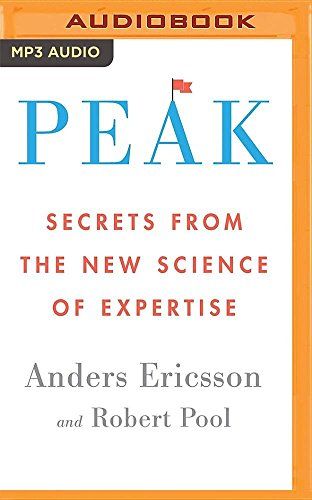
Prof. Eleanor Hart: Imagine standing on a stage in Vienna, watching a six-year-old child sit at a harpsichord. Without a single sheet of music in front of him, he plays a flawless, complex sonata, then immediately improvises a beautiful melody based on a random sequence of notes thrown out by the audience. That child, of course, was Wolfgang Amadeus Mozart. For centuries, we have looked at stories like his and whispered a single, defining word: genius. We assume some people are simply born with a golden ticket of innate talent, while the rest of us are destined to remain ordinary. But what if that assumption is not just wrong, but actively holding us back? Today, we are diving deep into Anders Ericsson's groundbreaking book,, to challenge everything you think you know about human potential. We will explore this from three distinct angles: first, the crucial difference between just doing something and engaging in true deliberate practice; second, the hidden architecture of the mind known as mental representations; and finally, how we can apply these insights to completely transform our classrooms and our lives. Joining me is Dr. Zen, a veteran educational researcher who spent over fifteen years studying how people actually learn. Welcome, Zen.
Zen: Thank you, Eleanor. It is a pleasure to be here. You know, that Mozart example is the perfect place to start because it highlights a massive cognitive bias we have in education. We love the myth of the natural prodigy. It is neat, it is romantic, and frankly, it lets the rest of us off the hook. But when you look at the actual historical data, as Ericsson did, you find that Mozart's father, Leopold, was a pioneer in music pedagogy who began intensely training Wolfgang from the toddler years. Mozart did not just sprout talent; he was the beneficiary of an incredibly rigorous, highly structured environment designed specifically to build his cognitive and physical capabilities.
Prof. Eleanor Hart: It is fascinating how we ignore the sweat behind the magic. Ericsson argues that the human brain possesses an extraordinary, almost miraculous level of adaptability—what we now call neuroplasticity. But to unlock it, we have to push past what he calls the "good enough" trap. Most of us think that if we do something for ten years, we must be an expert at it. We drive a car every day, so we must be expert drivers, right? But Ericsson says that is just naive practice.
Zen: Exactly, Eleanor. Naive practice is essentially just repeating an activity over and over, hoping that mere exposure will lead to improvement. In cognitive science, we see this all the time. A teacher might lecture for twenty years, but if they are using the exact same methods without targeted feedback, they are not actually getting better. They are just reinforcing existing habits. To truly improve, we have to transition to purposeful practice, which is goal-oriented, focused, and demands that we step outside our comfort zones.
Deep Dive into Core Topic 1
SECTION
Prof. Eleanor Hart: Let us look at how Ericsson proved this. One of the most famous studies in the book involves a normal college student named Steve Faloon. Now, Steve was not a math genius or a memory champion; he was just an ordinary guy who wanted to earn a little extra money. Ericsson brought him into a lab and gave him a simple task: listen to a string of random digits read at a rate of one per second, and then repeat them back. If he got them right, the next string would be one digit longer. If he made a mistake, the string would shorten. Zen, when they started, how many digits do you think Steve could remember?
Zen: Well, standard cognitive psychology tells us that the working memory capacity for an average adult is about seven digits, plus or minus two. It is the classic George Miller paper from the fifties. So, I would expect Steve to top out around seven or eight.
Prof. Eleanor Hart: And that is exactly where he started. For the first few sessions, he hovered around seven. He would hit a wall at eight, get frustrated, and drop back down. It seemed like his working memory was a hard physical limit, like the height of a ceiling. But Ericsson did not let him stop. He kept pushing Steve just slightly beyond his limit. If Steve could do seven, he was challenged with eight. And then, something incredible happened. Steve figured out a way to group the digits into running times—since he was a track athlete. Suddenly, "three four nine two" became three minutes and forty-nine point two seconds, a near-world-record mile time. By the end of the experiment, after hundreds of hours of practice, Steve could recall eighty-four digits. Eighty-four!
Zen: That study is absolutely legendary in our field, Eleanor. What Steve did was not actually expanding his raw working memory capacity. Instead, he developed what we call a retrieval structure in his long-term memory. He bypassed the physical bottleneck of short-term memory by creating a highly organized system of associations. From an educational standpoint, this is revolutionary. It shows that cognitive limits are not fixed. They are dynamic frontiers. But the key here is that Steve did not just sit there and listen passively. He was constantly operating at the very edge of his capability, experiencing immediate feedback—he knew instantly if he got a digit wrong—and he had to actively design new mental strategies to overcome his plateaus.
Prof. Eleanor Hart: Yes, and that feedback loop is so critical. Without it, you are just shooting arrows in the dark. You might be practicing, but you have no idea if your form is correct or if your arrows are even hitting the target.
Zen: Right, and as a researcher, I have to emphasize that this is where the role of a teacher or coach becomes indispensable. A good educator acts as an external feedback loop. They can see the subtle flaws in your technique that you are blind to. They know exactly what micro-step you need to take next to stretch your ability without causing complete frustration. In education, we refer to this as scaffolding within the Zone of Proximal Development. If the task is too easy, you get bored; if it is too hard, you give up. You have to find that sweet spot, that friction point, where learning actually occurs.
Prof. Eleanor Hart: It is like building muscle. You do not get stronger by lifting weights that are easy, nor do you get stronger by trying to lift a car and throwing your back out. You need that precise level of resistance. But this brings us to a crucial distinction Ericsson makes. There is purposeful practice, which is what Steve Faloon did, and then there is practice. What is the difference there, Zen?
Zen: Deliberate practice is a highly specialized subset of purposeful practice. It requires two things that purposeful practice does not necessarily have. First, it must occur in a well-developed field where there is already a rigorous, established body of knowledge and training techniques—think classical music, chess, or gymnastics. Second, it requires a teacher who can provide highly tailored, professional instruction. In a field like creative writing or business management, the path to excellence is not as standardized, so true deliberate practice is much harder to achieve. But we can still apply its core principles to those domains.
Deep Dive into Core Topic 2
SECTION
Prof. Eleanor Hart: That distinction is so important. And it leads us directly to the second major concept of the book, which is the idea of mental representations. Ericsson argues that the primary goal of deliberate practice is actually to construct highly sophisticated mental representations in our minds. To explain this, let us look at the world of chess. Back in the nineteen-forties, a Dutch psychologist named Adriaan de Groot did a fascinating experiment. He took chess grandmasters and ordinary club players and showed them a chess board from an actual game for just five seconds. Then, he covered the board and asked them to reconstruct the positions of all the pieces. Zen, what did he find?
Zen: The results were stark. The grandmasters could reconstruct the entire board with almost ninety-five percent accuracy, while the club players could only manage about thirty percent. It looked like the grandmasters had this incredible, photographic memory. But then, de Groot did something brilliant. He placed the chess pieces randomly on the board—positions that would never occur in a real game. And when he tested them again... the grandmasters' advantage completely vanished. They did no better than the novices.
Prof. Eleanor Hart: That is such a mind-blowing twist! If their memory was just naturally superior, they should have been able to remember the random board too. But they could not. Why?
Zen: Because their memory was not photographic; it was contextual. Over years of deliberate practice, grandmasters build up a massive library of mental representations—patterns of how chess pieces interact, typical offensive and defensive structures, and strategic pathways. When they look at a real game board, they do not see twenty-four individual pieces; they see a few highly organized "chunks" of information. They are reading the board the way you and I read a sentence. We do not see individual letters; we see words and phrases. But when the pieces are random, it is like looking at a jumble of letters from a language we do not speak. The mental representations cannot hook onto anything.
Prof. Eleanor Hart: That is a beautiful metaphor, Zen. So, a mental representation is essentially a pre-existing pattern of information that our brain holds, which allows us to process complex data incredibly quickly and make highly effective decisions. It is the difference between a novice doctor who has to go through a checklist of symptoms one by one, and an expert diagnostician who instantly recognizes a pattern of symptoms as a specific syndrome.
Zen: Exactly. And this is where my research background really gets excited. In education, our goal should not just be to stuff facts into students' heads. That is a very low-level way of thinking about learning. Our goal should be to help students build robust, flexible mental representations. If a student has a strong mental representation of, say, the scientific method, or algebraic structures, they can apply that framework to entirely new, unfamiliar problems. They do not just memorize the steps; they understand the underlying relationships.
Prof. Eleanor Hart: But how do we actually build these representations? Ericsson says they are both the result of practice and the key to practicing. It sounds like a bit of a chicken-and-egg scenario. How does that loop work in reality?
Zen: It is a self-reinforcing cycle. You attempt a task, you fail or make mistakes, you receive feedback, and you adjust. That adjustment slightly refines your mental representation of the task. With a better representation, you can practice more effectively, which in turn refines the representation even further. Think of a violinist. They have a mental representation of what a piece of music should sound like. When they play a note that is slightly flat, their mental representation detects the mismatch. They adjust their finger placement, and their brain registers the correct physical sensation associated with the correct sound. Over time, that mental map becomes incredibly precise.
Prof. Eleanor Hart: So, the mental representation actually acts as a quality control monitor for our own performance. It allows us to self-correct even when a teacher is not in the room.
Zen: Precisely. And that is the ultimate goal of deliberate practice: to create an autonomous learner who can monitor, evaluate, and refine their own performance.
Synthesis & Takeaways
SECTION
Prof. Eleanor Hart: This has such profound implications for how we structure our society, our schools, and our personal goals. If we accept Ericsson's premise—that talent is largely a myth and that deliberate practice is the true engine of expertise—then we have to completely rethink our approach to education. Zen, as a researcher who has spent fifteen years in this space, what does a school designed around deliberate practice actually look like?
Zen: It looks radically different from the traditional model we have today, Eleanor. Right now, our education system is largely passive. Students sit in desks, listen to lectures, and take standardized tests that mostly measure rote memorization. It is the equivalent of trying to learn to play tennis by watching someone else hit balls. In a deliberate-practice-centered school, the focus would shift from passive listening to active doing. We would design curriculum around specific, measurable skills. We would provide immediate, constructive feedback rather than waiting for a midterm exam. And most importantly, we would teach students to build mental representations—how to think like a historian, a scientist, or an artist, rather than just memorizing historical dates or scientific formulas.
Prof. Eleanor Hart: It sounds like we need to move from a culture of "knowing" to a culture of "doing and adapting."
Zen: Absolutely. We need to teach students to embrace struggle. In deliberate practice, if you are not making mistakes, you are not learning. We have to destigmatize failure and reframe it as the essential data our brains need to build better mental representations.
Prof. Eleanor Hart: That is a powerful shift in perspective. For our listeners who are sitting at home, or commuting, and wanting to apply this to their own lives—whether they want to learn a new language, master an instrument, or excel in their careers—what is the one actionable takeaway you would offer them today?
Zen: I would say: identify your comfort zone, and then find a way to step just one inch outside of it. If you are practicing something and it feels comfortable and easy, you are not improving; you are just maintaining. Find a specific skill you struggle with, break it down into a small, manageable goal, focus on it intensely, and actively seek feedback. Remember, the brain is incredibly adaptable, but it will only change if you give it a reason to. You have to push it past its current limits.
Prof. Eleanor Hart: A truly inspiring thought to end on. The ceiling of your potential is not fixed by your genes; it is a horizon that expands with every step of deliberate practice you take. Dr. Zen, thank you so much for sharing your profound insights with us today.
Zen: It was an absolute pleasure, Eleanor. Thank you for having me.
Prof. Eleanor Hart: And thank you to all our listeners. Next time you find yourself hitting a wall in your personal or professional life, do not walk away and blame a lack of natural talent. Instead, ask yourself: how can I change my practice to build a better mental map? Until next time, keep pushing those boundaries.