

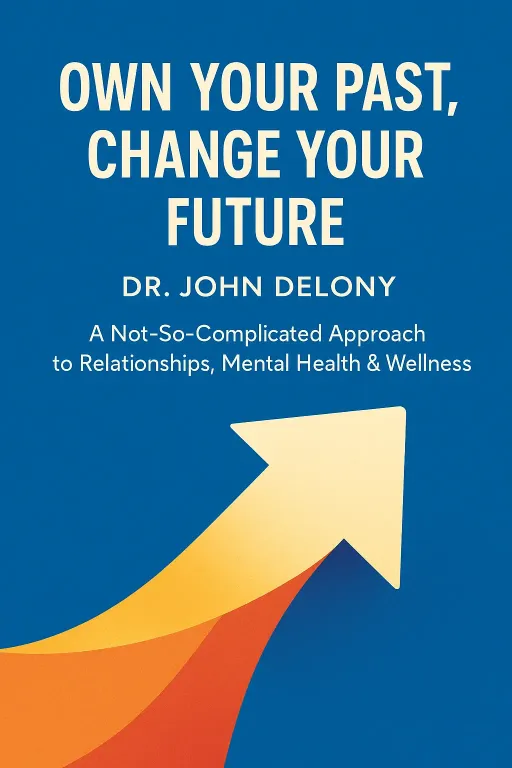
Rewriting the Script: How Owning Your Past Can Build a New Legacy
Golden Hook & Introduction
SECTION
Nova: What if every mistake, every trauma, every hard choice you’ve ever made wasn’t just a memory, but a physical weight you had to carry every single day? A brick in a backpack that just gets heavier. That’s the powerful idea at the heart of Dr. John Delony’s book, 'Own Your Past, Change Your Future.' And today, we have a guest, Warren, whose life is a testament to both carrying that weight and learning how to redeem it. Warren, thank you so much for being here.
Warren: Thanks for having me, Nova. It's an honor.
Nova: Your story is one of incredible strength, and you have a mission now to turn your experiences into a film to educate young people about the consequences of drugs, crime, and gang life. It's a mission of profound hope. And it connects so deeply with the ideas in this book. Today we'll dive deep into this from two powerful perspectives. First, we'll explore Dr. Delony's concept of the 'bricks in your backpack'—the real weight of the stories we carry. Then, we'll discuss the incredible process of redemption, focusing on how changing your actions can rewrite your entire legacy.
Warren: I'm ready. The concepts in this book… they put words to things I’ve felt my whole life.
Deep Dive into Core Topic 1: The Bricks in Your Backpack
SECTION
Nova: Let's start there, with that feeling. Dr. Delony uses this incredible metaphor in Chapter 8. He says our stories—especially the traumatic ones—are like bricks we carry in a backpack. They’re not just in our heads; they have a real, physical weight. When you hear that, Warren, what does that bring up for you?
Warren: It’s the most accurate description I've ever heard. For years, it wasn't just a metaphor. I felt it. The weight in my chest, the tension in my shoulders, the constant looking over my shoulder. Living a life of crime and addiction, you're always in a state of high alert. It's exhausting. It’s a physical burden. Those aren't just memories; they're bricks. The things you've done, the people you've hurt, the danger you were in. Each one is a brick.
Nova: And the book makes it so clear that our bodies keep the score. Delony quotes Dr. Nadine Burke Harris's work on Adverse Childhood Experiences, or ACEs, showing how these early 'bricks' lead to real, long-term health problems. He also tells a story in Chapter 6 that I think perfectly illustrates how this works on a smaller scale. He describes a 14-year-old kid who has to take a geometry test.
Warren: I remember reading that.
Nova: Right? So, this kid's father has always told him that failing a math test means you're stupid or lazy. That's the story he's been told. So when the teacher hands out the test, the kid's heart starts pounding, his palms get sweaty. His body goes into a full-on fight-or-flight response. He's not just afraid of a bad grade; his body is reacting to the story that a bad grade means he'll lose his father's love and respect. The story has a physical consequence.
Warren: That’s it exactly. When you're in the life, every interaction can feel like that geometry test. A wrong look, a police car driving by, a deal going bad… your body is constantly flooded with adrenaline and cortisol. You're living in that fight-or-flight mode 24/7. And drugs, for me and for so many others, become a way to try and numb that physical feeling. You're trying to lighten the backpack, but you're just adding another, heavier brick.
Nova: That's such a powerful way to put it. You’re adding the brick of addiction to the pile. The book talks about four types of stories: the ones we're born into, the ones others tell us, the ones that happen, and the ones we tell ourselves. It sounds like you were dealing with all four.
Warren: Absolutely. The story I was born into was one of limited options. The story I was told by some was that I wouldn't amount to much. The stories that happened were the crimes, the arrests. And all of that fed the most powerful story of all: the one I told myself.
Nova: What was that story?
Warren: That this was who I was. That I was a criminal. An addict. That I belonged in that world and nowhere else. In Chapter 7, Delony talks about stories of belonging. The gang, for a time, provided that. It was a twisted, dangerous sense of belonging, but it was a story that made sense of my world. It told me where I fit. And once you believe that story, it feels impossible to write a different one.
Nova: Because that story becomes your identity. You start to believe the bricks you, not just something you're carrying.
Warren: Exactly. And that’s the trap. That’s where the hopelessness comes from. You look at the pile of bricks and you think, "This is my life. This is all it will ever be."
Deep Dive into Core Topic 2: From Redemption to Legacy
SECTION
Nova: So, we've acknowledged these heavy bricks. The weight is real. But the book, and your life, Warren, proves that we don't just have to carry them. We can build with them. This brings us to the incredible idea of redemption. It's the whole second half of the book: The Stories Are the Solution.
Warren: That was the part that hit me the hardest. The idea that none of it has to be wasted.
Nova: Yes! In Chapter 13, Delony says, "Your life and hurt and pain will not be wasted." He tells this heartbreaking story about a woman from Alaska who calls into his radio show. Her dream was always to be a stay-at-home mom, but her husband racked up three-quarters of a million dollars in debt. For over fifteen years, she had to work to help pay it off. By the time they were almost free, her last child was leaving for college. Her dream was gone.
Warren: And she was angry. I get that.
Nova: She was furious. Full of resentment. She called the show, and Delony told her something profound. He said, "From this point forward, every minute you choose being resentful, angry, or bitter, is a minute you’re choosing to have less joy, less love, and less fun." He challenged her to let it go, not for her husband's sake, but for her own.
Warren: To set down that brick.
Nova: Exactly. And she did. She wrote back a month later and said she'd found peace. She had to change her story about what her life was supposed to be and start living the life she actually had. This ties into what Delony says in Chapter 12 is the final, crucial step: Change Your Actions. It’s not enough to think differently; you have to differently. He quotes the Avett Brothers: "Decide who to be and go be it."
Warren: That's everything. For me, getting sober, leaving the life… that was the first step. That was stopping the negative actions. But it wasn't enough. I was sober, but I was still just the guy with the heavy backpack. I hadn't decided who I was going to.
Nova: And how did that shift happen for you?
Warren: It was realizing that my story, all those bricks, could be useful. They weren't just a source of shame; they were a source of knowledge. I lived the consequences. I know what happens when you mix drink, drugs, and driving. I know the reality of gang life. What if I could use that? What if I could stop one kid from picking up that first brick?
Nova: So you decided to be an educator. A storyteller.
Warren: Yes. The action became creating this film. That’s me "going and being it." It changes the story I tell myself. I'm not just a former addict. I'm a creator. I'm someone trying to prevent pain. The film project is the action that solidifies the new identity. It’s me taking the pen back, just like the book says. I can't change what happened, but I can decide what the story means now.
Nova: You're not just setting the bricks down, Warren. You're taking them out of the backpack and using them to build a lighthouse for other people. It’s the ultimate act of redemption. You’re transforming the very material of your pain into a tool for healing.
Warren: I hope so. That's the goal. It's about making sure that the story doesn't end with the pain. It ends with a purpose.
Synthesis & Takeaways
SECTION
Nova: That's the core of it all, isn't it? The journey this book lays out, and that you've lived, is about moving from pain to purpose. We started by talking about the 'bricks'—acknowledging the real, physical weight of our past.
Warren: Which is a step you can't skip. You have to be honest about the weight. You have to own it.
Nova: You have to own it. But you don't have to be defined by it. The second, and most hopeful, part of our conversation is that you can then choose a new identity and take new actions. You can decide who to be and go be it. Your mission with this film is the most powerful example of that I can imagine.
Warren: Thank you. It feels like the only path forward. It's not about forgetting the past, but about giving it a new meaning. It's about redemption.
Nova: So, as we close, what's one thing you would want to say to someone listening right now who feels like they are buried under the weight of their own bricks?
Warren: I'd say that your story isn't finished. No matter how heavy that backpack feels, you are still the one writing the next chapter. The pen is in your hand. The past is real, but the future is still unwritten. You have the power to decide what happens next.
Nova: The pen is in your hand. That is so powerful. And for everyone listening, I’ll leave you with a question inspired by Warren's journey and Dr. Delony's work: What is one brick you're carrying, and what is one new action you could take, however small, to start writing a new chapter today? Warren, thank you for sharing your story and your wisdom with us.
Warren: Thank you, Nova. It was a privilege.









