Thriving Under Pressure: Sustaining Well-being in High-Stakes Roles
Golden Hook & Introduction
SECTION
Nova: You’ve been told to 'lean in' and 'power through' the pressure. But what if that very advice is quietly eroding your well-being? Today, we're flipping the script on stress.
Atlas: Oh, I like that. "Flipping the script." Because honestly, for anyone navigating high-stakes roles, it often feels like you’re just constantly bracing for the next wave, not really riding it.
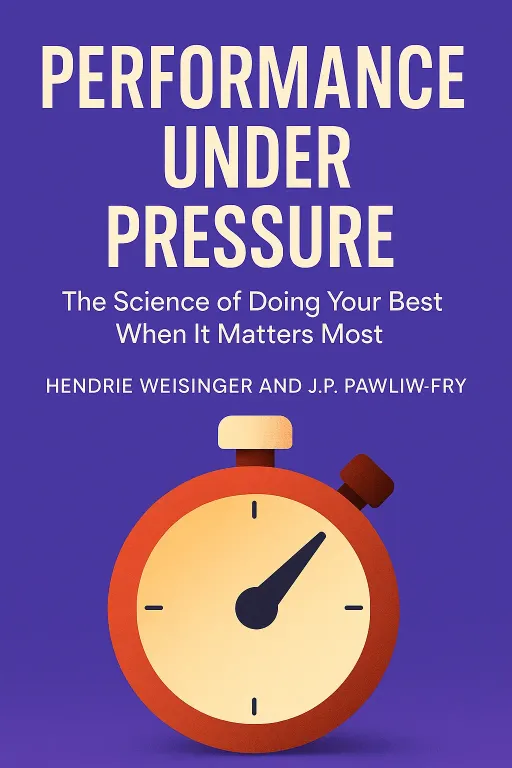
Nova: Exactly! It’s that perpetual state of being 'on' that can lead to burnout, even for the most driven among us. That’s why we’re diving into two brilliant works today: Hendrie Weisinger and J. P. Pawliw-Fry’s "Performing Under Pressure" and Scott Eblin’s "Overworked and Overwhelmed."
Atlas: What a powerful combination. Weisinger, a Ph. D. in psychology, teamed up with Pawliw-Fry, an Olympic performance psychologist, to really dissect what pressure does to us. And Eblin, a former Fortune 500 executive turned leadership coach, brings that battle-tested, real-world perspective. It’s the perfect blend of academic rigor and practical application for anyone looking to sharpen their leadership and boost productivity.
Nova: Absolutely. These authors aren't just theorizing; they’re giving us blueprints. And the core of our podcast today is really an exploration of how high-achievers can not only perform under immense pressure but also sustain their well-being and impact without succumbing to burnout. We’re going to explore how to reframe pressure and anxiety into focused action, and then discuss strategic ways to manage demands and protect your energy as a leader.
Atlas: So, it's not just about surviving, but genuinely thriving. That's a huge shift in perspective right there.
The Anatomy of Pressure: Reframing Anxiety into Focus
SECTION
Nova: It truly is. And that brings us to our first core idea from "Performing Under Pressure": understanding the anatomy of pressure itself. Weisinger and Pawliw-Fry identify four core triggers of pressure, and when you recognize them, it's like suddenly seeing the matrix.
Atlas: Four triggers? I always just thought "pressure" was a monolithic beast. What are they?
Nova: They are: novelty, unpredictability, a threat to your ego, and the sense of being watched. Think about it. When you’re facing a completely new challenge, or an outcome is uncertain, or your reputation is on the line, or everyone’s eyes are on you—your body and mind respond with pressure.
Atlas: Okay, I can definitely relate to all of those. That makes me wonder, how does knowing these triggers actually help? Isn't pressure, well, just pressure? My heart still races, my palms still get sweaty.
Nova: That’s the critical insight! Most people default to a "pressure response," which is essentially anxiety. We get overwhelmed, our focus narrows to the negative, and our performance drops. But the authors argue that you can transform that anxiety into a "pressure solution" – which is optimal focus and resilience.
Atlas: So, it's not about eliminating the triggers, but changing your internal reaction to them?
Nova: Precisely. Let me give you a classic example that illustrates this. Imagine a brilliant young surgeon, Dr. Anya Sharma, facing her very first solo, complex procedure. The trigger is immense novelty – she's never done it alone. Unpredictability – anything could happen. Threat to ego – her entire career could hinge on this. And being watched – the senior surgeon is observing every move.
Atlas: Oh man, I can feel the pressure just thinking about it. Most people would freeze or make mistakes.
Nova: Exactly. Her initial response is a surge of adrenaline, a tight chest, and a mind racing through all the ways it could go wrong. That's the pressure response. But instead of letting that spiral, she'd apply their framework. First, she’d recognize the of pressure, not as a sign of weakness, but as a signal: "Okay, this is important, I need to be at my best."
Atlas: So, acknowledging it, rather than fighting it?
Nova: Yes. Then, she’d reframe her self-talk. Instead of "What if I mess up?", she'd ask, "What’s the very next, precise step I need to take?" She’d focus on the process, not the potential outcome. She might even use a physical technique like a specific breathing pattern to calm her physiology.
Atlas: That sounds incredibly disciplined. For our listeners in high-stakes environments, whether it’s a critical presentation or a tough negotiation, it’s easy to get caught up in the "what if" scenarios.
Nova: Right. And here's the crucial part: by focusing on process, by breaking down the task into manageable, familiar steps, she reduces the unpredictability. By reminding herself of her training and preparation, she lessens the threat to her ego. And by channeling the 'being watched' into a sense of accountability and performing for her patient, she transforms it into a positive. The outcome? She performs with precision, not paralyzed by fear. The anxiety doesn’t disappear, but it's channeled into sharp, focused action.
Atlas: That’s a powerful distinction. It’s not about becoming emotionless under pressure, but about directing that energy. I can see how that would resonate with anyone who strives for mastery. It’s about cultivating that inner resilience, not just pushing through.
Beyond Burnout: Strategic Delegation & Energy Management
SECTION
Nova: And speaking of pushing through, that leads us perfectly into our second core idea, which often acts as a counterpoint to what we just discussed: Scott Eblin’s insights from "Overworked and Overwhelmed." Because while we need to perform under pressure, we also need to manage the of that pressure, especially for leaders.
Atlas: Okay, but wait, for a leader who’s already stretched thin, "strategic delegation" sounds like another thing to add to the plate. It’s easy to think, "If I want it done right, I have to do it myself." How is this different from just offloading work?
Nova: That’s a common misconception, and it’s precisely what Eblin addresses. He argues that true strategic delegation isn't about simply dumping tasks. It’s about a fundamental shift in how leaders perceive their role and the capabilities of their team. It’s about building capacity, both in yourself and in others.
Atlas: So it’s not just about taking things your plate, but about making sure the things are on your plate, and that your team is empowered to handle the rest?
Nova: Exactly! Think of a CEO, let’s call him David, who was a classic "do-it-all" leader. He felt indispensable, working 70-hour weeks, constantly bogged down in operational details. He was brilliant, but his team felt underutilized, and he was perpetually exhausted, experiencing the very real physical and mental toll of being overworked.
Atlas: I totally know that feeling. For pragmatic visionaries, it’s often hard to let go because you see the big picture, and you want to ensure every detail aligns.
Nova: And that's where Eblin's framework comes in. He helped David identify not just he was doing, but he was doing it. Was he the only one capable? Or was it fear of letting go, a desire for control, or even a subtle form of ego — the belief that only could achieve perfection?
Atlas: That's a deep dive. It's not just a task list, it's a self-analysis.
Nova: It is. David started by categorizing his tasks: what absolutely to be him, what could be delegated with training, and what could be eliminated entirely. He then invested time in coaching his direct reports, giving them not just tasks, but the authority and resources to execute. He created clear success metrics and check-in points, shifting from micro-managing to guiding.
Atlas: That sounds like a significant upfront investment, though. For a leader already short on time, that might feel like a luxury.
Nova: It feels like a luxury, but it's actually an investment with exponential returns. Initially, David felt a pinch, but within months, his team's capabilities soared. They felt more engaged, more trusted, and more productive. David, meanwhile, freed up 20 hours a week. He used that time not to do work, but to do work: strategic planning, mentoring, and even, gasp, spending time with his family and exercising.
Atlas: Wow. So it’s not about doing less, but doing work, and trusting your team more. That requires a mindset shift, especially for those who feel they do everything. It connects back to that ego trigger we talked about with pressure, doesn't it? The fear that if you don't do it, it won't be as good, or you won't be seen as essential.
Nova: Absolutely. And this leads to the second part of Eblin's approach: energy management. It’s not just about time, but about sustaining your physical, mental, emotional, and even spiritual energy. For David, reclaiming those 20 hours meant he could finally prioritize sleep, exercise, and reflective time. He wasn't just delegating tasks; he was delegating himself a state of greater well-being, which in turn made him a more effective, present, and inspiring leader.
Atlas: That’s a powerful outcome. It moves beyond just productivity hacks and into a holistic approach to leadership and personal sustainability. It’s about building a strong inner compass for decision-making, which is something our listeners deeply care about.
Synthesis & Takeaways
SECTION
Nova: Precisely. What both "Performing Under Pressure" and "Overworked and Overwhelmed" ultimately teach us is that thriving in high-stakes roles isn't about brute force or simply enduring. It's about a sophisticated blend of internal mastery and external strategic management. It's recognizing that pressure isn't just a hurdle, but a signal you can learn to decode and redirect. And that true leadership isn't about carrying every burden, but about intelligently distributing and empowering.
Atlas: That’s actually really inspiring. So often, the conversation around high performance feels like it’s just about gritting your teeth harder. This is about working smarter, living better, and leading more effectively, all at once.
Nova: It really is. And the beauty is, you don’t need a massive overhaul to start. Our tiny step from these books is simple: identify one recurring pressure trigger in your week. Maybe it's that weekly team meeting where you always feel on the spot, or a recurring deadline that makes your stomach clench.
Atlas: And then?
Nova: Then, apply a specific technique from "Performing Under Pressure" to reframe it. Instead of letting anxiety take over, ask yourself: "What's the very next step I need to take?" Or, "How can I channel this nervous energy into focused preparation?" Turn that pressure point into an opportunity for deliberate, focused action, not just a source of dread.
Atlas: That’s tangible. It's about taking ownership of your internal landscape, which then empowers you to navigate the external demands. For anyone who's a reflective leader, that’s a direct path to continuous improvement and tangible results.
Nova: Exactly. It's about building resilience from the inside out, and then creating systems that support that resilience. When you master both, you don't just survive pressure; you leverage it.
Atlas: What a fantastic way to look at it. It changes the entire game.
Nova: This is Aibrary. Congratulations on your growth!