** Outwitting the Mind's Silent Epidemic: Overcoming the Habit of Drifting
Golden Hook & Introduction
SECTION
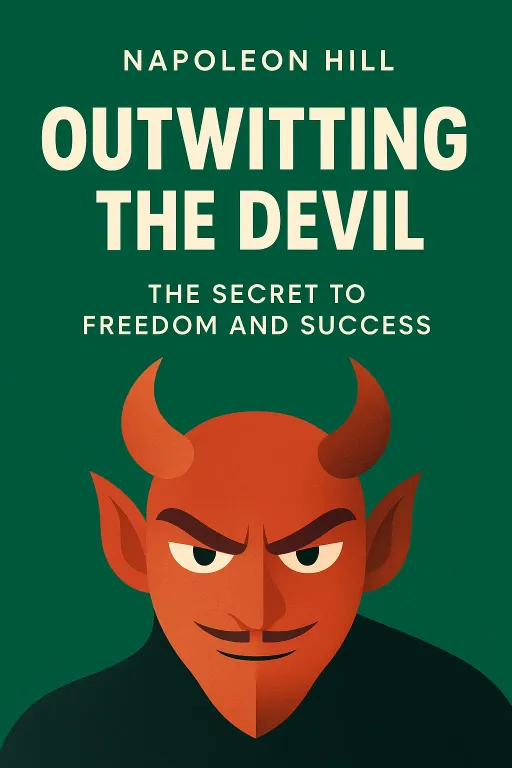
Prof. Eleanor Hart: Imagine writing a book so controversial, so potentially disruptive to the status quo, that your family locks it away in a vault for seventy-two years. That is exactly what happened to Napoleon Hill's manuscript, Outwitting the Devil, written in 1938 but hidden from the world until 2011. Why the secrecy? Because it dared to expose the subtle, invisible forces that keep ninety-eight percent of the population from ever thinking for themselves. Today, we are going to tackle this extraordinary text from three distinct angles. First, we will dissect the anatomy of drifting, the silent epidemic of mental passivity. Second, we will explore the universal law of hypnotic rhythm, the natural force that makes our daily habits permanent. And finally, we will look at self-discipline as a form of preventative mental healthcare. Joining me to analyze these deep psychological frameworks is Grace, a healthcare professional with a brilliant, analytical mind. Grace, welcome to the show.
Grace: Thanks, Eleanor. It is fascinating to be here. When I look at Hill's work, especially through an analytical lens, I do not just see a self-help book. I see a diagnostic manual for the human mind. In healthcare, we talk a lot about systemic failures and chronic conditions that creep up on patients because of lifestyle habits. Hill is essentially describing a chronic cognitive condition, a sort of mental paralysis that he calls drifting. And as an INTJ, I love looking at the root causes of things. Why do we lose our autonomy? How do we let external circumstances dictate our internal state? This book offers a highly structured, almost clinical breakdown of how that happens.
Prof. Eleanor Hart: It really does. And the backstory of the book itself is a perfect example of the very fear Hill warns us about. In 1938, Hill typed this manuscript on a manual typewriter. But his wife, Annie Lou, was terrified of the backlash. She worked for the president of a Presbyterian college, and she feared the book's provocative format, an interview with the Devil himself, would destroy Hill's career and cause a massive religious outcry. So, she blocked it. Even after Hill died in 1970, the manuscript remained locked away, passed down through family members who shared those same fears, until it finally reached Sharon Lechter for editing and publication decades later. It is a stunning case of fear suppressing truth.
Grace: It is the ultimate irony, isn't it? The book about overcoming fear was kept in the dark by fear itself. But from a systems perspective, that delay might have been a blessing. The economic and social anxieties of today make Hill's message incredibly timely. We are constantly bombarded by information, propaganda, and systemic stressors. If we do not have a robust framework for independent thinking, we simply drift.
Deep Dive into Core Topic 1
SECTION
Prof. Eleanor Hart: Let's pull on that thread of drifting. In the book, Hill conducts this imaginary, courtroom-style interrogation with the Devil, who proudly claims that he controls ninety-eight percent of the world's population. And his primary tool? Inducing the habit of drifting. The Devil defines a drifter as anyone who permits themselves to be influenced and controlled by circumstances outside of their own mind. They do not think for themselves, they accept whatever life throws at them without a fight, and they lack a definite purpose.
Grace: That definition is incredibly striking. In my field, we look at homeostasis, how the body maintains stability despite external changes. Drifting is the exact opposite of psychological homeostasis. It is a state where a person's mental state is entirely dependent on external stimuli. If the environment is chaotic, their mind is chaotic. They lose that internal regulatory mechanism. And what is fascinating to me is how Hill describes the onset of this condition. It starts early, often in childhood. Parents, teachers, and even religious leaders, with the best of intentions, often destroy a child's capacity for independent thought by doing their thinking for them, forcing them to memorize facts rather than learn how to use their own minds.
Prof. Eleanor Hart: Exactly. Hill is highly critical of the public school system for that very reason. He argues that schools prioritize rote learning and credits over critical thinking. There is a story in the book's commentary about a group of volunteer scientists and business professionals in the 1970s who offered to teach practical physics and math in public schools. The administrators rejected them because they were not certified teachers. The system protected its credentials over actual, practical knowledge. It is that rigid conformity that breeds drifters.
Grace: It is a classic case of prioritizing the process over the outcome. When we train people to just follow rules and memorize protocols without understanding the underlying principles, we create cognitive vulnerability. In a clinical setting, if a healthcare provider only knows how to follow a checklist but cannot think critically when a patient's presentation deviates from the norm, the results can be catastrophic. We need that analytical agility. Hill's concept of the other self is really about tapping into that deeper, resilient level of critical thinking that only emerges when we are pushed to our limits.
Prof. Eleanor Hart: Yes, the other self. Hill discovered his own other self during a period of intense personal crisis. In the mid-1920s, he was working with a crusading journalist named Don Mellett to expose corruption in Canton, Ohio. Mellett was brutally murdered by underworld figures, and Hill received anonymous warnings that he was next. He fled to West Virginia and spent a year paralyzed by fear, unable to write, unable to function. He had written all these principles of success, yet he was completely defeated by his own mind.
Grace: That is a crucial point of vulnerability. It shows that knowing the theory is not enough. You can have a bachelor's degree, you can have all the academic knowledge in the world, but when a crisis hits, the emotional brain can completely hijack the rational brain. Hill was experiencing a profound spiritual and psychological crisis. He was a lone wolf, isolated, and his fear had completely shut down his initiative.
Prof. Eleanor Hart: But then came the turning point. One night, walking near a school building, he had this sudden, powerful realization. He recalled Andrew Carnegie's advice about the other self, this intangible force that emerges during times of adversity. Hill made a firm, absolute decision to conquer his fear. He received what he called an order from his subconscious to go to Philadelphia to find a publisher. He had no money, no concrete plan, just a definite purpose. And when he acted on that intuition, doors started opening. He met Albert Pelton, who agreed to publish his work, and within months, Hill was earning a massive income.
Grace: From a cognitive standpoint, what Hill did was break the feedback loop of anxiety. Fear paralyzes action, and inaction breeds more fear. By making a definitive decision, he shifted his brain from a state of passive threat-response to active goal-directed behavior. In psychology, we know that taking decisive action, even a small step, reduces cognitive load and builds self-efficacy. It is like restarting a stalled engine. Once you get that initial momentum, the system can begin to regulate itself again.
Deep Dive into Core Topic 2
SECTION
Prof. Eleanor Hart: And that momentum is governed by a powerful natural law that Hill calls hypnotic rhythm. This is the second core concept we need to unpack. The Devil explains that hypnotic rhythm is the universal law through which nature solidifies our habits and makes them permanent. Think of it like a psychological gravity. Whatever thought patterns we repeat, whether positive or negative, hypnotic rhythm weaves them into our very character.
Grace: This is where Hill's philosophy aligns beautifully with modern neuroscience. We have this saying in neurology: neurons that fire together, wire together. That is hypnotic rhythm in biological terms. When you repeat a thought or a behavior, you strengthen the neural pathways associated with it. Over time, those pathways become myelinated, meaning the signal travels faster and with less effort. The habit becomes automated. If you constantly practice fear, worry, and indecision, your brain becomes physically wired to drift.
Prof. Eleanor Hart: Hill uses a wonderful analogy for this, the whirlpool. An object can float freely in a river for a long time, but if it gets too close to a whirlpool, it gets caught in the circular current and is dragged down, unable to escape. Hypnotic rhythm is that whirlpool. If you allow yourself to drift into negative thinking, you eventually get caught in a cycle that is incredibly difficult to break.
Grace: It is a perfect metaphor for systemic feedback loops. And we see this in societal structures too. Hill contrasts the rhythm of Fifth Avenue in New York, with its energy, ambition, and success-oriented mindset, with the rhythm of a poverty-stricken slum street, dominated by despair and hopelessness. The environment itself has a rhythm, a collective vibration that influences the individuals within it. As a healthcare professional, I see this in public health all the time. Socioeconomic environments shape health behaviors. If you are surrounded by chronic stress, poor nutrition, and lack of resources, those negative habits are reinforced by the collective rhythm of your community.
Prof. Eleanor Hart: So how do we protect ourselves from being dragged down by a negative hypnotic rhythm? Hill argues it starts with self-discipline, specifically mastering three key appetites: food, sex, and loosely organized opinions. Let's talk about food first, because Hill makes a direct connection between physical health and mental clarity that I think will really resonate with your background, Grace.
Grace: Oh, absolutely. Hill talks about auto-intoxication, which is essentially self-poisoning due to poor digestion and elimination. He argues that overeating and consuming unhealthy food combinations lead to a buildup of toxins in the body, which clogs the brain and impairs our capacity for accurate thinking. Now, in 1938, the medical understanding of the gut-brain axis was in its infancy, but Hill was spot on. Today, we know that the gut microbiome produces a significant portion of our neurotransmitters, including serotonin. If your digestive system is inflamed and toxic due to a poor diet, it directly impacts your cognitive function, your mood, and your decision-making. You get brain fog, sluggishness, and a lack of willpower, which makes you incredibly susceptible to drifting.
Prof. Eleanor Hart: It is incredible how ahead of his time he was. He saw the body as a single, integrated system. If the physical sewer system, as he calls it, is clogged, the mental system cannot function. And the second appetite he discusses is sex. He does not advocate for suppression, but rather transmutation, channeling that powerful creative energy into productive work rather than wasting it on mere physical indulgence.
Grace: Yes, sex energy transmutation is a major theme in Hill's philosophy. From an analytical perspective, sexual desire is one of the most potent drivers of human behavior. It is pure, raw energy. If you dissipate that energy constantly through short-term gratification, you drain your drive, your enthusiasm, and your persistence. But if you learn to redirect that focus toward a creative project, a career goal, or a scientific breakthrough, you harness an incredible force. It is about delayed gratification, which is the cornerstone of any significant achievement.
Prof. Eleanor Hart: And the third appetite is the habit of expressing loosely organized opinions. Hill warns that freely sharing unformed thoughts and gossiping not only prevents us from listening and learning, but it also makes us vulnerable to manipulation. He tells a story about an editor who lost a highly lucrative position simply because he could not resist writing an uninvited, highly critical letter to a magazine publisher. His vanity and lack of caution cost him his career.
Grace: That is a classic INTJ pet peeve, honestly. The world is full of noise and unscientific opinions. When people speak without facts, they are just drifting in a sea of cognitive biases. In healthcare, we rely on evidence-based practice. You do not make a diagnosis based on a hunch or a popular trend; you look at the data. Self-discipline means having the restraint to keep your mouth shut until you have actually analyzed the facts. It protects your intellectual integrity and keeps you from being manipulated by propaganda.
Synthesis & Takeaways
SECTION
Prof. Eleanor Hart: As we wrap up our discussion, it is clear that Outwitting the Devil is not just a historical curiosity. It is a practical blueprint for cognitive sovereignty. Hill's seven principles, Definiteness of Purpose, Mastery Over Self, Learning from Adversity, Controlling Environmental Influence, Time, Harmony, and Caution, offer a comprehensive system for navigating the complexities of modern life. Grace, when you synthesize all of this, what is the ultimate takeaway for our listeners?
Grace: For me, it comes down to the realization that mental autonomy is not a given; it is an active, daily practice. Just like physical fitness, if you do not use your mind, you lose it. If you do not consciously choose your goals and direct your thoughts, nature's law of hypnotic rhythm will fill that vacuum with the dominant fears and anxieties of your environment. We have to treat our minds with the same preventative care we give our bodies. Choose your associates carefully, guard your physical health to maintain mental clarity, and above all, be definite in your purpose.
Prof. Eleanor Hart: Beautifully said, Grace. I want to leave our audience with a powerful quote from the book's summary: "One’s dominating desires can be crystallized into their physical equivalents through definiteness of purpose backed by definiteness of plans, with the aid of nature’s law of hypnotic rhythm and time." Ask yourself today: Are you actively steering your ship, or are you drifting with the current? Thank you for listening to this episode of our podcast. Until next time, keep thinking, keep analyzing, and keep outwitting the forces that seek to quiet your mind.