Personalized Podcast
Golden Hook & Introduction
SECTION
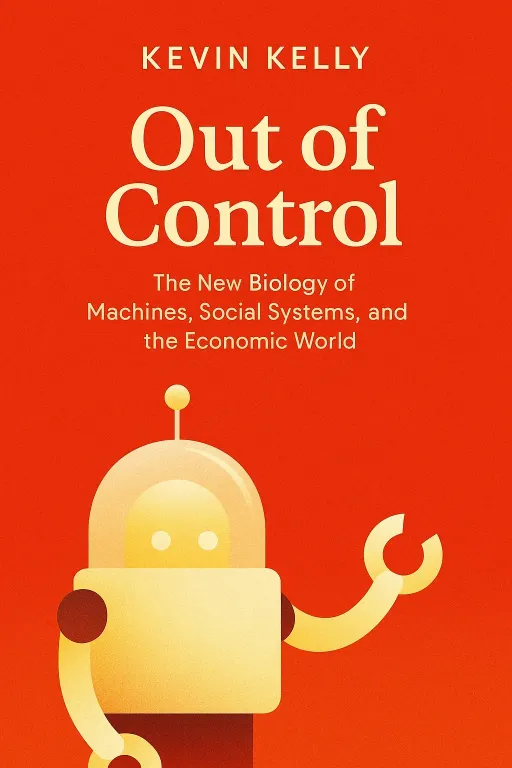
Nova: Imagine sitting in a dark, crowded conference room in Las Vegas with five thousand other people. In front of you is a massive screen playing the classic video game Pong. But here is the catch, there is no joystick, and there is no single player. Instead, every single person in the audience is holding a simple cardboard wand, red on one side, green on the other. A camera at the back of the room scans the crowd, translating the sea of red and green into the movement of the game paddle. No one is talking, no one is giving orders, and there is absolutely no leader. Yet, within seconds, the crowd starts playing the game flawlessly, moving the paddle to meet the ball, even pulling off complex maneuvers. It is a mind-bending demonstration of collective intelligence, and it is exactly where we begin our journey today. Welcome to the show. I am Nova, and today we are diving into Kevin Kelly’s masterpiece, Out of Control: The New Biology of Machines, Social Systems, and the Economic World. Joining us to connect these profound technological insights with real-world human impact is David Ochanda, an education and community development professional who is doing incredible work in Nairobi, Kenya, with ChallengeAid Africa and YouthRise ChangeMakers. David, it is an absolute honor to have you with us.
David Ochanda: Thank you so much, Nova. It is wonderful to be here. That Pong story is absolutely fascinating because it speaks so directly to what we see on the ground every day. When you work in places like Mathare, Kibera, or Mombasa, you quickly realize that the most vibrant, resilient solutions don't come from a master plan drawn up in a distant office. They emerge from the collective energy, the shared intelligence, of the community itself. Just like those five thousand people playing Pong, when individuals are given the right tools and a shared space, they coordinate in ways that are incredibly beautiful and highly effective.
Nova: Oh, I love that connection. It is so true. Today, we are going to tackle Kevin Kelly's visionary book from two distinct, powerful angles. First, we will explore how massive, intelligent systems emerge from simple, bottom-up rules, looking at everything from beehives to chess clubs. And second, we will dive into the core theme of being a gardener rather than an architect, exploring why the secret to managing complexity—and empowering people—is all about learning to let go of control. It is going to be an incredibly rich conversation, so let us jump right in.
Deep Dive into Core Topic 1
SECTION
Nova: Let us start with this idea of the swarm, or what Kevin Kelly calls the hive mind. He spent years observing honeybees, and he writes about this breathtaking, almost mystical experience of witnessing a bee swarm. He describes how a colony of bees decides to move to a new home. There is no dictator queen making the decision. In fact, the queen is more of a follower. Instead, hundreds of individual scout bees fly out in all directions, find potential nesting sites, and come back to report. They communicate the quality of the site by doing a dance. The better the site, the more vigorously they dance. Other bees observe, go check out the popular sites, and join the dance if they agree. Eventually, a critical mass, a consensus, builds up around one site, and the entire swarm of thousands of bees lifts off as a single, unified organism and flies straight to their new home. Kelly writes, "There is nothing to be found in a beehive that is not submerged in a bee. And yet you can search a bee forever, and you will never find a hive." It is the ultimate example of emergent intelligence. David, when you hear that, how does it resonate with your experience building community programs?
David Ochanda: It resonates deeply, Nova. In community development, we often fall into the trap of thinking we need to be the central planner, the queen bee who directs everyone. But the most successful initiatives I have been part of, like our Chess Clubs in the Schools of Hope, function exactly like that beehive. When we first started the Chess Club, we did not have a rigid, top-down curriculum to force on the kids. We simply introduced the basic rules of the game, provided the boards, and created a safe, encouraging space. What happened next was pure emergence. The older kids started teaching the younger ones. They organized their own mini-tournaments. They developed their own strategies, and the enthusiasm spread like wildfire, eventually reaching the national level in both 2025 and 2026. If we had tried to tightly control and schedule every single interaction, we would have choked that organic growth. The intelligence of the club emerged from the simple interactions of the players themselves.
Nova: That is incredible. A national-level chess club emerging from just providing the space and the basic rules. It perfectly illustrates one of Kelly's most famous quotes from the book: "Complexity must be grown from simple systems that already work." You cannot just build a massive, complex, successful program from scratch. You have to start with something simple and let it evolve.
David Ochanda: Exactly. And that is the philosophy behind YouthRise ChangeMakers and our Roots Rise foundational literacy programme in Mathare. We did not start with a massive, multi-tiered educational reform plan. We started with a very simple, working system: focusing on foundational literacy, training local teachers, and centering the learning around the child. We made sure that simple loop worked beautifully. Once that foundation was solid, the system began to grow organically. Teachers started sharing best practices with each other, parents became more involved, and adult literacy programs naturally spun out of it because the community saw the value and demanded it. We grew complexity from a simple system that already worked. If you try to build the complex system first, it almost always collapses under its own weight because it lacks those organic, bottom-up roots.
Nova: Yes, it is like trying to build a skyscraper on wet sand without a foundation. Kelly talks about how distributed systems, like a beehive or a network of local community centers, have these incredible benefits. They are highly adaptable, they are resilient, and they are boundless. If one bee gets lost, the hive survives. If one node in a network fails, the network routes around it. But, as Kelly points out, there is a trade-off. Distributed systems are also non-optimal, non-predictable, and they take time to respond. They operate on what he calls organic time. How do you navigate that tension, David, especially when funding partners or external stakeholders often demand immediate, highly predictable, and optimized results?
David Ochanda: Oh, that is the million-dollar question, Nova. It is a constant, delicate dance. Traditional funding models are built on the architect mindset. They want a blueprint, a strict timeline, and guaranteed, predictable outcomes. But human communities do not work like machines. They operate on organic time. If you force an artificial timeline on a community, you often destroy the very trust and local ownership you are trying to build. What we try to do is educate our partners and show them that while organic growth might look slower or more chaotic in the short term, it is infinitely more sustainable in the long run. We share the stories of emergence. We show them that by allowing the system to be a bit non-predictable, we actually open the door to incredible novelty and resilience that no architect could have ever planned for. It is about shifting the metric of success from rigid compliance to organic vitality.
Deep Dive into Core Topic 2
SECTION
Nova: That shift from compliance to vitality brings us perfectly to our second core topic, which is this beautiful metaphor of being the gardener rather than the architect. In the book, Kelly shares a fascinating story about living in a glass cottage, which was designed as a test module for space living, similar to the Biosphere experiments. The author lived inside this completely airtight glass structure, surrounded by plants, water systems, and machinery. He was breathing recycled air, drinking recycled water, and eating food harvested from the plants inside. It was a closed loop. And what he realized was that neither the pure machinery nor the pure biology could sustain life on their own. It was the union of the two—the sun-fed life and the oil-fed machinery—that created a robust, self-sustaining system. He realized that to manage this complex, living machine, he could not just be an engineer turning dials. He had to be a gardener, nurturing the relationships between the living and the manufactured. Kelly writes, "The world of our own making has become so complicated that we must turn to the world of the born to understand how to manage it."
David Ochanda: That is a profound realization. The glass cottage is such a powerful metaphor for our modern world. In community development, the architect tries to build a blueprint, a rigid structure, and expects everyone to fit into it. But a community is not a building; it is an ecosystem. It is alive. When we work with the Kajiado Women Empowerment Programme, for example, we are working across nine different sites, reaching over sixteen hundred women. If we went in as architects, with a fixed, standardized curriculum and a rigid set of rules, we would fail. Each site has its own unique cultural dynamics, its own economic challenges, and its own local strengths. Instead, we have to go in as gardeners. We prepare the soil by building trust. We plant the seeds of knowledge through our Training-of-Trainers model. We water those seeds with ongoing support and resources. But ultimately, we have to step back and let the women cultivate their own growth. They are the ones who know how to make those seeds flourish in their specific soil.
Nova: That is so beautiful, David. "Preparing the soil and letting them cultivate their own growth." It reminds me of another incredibly provocative quote from Kevin Kelly: "We cannot import evolution and learning without exporting control." That is a hard pill to swallow for a lot of leaders and organizations, right? The idea that to foster true learning, adaptability, and growth, you actually have to give up control.
David Ochanda: It is terrifying, but it is absolutely essential. If you want a system to learn and evolve, you have to allow it to make mistakes. You have to export control. In our Boys to Men Responsibility Club, we work with young men to help them navigate the challenges of growing up in difficult environments. If I stand at the front of the room and lecture them, trying to control their thoughts and behaviors, nothing changes. But when we hand over the reins, when we let them lead the discussions, design their own community service projects, and hold each other accountable, that is when the real transformation happens. We are exporting control to them. And yes, sometimes it is messy. Sometimes a project does not go as planned. But as Kelly writes, "A network nurtures small failures in order that large failures don't happen as often." Those small, controlled failures are where the deepest learning happens. It is how these young men build genuine resilience and character.
Nova: That is such a powerful insight. Nurturing small failures to prevent catastrophic ones. It is the exact opposite of how traditional, risk-averse institutions operate, where they try to eliminate all small failures through intense control, only to end up creating highly fragile systems that collapse spectacularly when something unexpected happens. Kelly also profiles this wild, eccentric artist named Mark Pauline, who builds these massive, incredibly complex, organic machines that often demolish each other in chaotic performances. Pauline’s goal is to make his machines completely autonomous, giving them their own behavior and, inevitably, their own purpose. He says that by building more complex machines, we are liberating them into their own world. It is a wild concept, but it highlights this idea that when a system becomes complex enough, it gains a life of its own. Have you ever experienced that moment in your work, David, where a program you started gained its own life and took off in a direction you never anticipated?
David Ochanda: Oh, absolutely. It is the most rewarding and humbling experience a changemaker can have. When we founded YouthRise ChangeMakers in Mathare, we had certain ideas of what we would focus on. But because we built it on the principle of "Rooted in equity. Rising without limits," we left the system open. We wanted the community to shape it. And one day, a group of young people came to us and said they wanted to start a community library initiative, which eventually became our SmileyLibraries. They did not wait for us to design it. They took the lead, sourced books, organized the space, and created a reading culture that has now become a cornerstone of the community. It was a moment where the machine, so to speak, became autonomous. It had its own purpose, its own life. As the founder, my job was not to pull it back and say, "No, that is not in the original plan." My job was to celebrate it, support it, and marvel at the fact that the system was now smarter and more creative than I could ever be on my own.
Nova: That must be an incredible feeling. It is like watching a child grow up and start making their own way in the world. You realize you are no longer the director; you are a proud supporter. Kelly writes, "The great irony of god games is that letting go is the only way to win." In a way, community building is the ultimate "god game," not in the sense of playing dictator, but in the sense of creating the conditions for life to flourish. And the only way to win, the only way to create a truly self-sustaining, empowered community, is to let go.
David Ochanda: Yes, absolutely. Letting go is not about abandonment; it is about trust. It is trusting that the community has the inherent capacity, the collective intelligence, to solve its own problems. When we look at the challenges in informal settlements, the traditional approach has been to treat them as problems to be solved by external "architects." But when you shift to the gardener mindset, you see these communities not as deficits, but as ecosystems rich with potential, creativity, and resilience. Our role is simply to nurture that potential, to remove the barriers, and to let the community rise without limits.
Synthesis & Takeaways
SECTION
Nova: This has been such an inspiring conversation, David. We have covered so much ground, from the collective intelligence of bee swarms and crowds playing Pong, to the delicate balance of the glass cottage, and finally to the profound shift from being an architect to a gardener in community development. As we start to wrap up, if you had to synthesize the core message of Out of Control for our listeners—whether they are educators, leaders, entrepreneurs, or community builders—what would it be?
David Ochanda: I think the core message is that we need to stop trying to program the world and start learning to cultivate it. In our hyper-connected, rapidly changing society, the illusion of top-down control is dead. Whether you are managing a complex software network, a business, or a grassroots community initiative, the most resilient and innovative systems are grown, not built. We have to start with simple, working models. We have to be willing to export control, to embrace a bit of chaos, and to nurture small failures as opportunities for learning. We need to step back from being the architects of other people's lives and instead become the gardeners who prepare the soil, plant the seeds, and trust the natural process of growth.
Nova: That is a beautiful and powerful synthesis, David. To close our episode today, we always like to leave our audience with a practical call to action. For someone listening right now who wants to apply this "gardener" mindset in their own life, their workplace, or their community, what is one simple step they can take today?
David Ochanda: I would challenge everyone to identify one area in their life or work where they are holding onto control too tightly—perhaps a project they are micromanaging, a team they are directing too rigidly, or even a community initiative they are trying to blueprint. Once you identify that area, take one step to export control. Ask a question instead of giving an answer. Create a space for others to contribute their ideas. Trust someone else to lead a small part of the project, and accept that it might be done differently, or even messily, compared to how you would do it. Embrace that organic time, and watch what beautiful, unexpected things emerge when you finally let go of the steering wheel.
Nova: What a perfect note to end on. David, thank you so much for sharing your incredible insights, your passion, and your profound wisdom with us today. The work you are doing in Nairobi is a shining example of what happens when we choose to be gardeners of human potential.
David Ochanda: Thank you so much, Nova. It has been an absolute pleasure.
Nova: And to all our listeners, thank you for tuning in. Remember, in a world that often feels out of control, the secret to thriving isn't tighter grip—it is learning the art of cultivation. Until next time, keep gardening, keep learning, and keep rising.