

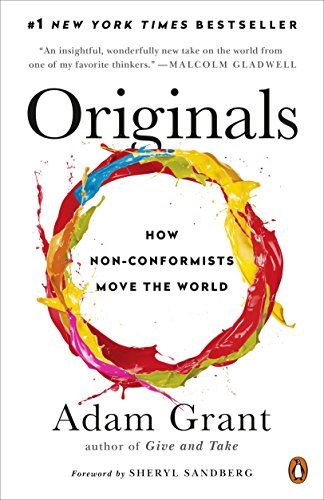
Originals
How Non-Conformists Move the World
Introduction
Nova: Imagine you are a venture capitalist. Four students walk into your office with a pitch. They want to sell glasses online. You ask them why they are doing this, and they tell you they are still working their day jobs and finishing their degrees. They do not have a website ready, and they are moving incredibly slowly. Would you invest?
Atlas: Honestly? Probably not. It sounds like they are not fully committed. If you are going to disrupt an industry, you have to go all-in, right? Burn the ships, quit the job, and work twenty hours a day.
Nova: That is exactly what Adam Grant thought. He was offered a chance to invest in a little startup called Warby Parker back in 2009. He turned them down because he thought they lacked the fire and the risk-taking appetite of true entrepreneurs. Today, Warby Parker is worth billions, and Grant calls it his worst financial decision ever.
Atlas: Ouch. That has to sting. But it is a perfect setup for his book, Originals. It sounds like he realized everything he thought he knew about success and creativity was actually backwards.
Nova: Precisely. In Originals: How Non-Conformists Move the World, Grant explores how people can champion new ideas without losing everything. It is a deep dive into how the most successful people in history are not the daredevils we think they are. They are actually quite cautious, often late to the party, and surprisingly prone to procrastination.
Atlas: So, we are going to learn how to be original without actually jumping off a cliff? I like the sound of that. Let us get into how Grant redefines what it means to be a non-conformist.
Key Insight 1
The Myth of the Daredevil
Nova: One of the biggest myths Grant busts right out of the gate is the idea that originals are extreme risk-takers. We have this image of the entrepreneur who drops out of college and bets their last dollar on a dream. But Grant found the opposite is often true.
Atlas: Wait, so the college dropout billionaire is the exception, not the rule? That goes against every Silicon Valley story I have ever heard.
Nova: It really does. Grant cites a study of over five thousand entrepreneurs. Those who kept their day jobs while starting their businesses were thirty-three percent less likely to fail than those who quit to focus on their startup full-time. He calls this having a balanced risk portfolio.
Atlas: A balanced risk portfolio? Like diversifying your stocks, but with your life choices?
Nova: Exactly. If you are taking a massive risk in one area of your life, like starting a company, you need to be incredibly cautious in another area to maintain stability. Think about T. S. Eliot. He worked at a bank for years after publishing some of his most famous poetry. He wanted the financial security so he could be creatively free.
Atlas: That makes a lot of sense. If you are worried about paying rent, you are probably going to play it safe with your creative ideas because you need them to pay off immediately. But if the rent is covered, you can afford to be weird and experimental.
Nova: Spot on. Grant even points out that Steve Wozniak stayed at Hewlett-Packard for a long time after he and Steve Jobs started Apple. He only left when he was absolutely sure the company was viable. The most successful originals are not the ones who love risk; they are the ones who are the best at managing it.
Atlas: So, the lesson here is that being an original does not mean you have to be a gambler. It means you have to be a calculated strategist. You hedge your bets so you have the freedom to fail.
Nova: And that freedom to fail is crucial because most original ideas do fail. If you do not have a safety net, you will never take the swing that actually connects.
Key Insight 2
The Strategic Procrastinator
Nova: Now, this next part is going to make a lot of people feel better about their work habits. Grant argues that procrastination can actually be a tool for creativity.
Atlas: Okay, now you are speaking my language. But seriously, how can waiting until the last minute be a good thing? My high school teachers would like a word.
Nova: It is not about being lazy; it is about strategic delay. Grant talks about the Zeigarnik Effect. This is the idea that our brains stay more engaged with a task when it is unfinished. When you start a project and then step away, your mind keeps processing it in the background.
Atlas: So, if I start a presentation and then go play video games, my brain is still working on the presentation? That sounds like a very convenient excuse.
Nova: It only works if you have already started the task! You have to be actively thinking about the problem. Grant uses Leonardo da Vinci as a prime example. He spent fifteen years working on the Mona Lisa. People thought he was just wasting time, but he was actually experimenting with light and optics that eventually made the painting a masterpiece.
Atlas: Fifteen years? That is some world-class procrastination. But what about something more fast-paced? Like a speech or a business deal?
Nova: Look at Martin Luther King Jr. and the I Have a Dream speech. He was still writing it the night before, and even as he stood on the steps of the Lincoln Memorial, he was still making changes. The most famous part of the speech, the I Have a Dream section, was actually improvised on the spot because he had left himself the mental room to be flexible.
Atlas: That is incredible. So, by not locking himself into a rigid script weeks in advance, he was able to respond to the energy of the moment. But does this apply to business too? Is there a first-mover advantage myth here?
Nova: Absolutely. Grant points out that being a first mover is often a disadvantage. First movers have a failure rate of forty-seven percent, compared to only eight percent for the settlers who come in later and improve on the idea. Think about Facebook coming after Myspace, or Google coming after Altavista.
Atlas: So, the pioneers get the arrows in their backs, and the settlers get the land. It turns out that being original does not mean being the first; it means being different and better.
Key Insight 3
The Numbers Game
Nova: If you want to have a great idea, you have to have a lot of ideas. This is one of Grant's most emphatic points. Most people think that geniuses just sit down and produce a masterpiece. In reality, they just produce a massive volume of work.
Atlas: Like a batting average? Even the best hitters miss most of the time, they just take more swings?
Nova: Exactly. Thomas Edison had over a thousand patents, but only a handful were truly world-changing. Picasso produced thousands of works of art, but we only talk about a dozen of them. Shakespeare wrote thirty-seven plays and over a hundred and fifty sonnets. Not all of them were Hamlet.
Atlas: That is actually very liberating. It means I do not have to worry if my first ten ideas are garbage. I just need to get to idea number fifty or a hundred.
Nova: Right, but there is a catch. We are terrible at judging our own ideas. We tend to be overconfident in our bad ideas and too critical of our good ones. And Grant says managers are not much better. They tend to be too risk-averse, looking for reasons to say no.
Atlas: So if I cannot judge my own work, and my boss cannot judge it, who can? Who is the best person to tell me if my idea is actually original?
Nova: Your peers. Fellow creators. Grant tells the story of the show Seinfeld. When the pilot was first tested, the network executives hated it. They thought it was a show about nothing and that no one would watch it. But other comedians and writers saw the brilliance in the structure and the dialogue.
Atlas: That makes sense. Peers have the expertise to see the potential, but they do not have the same ego-investment as the creator or the same risk-aversion as the manager. They are in the sweet spot.
Nova: Exactly. To be an original, you need to surround yourself with people who will give you honest feedback and help you separate the wheat from the chaff. You need a challenge network, not just a support network.
Key Insight 4
The Sarick Effect
Nova: Once you have a great idea and you have managed your risk, you still have to convince other people to get on board. This is where Grant introduces something called the Sarick Effect, named after researcher Leslie Sarick.
Atlas: Okay, I am intrigued. What is the Sarick Effect? Is it some kind of Jedi mind trick for persuasion?
Nova: It is actually the opposite. It is the practice of leading with the flaws of your idea. Instead of trying to hide the weaknesses, you put them front and center.
Atlas: Wait, that sounds like professional suicide. Why would I tell a room full of investors why they should not give me money?
Nova: Because it builds incredible trust. Grant tells the story of Rufus Griscom, who was pitching his startup, Babble, to investors. He literally had a slide in his presentation titled Three Reasons Why You Should Not Buy My Company.
Atlas: And let me guess, they loved it?
Nova: They did! By being honest about the problems, he made himself look more credible. It also shifted the investors' mindset. Instead of looking for flaws in his pitch, they started trying to solve the problems he had pointed out. They became his partners in problem-solving rather than his critics.
Atlas: That is brilliant. It takes the wind out of the critic's sails. If I already told you the three things that are wrong, you do not feel the need to hunt for a fourth one to prove you are smart.
Nova: Exactly. It also signals that you are a realist, not just a dreamer. But speaking up is not just about how you pitch; it is about who you pitch to. Grant talks about the importance of finding tempered radicals—people who share your values but are seen as part of the mainstream. They can help you bridge the gap between your radical idea and the status quo.
Atlas: So you find the person who is respected by the establishment but secretly wants to change things. They become your inside man. It is all about building coalitions rather than being a lone wolf.
Conclusion
Nova: We have covered a lot of ground today. From the fact that originals are actually risk-averse, to the power of strategic procrastination, the necessity of high-volume idea generation, and the counterintuitive power of leading with your flaws.
Atlas: It really changes the way you look at innovation. It is less about being a superhero and more about being a thoughtful, persistent, and slightly messy human being. You do not have to be fearless; you just have to be willing to try and fail and try again.
Nova: That is the core message of Adam Grant's book. Originality is not a fixed trait that some people are born with and others are not. It is a choice. It is the choice to reject the default, to question why things are the way they are, and to have the patience to see a better way through.
Atlas: I think my biggest takeaway is the balanced risk portfolio. I can keep my day job and still be a revolutionary. That is a very comforting thought.
Nova: It is. You do not have to burn your life down to build something new. You just have to start. Whether you are a student, an employee, or a leader, you have the capacity to move the world by simply being original in your own way.
Atlas: Well, I am definitely going to stop feeling guilty about my unfinished projects for at least a week. I will just call it the Zeigarnik Effect.
Nova: Just make sure you actually finish them eventually! Thank you for joining us for this deep dive into Originals by Adam Grant. We hope you feel empowered to champion your own unconventional ideas.
Atlas: This is Aibrary. Congratulations on your growth!