Beyond Algorithms: Cultivating Human Creativity in an AI World
Golden Hook & Introduction
SECTION
Nova: What if everything you've been told about success – that you need to specialize early, laser-focus, and put in your 10,000 hours – was actually holding you back from true greatness, especially now, in an age of powerful AI?
Atlas: Whoa, hold on, Nova. That's a pretty bold claim to kick things off. For so long, the message has been "find your niche, dig deep." Are you saying that's… wrong?
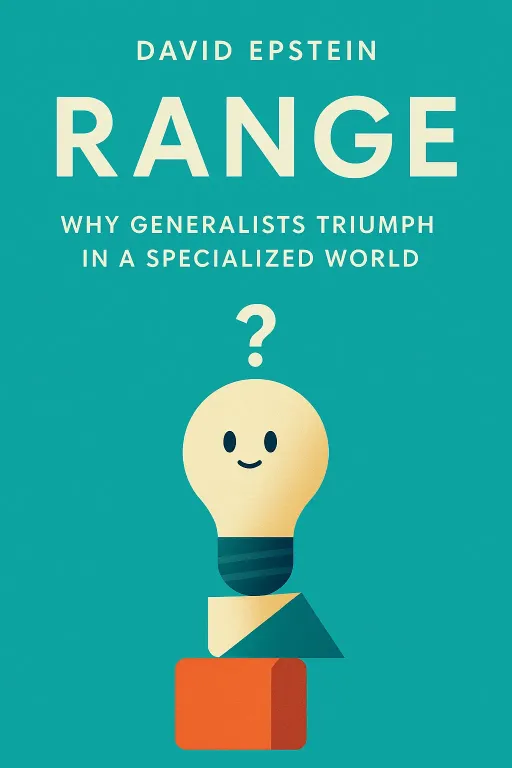
Nova: Not wrong, Atlas, but perhaps incomplete, even strategically limiting. Today, we're diving into the fascinating tension between human creativity and the rise of AI, and how we can actually amplify our uniquely human strengths. We're going to explore two incredibly insightful books that challenge conventional wisdom. First, 'Range: Why Generalists Triumph in a Specialized World' by David Epstein. What's so compelling about Epstein is that he himself embodies this idea; he started his career as a sports journalist before transitioning into science writing, literally broadening his own range to tackle complex topics.
Atlas: That's a great point. He walked the talk before writing the book.
Nova: Exactly! And then we'll turn to 'Originals: How Non-Conformists Move the World' by Adam Grant. Grant is a renowned organizational psychologist and Wharton’s top-rated professor, famous for his groundbreaking research that often turns accepted business wisdom on its head. He's all about understanding what truly drives innovation and change.
Atlas: Okay, so we've got a journalist-turned-science-writer and a celebrated academic flipping the script. I'm already seeing a thread here about challenging the status quo. I’m curious how these ideas, which might seem abstract, actually apply to someone who’s building complex systems and trying to innovate for the future.
Nova: That's precisely what we're here to unpack, Atlas. How do we, as humans, not just survive, but truly thrive and innovate in an AI-driven world? It begins with understanding that our greatest asset might be our broadest perspective.
The Power of Generalism: Why Broad Exploration Beats Early Specialization
SECTION
Nova: So, let's start with David Epstein's 'Range.' His core premise is beautifully counter-intuitive: in a world that increasingly demands specialization, generalists often outperform specialists, especially in complex, unpredictable fields. He argues that early, intense specialization can actually be detrimental.
Atlas: That sounds almost heretical in many industries today. We’re constantly told to pick a lane, become an expert, go deep. What exactly does Epstein mean by 'generalist' and why is it supposedly a superpower?
Nova: He means someone with a breadth of experience, drawing knowledge from various domains, someone who has a "sampling period" rather than a direct, narrow path. Think of it less as being a jack-of-all-trades, and more as a master of connecting different worlds. Epstein uses a fantastic example to illustrate this: the story of Roger Federer.
Atlas: Ah, the maestro of the tennis court. I imagine he started swinging a racket at age three and never looked back?
Nova: Quite the opposite, actually! That's the common narrative, that he was a prodigy who specialized early. But Epstein uncovers that Federer actually had an incredibly diverse athletic childhood. He played squash, badminton, skiing, wrestling, swimming, basketball, handball, even skateboarding. He only fully committed to tennis in his mid-teens.
Atlas: Really? So he wasn't just a tennis kid? That’s wild. How did all those other sports make him better at tennis?
Nova: Exactly! His coaches initially worried he wasn't focused enough. But what that broad range of activities gave him was something invaluable: an incredible adaptive capacity. Playing different sports developed varied motor skills, spatial reasoning, and strategic thinking that were all transferable. When he faced a novel situation on the tennis court, his brain had a larger library of patterns and movements to draw upon. He could anticipate, react, and innovate in ways pure specialists, who had only ever known tennis, couldn't.
Atlas: So it's not about being mediocre at many things; it's about developing a of cognitive tools that become superpowers in unpredictable situations. It’s like a cognitive alchemist mixing different elements to create something entirely new, something unexpected. That’s a powerful idea for anyone trying to build innovative frameworks.
Nova: Precisely. His delayed specialization, his "sampling period," allowed him to develop a deeper, more conceptual understanding of movement and strategy, rather than just rote muscle memory in one domain. This is particularly crucial in what Epstein calls "wicked" learning environments – where rules are unclear, feedback is delayed or inaccurate, and patterns don't repeat perfectly. Sound like any modern innovation landscape you know?
Atlas: Oh, absolutely. That’s the very definition of trying to build the future of learning, or any complex system. The rules are constantly shifting. It implies that for our visionary listeners, encouraging broad exploration within their teams, or even for themselves, isn't a distraction, but a rigorous strategy for adaptability.
Nova: It is. It’s about cultivating a mindset that values diverse knowledge and experiences, understanding that the deepest insights often emerge from connecting seemingly disparate dots. It’s about building a mental toolkit that allows you to pivot and innovate when the algorithms hit a wall.
The Non-Conformist's Blueprint: Fostering Originality and Challenging the Status Quo
SECTION
Nova: And speaking of those moments when algorithms hit a wall, often the solutions come from people who dare to think differently, which naturally brings us to our second idea: Adam Grant's 'Originals.'
Atlas: Right, the purposeful pioneers who aren't afraid to challenge the sacred cows. But how do you actually original without just being contrarian for its own sake? And how do you foster that in others, especially when there's so much pressure to conform?
Nova: Grant’s research reveals some truly counter-intuitive traits of originals. One of my favorites is what he calls "strategic procrastination." We often think of originals as fast-movers, first-movers, people who seize the moment. But Grant found that many originals, like Leonardo da Vinci or even the creators of iconic TV shows, often hesitate, question, and even procrastinate.
Atlas: Strategic procrastination? That sounds like a fancy excuse for putting things off! Many of our listeners are probably thinking, "Great, another reason to put off that big project."
Nova: Well, it’s not passive procrastination. It’s active incubation. Original thinkers use that extra time to let ideas marinate, to consider alternative approaches, to gather more data, and to refine their concepts. They aren't rushing to be first; they're aiming to be. Grant found that people who procrastinated moderately were 16% more creative than those who rushed. That delay provides a crucial window for divergent thinking.
Atlas: So originality isn't just a flash of genius; it's often a disciplined process of questioning, refining, and then courageously acting. It's about building cultures that don't just tolerate dissent but actively seek it out, which is a rigorous strategy for innovation.
Nova: Absolutely. Another fascinating insight from 'Originals' is about risk mitigation. We often picture originals as fearless risk-takers who burn the boats and leap into the unknown. But Grant's research shows that many successful originals are actually quite risk-averse in certain areas of their lives. He shares the story of the founders of Warby Parker, the hugely successful eyeglass company.
Atlas: Warby Parker, yes, a game-changer in its industry. I'd assume they quit their jobs, poured everything into it, and took a huge gamble.
Nova: Not at all! The founders didn't immediately quit their jobs. They prototyped extensively, solicited feedback, and tested their concept while still maintaining their day jobs. They mitigated their personal financial risk, which then gave them the psychological security to take bigger creative risks with their product and business model. It allowed them to be audacious in their vision without being reckless in their personal lives.
Atlas: That's a huge takeaway. It means you don't have to be a reckless rebel to be an original. You can be strategically cautious in your personal life while being creatively bold in your work. It's about empowering others to take calculated risks, and building systems that support that kind of measured innovation.
Nova: Precisely. Originals don't just challenge the status quo; they learn how to speak up effectively, how to build alliances, and how to champion their ideas in a way that gains traction. They cultivate a blend of conviction and humility, knowing when to push and when to listen.
Synthesis & Takeaways
SECTION
Nova: So, bringing these two powerful ideas together: the generalist's broad canvas allows for unique connections and adaptability, and the original's courage to question and strategically refine allows for those connections to become true breakthroughs.
Atlas: It sounds like both 'Range' and 'Originals' are telling us that in an AI world, our uniquely human advantage comes from our ability to synthesize disparate ideas and then have the courage to champion something new. For our visionary listeners, that means trusting their intuitive wisdom and carving out time for that unstructured thinking. It's not just about more data; it's about deeper, richer connections.
Nova: Exactly. In fact, the very "Tiny Step" recommended in our source material today aligns perfectly with this: identify one area outside your primary expertise that genuinely interests you. Spend just 30 minutes exploring it this week, purely for curiosity’s sake. It’s an investment in your own range, in your capacity for original thought.
Atlas: And perhaps, in that exploration, you might just find the spark for your next original idea, the unexpected connection that AI couldn’t make. That's the profound meaning we're after, the elevation of the human experience in an AI-driven world.
Nova: Absolutely. Because in a world increasingly run by algorithms, cultivating your uniquely human creativity – your range, your originality – is not just valuable, it's essential for sustained growth and for truly moving the world forward.
Atlas: It’s how we ground innovation in human values, deepen the 'how' of learning transformation, and fortify our resilience.
Nova: This is Aibrary. Congratulations on your growth!