

Unlocking Options: From Fundamentals to Strategic Edge
Golden Hook & Introduction
SECTION
Nova: You know, Atlas, I was reading this wild statistic the other day. Apparently, only about 13% of individual investors actively participate in options trading. That's a huge gap, considering the potential it holds for financial security.
Atlas: Whoa, that's a pretty stark number, Nova. It almost feels like there's a velvet rope around options, guarded by financial wizards and secret handshakes. For someone like me, who just wants to protect their family's future and understand the nuts and bolts, it can feel incredibly intimidating.
Nova: Exactly! It's like people hear "options" and immediately picture a high-stakes casino, not a sophisticated tool for strategic investing and capital protection. And yet, this isn't some arcane magic; it's a fundamental financial instrument.
Atlas: That’s a powerful reframing. I imagine a lot of our listeners, the resilient achievers and focused learners out there, are nodding along. They want deep understanding, not just surface-level tips. They’re driven by that core need for financial security, just like I am.
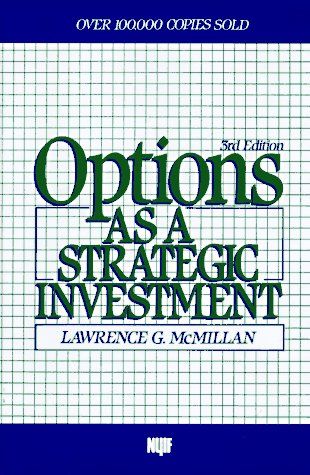
Nova: Absolutely. And that's precisely why we’re diving into two foundational texts today. We’re talking about "Options as a Strategic Investment" by the legendary Lawrence G. McMillan, a true pioneer in demystifying complex option strategies, and "Options Trading for Dummies" by Alan Ellman, which, despite its title, is an incredibly clear and step-by-step guide for anyone looking to build a robust understanding.
Atlas: McMillan and Ellman – that sounds like a powerhouse duo. One for the deep strategy, the other for the absolute bedrock. I like that. It’s about building a complete picture, from the 'what' to the 'how' and 'why,' right?
The Options Primer - Demystifying the Basics
SECTION
Nova: Precisely. Let's start with Ellman, because before you can run advanced strategies, you need to crawl, then walk. He literally lays out the blueprint for understanding the basics. Think of an option contract not as a gamble, but as a right, not an obligation, to buy or sell an underlying asset at a specific price by a specific date.
Atlas: So you're saying it's like a reservation, or a rain check? I pay a small fee now to secure a price for something later, but if I don't want it, I don't have to follow through?
Nova: That’s a fantastic analogy! Imagine you're planning a big family vacation, and you want to book a resort. You see a great price today, but you're not 100% sure your dates will align. You could pay a non-refundable deposit to lock in that price, knowing that if your plans change, you lose only the deposit, but if they don't, you get the good rate. That's essentially a call option, giving you the right to buy.
Atlas: Oh, I see! So if I buy a call option, I'm hoping the price of the underlying asset, let's say a stock, goes above my locked-in price, right? Because then I can buy it cheaper than the market price.
Nova: Exactly. And the reverse is a put option. Instead of the right to, it gives you the right to an asset at a specific price by a specific date. So, if you own a stock and you're worried it might drop in value, you could buy a put option. It’s like buying insurance for your stock.
Atlas: Wow, that’s actually really inspiring. So, if I’m a family provider, I can use these things to protect my existing investments? Not just to speculate on wild gains?
Nova: Absolutely. That's a core takeaway from both these books, especially when you combine Ellman's fundamentals with McMillan's strategic approach. It's about empowering your financial security. Ellman’s great at walking you through the mechanics: the strike price, the expiration date, the premium you pay. He breaks down how to execute your first trades with confidence, ensuring you don't just skim the surface.
Atlas: Okay, so the 'Dummies' book isn't about treating me like a dummy, but about making sure I understand the absolute groundwork before I even think about anything fancy. That’s crucial for a focused learner who wants a strong base. What’s an example of a simple strategy he might cover?
Nova: He’d walk you through something straightforward like buying a single call or put. Let’s say you believe a certain company’s stock, currently trading at $100, is undervalued and will rise. Instead of buying 100 shares for $10,000, which ties up a lot of capital, you could buy one call option contract, which typically controls 100 shares, with a strike price of $105 and an expiration three months out, for a premium of, say, $3 per share, or $300 total.
Atlas: So my maximum loss is that $300 premium, if the stock doesn’t go above $105 plus the premium? But my potential profit could be much larger if it skyrockets?
Nova: Precisely. It allows you to leverage a smaller amount of capital for potentially higher returns, but with a maximum risk, which is that premium you paid. Ellman emphasizes defining your maximum acceptable loss you place the trade. It's a tiny step, but a crucial one for capital protection.
Atlas: That makes sense. It’s about building in that safety net from the start. That’s something a resilient achiever would appreciate—calculated risk, not blind leaps.
Strategic Edge & Capital Protection with the Greeks
SECTION
Nova: And that naturally leads us to the second key idea we need to talk about, the strategic edge, which is where McMillan truly shines. He takes those foundational concepts and shows you how to wield them with precision, focusing heavily on volatility and risk management. This is where the 'Greeks' come into play.
Atlas: Ah, the Greeks! That sounds like a bit out there. Is this where the secret handshakes I joked about earlier come in? How do these mythical-sounding terms actually help me anticipate and manage the risk of my portfolio more effectively? Because honestly, that’s the deep question I, and I’m sure many listeners, have.
Nova: Not at all mythical, Atlas, but incredibly practical. The Greeks are simply measures of an option's sensitivity to various factors. Think of them as your options dashboard, giving you real-time feedback. Let's start with Delta.
Atlas: Delta. Sounds important.
Nova: It is. Delta tells you how much an option's price is expected to change for every one-dollar move in the underlying stock price. If an option has a Delta of 0.50, it means for every dollar the stock goes up, your option value goes up by 50 cents. It's like the speed of your option relative to the stock.
Atlas: Okay, so a higher Delta means my option is moving more in lockstep with the stock. But what if the stock price moves really fast?
Nova: That brings us to Gamma. Gamma measures how much the Delta itself changes for every one-dollar move in the stock. It’s the acceleration of your option’s price sensitivity. If Delta is speed, Gamma is the accelerator. High Gamma means your option's Delta is going to change rapidly as the stock moves. This is crucial for understanding how quickly your exposure can shift.
Atlas: So, Delta is how fast I’m going, and Gamma is how quickly I can speed up or slow down. That’s a great analogy. But what about time? Doesn't the expiration date matter a lot?
Nova: Absolutely, and that’s Theta’s domain. Theta measures how much an option’s price decays each day as it approaches expiration. Options lose value over time – it’s often called "time decay." If an option has a Theta of -0.10, it means it loses 10 cents of value every day, all else being equal.
Atlas: Oh man, I know that feeling of time running out! So, if I buy an option, Theta is working against me every single day. That’s something I need to factor into my maximum acceptable loss, right? That ticking clock.
Nova: Exactly. McMillan stresses the importance of understanding Theta because it’s a constant drain on long options positions. It’s why buying options can be tricky if you’re not precise with your timing. But shrewd traders can also options to Theta, essentially getting paid for time decay.
Atlas: That gives me chills! Getting paid for time passing, instead of it costing me. That's a whole new way to think about it. And finally, Vega? Sounds like it has something to do with Vegas, or maybe a constellation?
Nova: Vega measures an option's sensitivity to changes in implied volatility. Implied volatility is the market's expectation of how much the stock price will fluctuate in the future. High Vega means your option price is very sensitive to market sentiment and expected swings.
Atlas: So, if the market suddenly gets nervous and expects wild swings, my option’s value might pop, even if the stock hasn't moved yet? And vice versa? That sounds like the market's mood ring.
Nova: You’ve got it. McMillan argues that truly strategic options trading involves not just predicting price direction, but also understanding and forecasting volatility. It’s about leveraging these Greeks to build strategies that protect capital, manage risk intelligently, and achieve specific financial goals, rather than just chasing quick profits.
Atlas: That’s amazing. It's like having these super-sophisticated tools to dissect the market and make informed decisions, instead of just guessing. It transforms options from a gamble into a calculated, strategic endeavor for a family provider who needs to safeguard their future.
Synthesis & Takeaways
SECTION
Nova: And that’s the true power of bringing these two perspectives together. Ellman gives you the sturdy foundation, the clear instructions for the 'what' and 'how' of basic options. McMillan elevates that to the 'why' and 'how to strategize' with advanced tools like the Greeks.
Atlas: So, it's not enough to know what a call or a put is; you need to understand how Delta, Gamma, Theta, and Vega are constantly influencing your positions. It’s about being proactive in managing risk.
Nova: Spot on. For our focused learners and resilient achievers, the actionable insight here is twofold. First, as Ellman would urge, always define your maximum acceptable loss and potential profit target you enter any options trade. Don't just hope for the best; plan for the worst and the best.
Atlas: That’s a tiny step with massive implications for capital protection. It means bringing intention and discipline to every single decision.
Nova: Exactly. And second, as McMillan teaches, embrace the Greeks. Even if you start with just understanding Delta and Theta, begin to integrate them into your risk assessment. Ask yourself: "How will time decay impact this option in the next month?" "How sensitive is this option to a small move in the underlying stock?"
Atlas: That makes total sense. It's about moving from simply understanding the mechanics to truly anticipating and managing the intricate dance of the market. It builds towards that financial security we all crave.
Nova: It’s about transforming from a passive observer of market movements to an empowered participant who understands the strategic levers at play. It’s complex, yes, but your resilience is a gift here. Embrace the journey, dedicate even 15 minutes a day, and consistency will build mastery.
Atlas: Wow. That’s actually really inspiring. It’s not just about making money; it’s about gaining control, understanding the forces at play, and ultimately, building a more secure future for yourself and your loved ones.
Nova: This is Aibrary. Congratulations on your growth!