

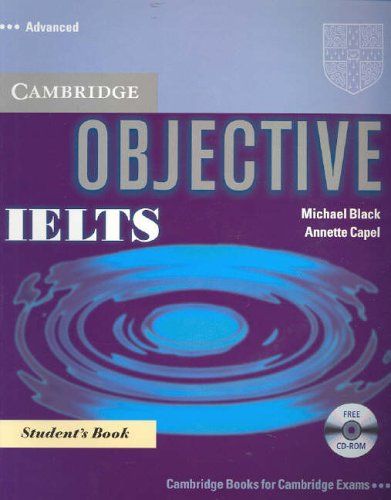
Objective IELTS Advanced
Introduction
Nova: Picture this. You're sitting in an IELTS exam hall. The clock is ticking. You've prepared for months, but when you flip open the test booklet, the reading passage is about genetic inheritance and the listening section throws you a map-labelling task you've never practiced. That moment of panic? That's exactly what a well-designed preparation book is meant to prevent. And today, we're diving into one of the most respected names in IELTS prep: Objective IELTS Advanced by Annette Capel and Michael Black.
Nova: Exactly right. Annette Capel is a major figure in Cambridge English assessment publishing. She's authored or co-authored over 200 titles in the Objective series, and her books have collectively garnered thousands of ratings. But Objective IELTS Advanced, specifically, was published in 2006 by Cambridge University Press, and here's the thing that makes it genuinely interesting. It's not just another test prep book thrown together. It's built on something called the Cambridge Learner Corpus, a massive database of over 20 million words drawn from real IELTS candidate papers.
Nova: Precisely. They analyzed patterns in real exam answers and built the course around those common errors. That's a fundamentally different approach from a book that simply explains the test format and gives you practice questions. And that's why, even though this book came out almost two decades ago, it remains so widely used and referenced. Let's unpack what makes it tick.
How the Cambridge Learner Corpus Shapes the Book
The Data-Driven Design
Nova: So let's start with what genuinely sets Objective IELTS Advanced apart: its use of the Cambridge Learner Corpus. Most IELTS books teach you what the exam wants. This one also teaches you what students consistently get wrong.
Nova: Great question. Throughout the Student's Book, you'll find boxes flagged with corpus insights. For instance, in the grammar sections, the authors highlight specific error patterns. One common area the corpus reveals is modality. Students often misuse modal verbs, confusing must and have to, or misapplying might versus may in academic contexts. The book doesn't just explain the rule. It shows you real examples of mistakes drawn from thousands of scripts and then walks you through correction strategies.
Nova: Exactly. And it extends to vocabulary too. The corpus showed that advanced learners frequently make errors with word building, like confusing analyze and analysis, or mixing up adjective and noun forms. The Language Focus sections in each unit drill these patterns systematically. There's a whole section on agreement errors, spelling issues, word order. These aren't random grammar lessons. They're targeted at the highest-frequency mistakes made by students aiming for bands 6.0 to 7.0.
Nova: Right. And this corpus-informed approach is something even modern IELTS books don't always match. The authors also consulted the Cambridge Academic Corpus alongside the learner corpus, which means they analyzed authentic academic English to ensure the language models presented are genuinely representative of what candidates will encounter in university settings.
The Architecture of the Book
Twenty Topics, Four Skills
Nova: Let's talk about how the book is actually organized. Objective IELTS Advanced contains twenty units, each built around a distinct topic that mirrors real IELTS exam themes.
Nova: It's a genuinely wide-ranging list. You've got Information Overload in Unit 1, then Sport, then Brands and Marketing. Later units tackle everything from Plastic and waste to Music, Space exploration, Genetic inheritance, Migration patterns, Literary studies, and even The History of History itself. These aren't random. They map directly onto the kinds of topics that appear repeatedly in IELTS Academic and General Training exams.
Nova: Yes, but here's what's clever. Each unit combines two of the four skills. So Unit 1 pairs Listening and Reading, Unit 2 pairs Reading and Speaking, and so on. Every unit also has a Language Focus component covering vocabulary, grammar, or pronunciation. So you're never practicing a skill in isolation, you're always building related language knowledge alongside it.
Nova: Writing gets special treatment. Interspersed between units are dedicated Writing Folders. There are nine of them across the book, and they cover everything from planning a Task 2 essay and developing arguments, to describing graphs for Academic Task 1, to comparing and contrasting data. There's even an errors clinic and guidance on expressing disagreement appropriately. Each Writing Folder targets a very specific sub-skill.
Nova: Far from it. And then you have Test Folders, ten of them, which give you exam-style practice for Reading and Listening at regular intervals. Plus Revision sections after every block of four units. The entire architecture is designed to build momentum in a structured, almost spiral fashion. You learn, you practice, you test, you revise, you move on.
Student's Book, Workbook, Teacher's Book, and CD-ROM
The Complete Learning Ecosystem
Nova: One thing that makes Objective IELTS Advanced stand out is that it's not just a single book. It's a full ecosystem of materials.
Nova: There are three core books for this level. First, the Student's Book, which is the main coursebook containing all twenty units, the Writing Folders, the Test Folders, and the revision material. It's available in a standard edition and as a Self-Study Student's Book which includes a CD-ROM with additional grammar, vocabulary, and pronunciation exercises, plus answer keys.
Nova: Precisely. Then there's the Workbook with Answers, authored by Michael Black and Annette Capel. It provides supplementary exercises for every unit, reinforcing what's covered in the Student's Book. The workbook is particularly valuable because it offers the repetition and consolidation that language learning requires. You can't just encounter a grammar point once.
Nova: The Teacher's Book, which runs about 132 pages. It includes full answer keys, vocabulary explanations, step-by-step instructions for classroom activities, and complete audio transcripts. For teachers or tutors, this is invaluable because it turns the coursebook into a fully scripted curriculum. Each level is designed to provide 60 to 80 hours of classroom study, which can be extended considerably if you incorporate the Workbook and CD-ROM materials.
Nova: It's handled through clear labeling throughout. Every reading or writing task is marked as AC, meaning Academic, or GT, meaning General Training. Some tasks are common to both. The key differences between the two modules are explained in the introduction, and the Test Folders include both types. So a student preparing for either exam can navigate the book without wasted effort.
Who Should Use This Book and Why
Strengths, Limitations, and the Verdict
Nova: Let's get honest about what this book does brilliantly and where it falls short.
Nova: First, the topic-based vocabulary and grammar building is exceptionally well-executed. Each unit's vocabulary is thematically coherent, which mirrors how our brains actually retain language. You learn compound nouns alongside modality in the Information Overload unit, collocations about packaging when studying plastics, geographical terms alongside non-finite clauses in the Physical World unit. The sequencing is logical and cumulative.
Nova: Not at all. Second, the task-type coverage is comprehensive. The book exposes students to virtually every question format they'll face: multiple choice, matching, headings, sentence completion, summary completion, note completion, flow-chart completion, labelling diagrams and maps, short-answer questions, classification, true false not given, yes no not given. By the time you finish the twenty units, no IELTS question format should surprise you.
Nova: The biggest one is age. The book was published in 2006. While the core IELTS exam format hasn't radically changed, some content references may feel dated. The speaking prompts and reading passages won't reflect the most current topics. Also, the practice tests don't include a Speaking component. You get Reading and Listening tests, but you'd need to supplement Speaking practice elsewhere. Some reviewers also note that the book doesn't contain full-length mock exams, so you'd want to pair it with something like the Cambridge IELTS authentic practice test series.
Nova: This book is pitched at learners currently around band 6.0 who are aiming for 6.5 to 7.0. It's ideal for students who want a structured, thorough course rather than a quick test-cram approach. It works well in classroom settings with a teacher, but the self-study version is genuinely viable for independent learners. It's also excellent for teachers who want a ready-made, corpus-informed curriculum. On Goodreads, it holds a 3.91 rating, and user reviews consistently mention that completing all exercises methodically led to achieving target band scores.
Nova: In many ways, yes. The corpus-based methodology is timeless. The skill-building approach is pedagogically sound. But you'd want to supplement it with more recent practice tests from the Cambridge IELTS series, which go up to Book 19 now, and possibly a dedicated speaking resource. Think of Objective IELTS Advanced as the foundational training and newer authentic test books as the final race simulation.
Conclusion
Nova: So what's the big takeaway from our dive into Objective IELTS Advanced?
Nova: I'd highlight the comprehensiveness. Twenty topic-based units covering all four skills, dedicated Writing Folders that break essay writing into teachable sub-skills, Test Folders for ongoing assessment, and a full supplementary Workbook. This is not a book you skim. It's a course you commit to for 60 to 80 hours, and if you do, the structure genuinely carries you from band 6.0 territory toward that 7.0 goal.
Nova: Right. The smart approach is to use Objective IELTS Advanced as your core curriculum for building skills, vocabulary, and grammar, then supplement with recent Cambridge IELTS authentic practice tests for exam simulation, and find a speaking partner or online resource for that missing oral practice. Annette Capel and Michael Black built a remarkably thoughtful foundation. You just need to add the finishing touches.
Nova: Exactly. Good methodology ages well. Great data never goes out of style. And Objective IELTS Advanced has both in abundance.