

The Unseen Language: Decoding Non-Verbal Cues for Deeper Connection
Golden Hook & Introduction
SECTION
Nova: We're often told to choose our words carefully, to articulate our thoughts with precision. But Atlas, what if the most important messages we send – and receive – aren't words at all? What if our true selves are speaking volumes, entirely silently?
Atlas: Oh, I like that. That immediately makes me think about that uncomfortable feeling you get when someone says "I'm fine" but their whole body is screaming the exact opposite. It's that gut feeling, right?
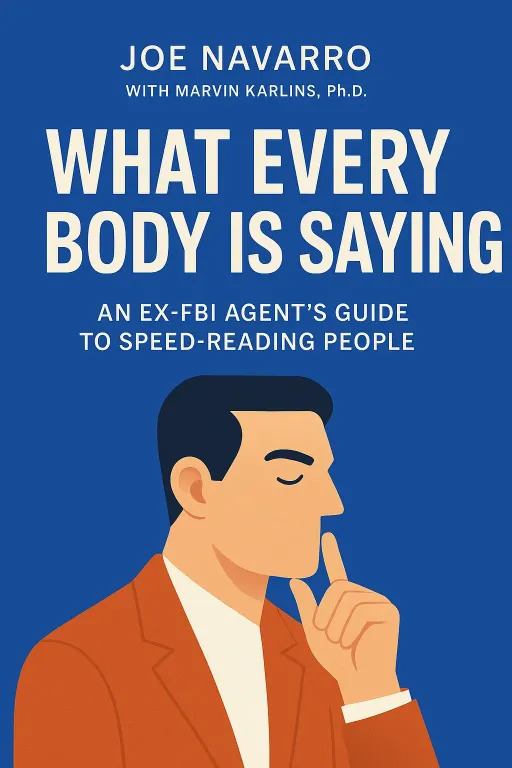
Nova: Exactly that gut feeling! Today, we're diving into the fascinating, often overlooked, world of non-verbal communication. We're going to decode this unseen language, drawing insights primarily from two incredibly powerful sources: by former FBI agent Joe Navarro, and the foundational academic text, by Mark L. Knapp and Judith A. Hall.
Atlas: A former FBI agent? That immediately makes me wonder about the stakes. He wasn't just studying this for academic curiosity, was he? That sounds like something born out of necessity.
Nova: Absolutely not. Navarro spent decades in counterintelligence for the FBI, honing his ability to read body language. We're talking about high-stakes situations: interrogations, surveillance, negotiations where lives and national security were on the line. His insights aren't just theories; they’re battle-tested methods for spotting deception, understanding intentions, and getting to the truth when words fail or mislead.
Atlas: Wow. So it’s less about psychology and more about survival in his case. That’s a powerful origin story. It adds a whole new layer of credibility to the idea that our bodies are constantly broadcasting.
Nova: Precisely. And that's where we start our journey today. The core of our podcast today is really an exploration of how mastering the unseen language of non-verbal cues allows us to read situations better, connect more authentically, and truly understand others beyond the spoken word.
Decoding Intentions: The Silent Language of Truth and Deception
SECTION
Nova: So, let's jump into Navarro's world. He argues that our limbic system – that ancient, emotional part of our brain – is constantly reacting to our environment, and those reactions often leak out through our bodies, long before our conscious mind can filter them. He calls these "tells."
Atlas: Okay, so it’s like our primal brain speaking directly, bypassing the filter of our conscious thoughts. That makes a lot of sense. So, what kind of 'tells' are we talking about? How do these leaks manifest?
Nova: Think about it this way: when we're stressed, anxious, or uncomfortable, our bodies have specific ways of trying to soothe themselves or prepare for action. For instance, consider the feet. Navarro often says the feet are the most honest part of the body because they're furthest from the brain and hardest to consciously control.
Atlas: The feet? That’s counterintuitive. Most people focus on eyes or hands. Why the feet?
Nova: Because they're designed for fight or flight. If someone is uncomfortable in a conversation, their feet might point towards the exit, or shake, or even tap impatiently. These are pacifying behaviors or indicators of a desire to escape. In a high-stakes interrogation, an agent might notice a suspect's feet suddenly shift into a 'ready-to-flee' position, even if their face remains calm. That's a tell.
Atlas: That's fascinating. So it's not just about what someone with their feet, but what their feet are to do, almost instinctively. I imagine a lot of our listeners who are in leadership roles, or even just navigating complex family dynamics, might find this incredibly useful. It’s like getting a secret decoder ring for unspoken anxieties.
Nova: It really is. Another classic example is pacifying behaviors with the hands and face. Someone rubbing their neck, touching their lips, or stroking their hair during a stressful conversation isn't necessarily being deceptive, but they are almost certainly experiencing some level of discomfort or anxiety. These are self-soothing gestures.
Atlas: But wait, can't people fake this? Like, if I know someone is looking at my feet, I could consciously try to keep them still. Is it really that reliable?
Nova: That's a great question, and it speaks to the nuance. While you consciously control some behaviors, especially those in the upper body, the sheer volume and speed of non-verbal cues make it incredibly difficult to fake them all convincingly, all the time. Micro-expressions, for example, flash across the face for fractions of a second – too fast for conscious control. And the further down the body, the harder it is to control. That's why the feet are so honest. The key is to look for clusters of behaviors, not just one isolated signal.
Atlas: So basically, you're not looking for one red flag, but a whole constellation of little signals that point towards a consistent internal state. That’s a really important distinction for an insight seeker. It's about pattern recognition, not just cherry-picking one gesture.
Nova: Absolutely. It's about observing the baseline behavior first, and then noticing deviations from that baseline. If someone is usually animated and then suddenly becomes rigid and still when asked a specific question, that change is the tell. Navarro's work provides a powerful toolkit for observing and interpreting this rich, often hidden, layer of human communication that moves beyond surface-level interactions.
The Hidden Architecture of Interaction: How Non-Verbal Cues Govern Our Connections
SECTION
Nova: Now, while Navarro gives us the tools to decode individual intentions, Knapp and Hall, in their comprehensive work, give us the bigger picture. They show us how non-verbal cues don't just betray internal states, but they actually our entire interactions. They regulate conversations, display affection, and signal power dynamics, often without a single word being spoken.
Atlas: That’s a fascinating pivot. So it's not just about what's going on someone, but how our bodies are actually the flow of a conversation or a relationship. Can you give an example of how non-verbal cues regulate conversations? Because I imagine most people think words do that.
Nova: Think about turn-taking. How do you know when it's your turn to speak, or when someone is finished? Often, it's not explicitly stated. It's through eye contact – a sustained gaze might signal 'I'm done, your turn' – or a slight head nod, or even just a pause in speech accompanied by a relaxed posture. Conversely, if someone wants to keep talking, they might avoid eye contact or maintain a tense posture, signaling 'don't interrupt me yet.'
Atlas: Oh, I totally know that feeling! It’s like that awkward moment when two people start talking at once, and then they both stop, and then one starts again. That’s regulated by these invisible signals. So we’re doing this all the time, completely unconsciously?
Nova: For the most part, yes. And it extends beyond conversation regulation. Non-verbal cues are also crucial for displaying affection or disinterest. Proximity, touch, mirroring body language – these are all powerful indicators of connection or disconnection. A slight lean in, an open posture, a prolonged gaze can signal warmth and interest, while crossing arms, turning away, or avoiding eye contact can signal the opposite.
Atlas: That’s going to resonate with anyone who’s ever been on a first date! It’s like the entire success or failure of the interaction is being written in body language before any deep words are exchanged. So if I understand these patterns, I can actually my interactions, not just read them?
Nova: Absolutely. It empowers you to be more intentional. If you want to convey warmth, you can consciously adopt more open postures. If you want to show you're listening, you can mirror their lean, maintain appropriate eye contact. It’s about understanding the subtle dance. And it also plays a huge role in displaying power or status. Think about the CEO who takes up more space, or maintains a steady, unwavering gaze. Or the person who consistently interrupts or stands too close. These are all non-verbal power plays.
Atlas: So it’s not just about observing, but about consciously participating in this unseen language. That’s a really profound insight. It means we're not just passive receivers, but active broadcasters and directors of our interactions. It's like understanding the grammar of connection.
Nova: Precisely. And that's the beauty of combining Navarro's decoding skills with Knapp and Hall's comprehensive framework. Together, they provide a powerful, holistic understanding of how much is truly communicated without a single word. It moves us from simply observing human behavior to truly grasping human interaction on a much deeper, more authentic level.
Synthesis & Takeaways
SECTION
Nova: So, to synthesize these powerful insights, we’re talking about moving beyond the superficiality of spoken words to truly understand the rich, often hidden, layer of human communication. Navarro gives us the micro-level, the 'tells' that reveal internal states. Knapp and Hall give us the macro-level, the foundational functions that govern how we interact.
Atlas: It's like having X-ray vision for conversations. It reveals that gap between what people say and what their bodies are truly experiencing or trying to communicate. And for anyone looking to build stronger, more effective connections, or just understand human behavior better, this is an invaluable toolkit.
Nova: It is. The cold, hard fact is that many of our most important messages are sent without a single word. Mastering these non-verbal cues allows you to read situations better, connect more authentically, and move beyond surface-level interactions to truly understand others. It’s about enhancing empathy, not just spotting deception.
Atlas: That’s a great way to put it. It’s not about becoming a human lie detector, but about becoming a more attuned, more empathetic analyst of the human experience. It's about getting to the 'why.'
Nova: Exactly. And that brings us to our tiny step for today. For your very next conversation, I want you to try something simple: observe one person's hands and feet for five minutes. Just note any shifts in position or movement. Don't judge, just observe. See what patterns emerge. It's a small step that opens up a whole new world of understanding.
Atlas: That’s a brilliant suggestion. It’s practical, it’s immediate, and it doesn’t feel overwhelming. It’s how you start training that X-ray vision.
Nova: This is Aibrary. Congratulations on your growth!