

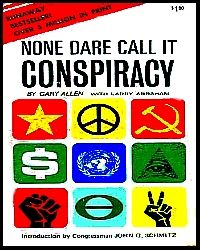
None dare call it conspiracy
Introduction
Nova: Picture this: it's 1971. Richard Nixon is in the White House, the Vietnam War is raging, and a book hits the market claiming that everything you think you know about how the world works is wrong. Not just wrong, but deliberately engineered wrong by a hidden network of bankers, elites, and shadowy organizations. That book sold over five million copies, was ignored by every major newspaper and magazine in America, and yet somehow became one of the most influential political texts of the late 20th century. Welcome to Aibrary. I'm Nova.
Atlas: And I'm Atlas. So what was this book that five million people read but nobody reviewed?
Nova: It's called None Dare Call It Conspiracy, co-authored by Gary Allen and Larry Abraham, published in 1971. And here's what makes it so fascinating: the book actually predicted its own reception. Right in the introduction, it says the mainstream media will give it the silent treatment, that the people exposed in its pages will try to kill it with silence, and that eventually they'll have to attack it. And that's almost exactly what happened.
Atlas: That's a pretty good parlor trick. Predict your own suppression and then when nobody reviews you, point to it as proof you're right.
Nova: Exactly, and that self-reinforcing logic is part of why the book became so powerful. But we're not here just to debunk or endorse. We're here to understand: what did this book actually argue, who was Gary Allen, and why does this book still matter more than fifty years later? Because its fingerprints are all over modern political discourse, from Tea Party rhetoric to debates about the Federal Reserve to the very phrase new world order.
Atlas: So let's open the book and figure out what five million Americans were reading in the early 1970s.
Author and Context
Who Was Gary Allen and What Was He Trying to Do?
Nova: So before we dive into the book's arguments, let's talk about the man behind it. Gary Allen was born in 1936 in Glendale, California. He studied history at Stanford University and also attended Cal State Long Beach. He was a prominent spokesman for the John Birch Society, the fiercely anti-communist organization founded by Robert Welch. He also served as a speechwriter for George Wallace's third-party presidential campaign in 1968.
Atlas: Wait, the George Wallace? The segregationist Alabama governor?
Nova: That's the one. So Allen was deeply embedded in the far-right political ecosystem of the 1960s and 70s. He wrote for American Opinion magazine, the John Birch Society's flagship publication, and he was an advisor to Nelson Bunker Hunt, the Texas oil billionaire. So this is not someone operating from the fringe in obscurity. He had connections to serious money and serious political machinery.
Atlas: And he co-wrote the book with Larry Abraham, and it had a preface by a sitting U. S. Congressman, John Schmitz of California, who later ran for president in 1972 on the American Independent Party ticket. So this had institutional backing.
Nova: Right. And here's something that Allen insisted repeatedly: he started out as a skeptic. He claimed he set out to prove the conservative anti-communists wrong and ended up convinced the conspiracy was real. He also made a point of distancing himself from overt antisemitism, even though critics have long noted the book's heavy focus on Jewish banking families like the Rothschilds, the Warburgs, and Jacob Schiff.
Atlas: So the book comes with a built-in conversion narrative. I was a doubter too, until I saw the evidence.
Nova: Precisely. And that rhetorical move is enormously powerful. It says to the reader: you're not gullible for believing this; the smart, skeptical thing to do is to see what I saw. Now, the book came out in the context of deep national turmoil: the Vietnam War, the collapse of the Bretton Woods system, Watergate was about to break, and there was widespread distrust of institutions. So the soil was incredibly fertile for a book that said: you're right to be suspicious, and here's why.
Key Insight 1
The Accidental Theory of History vs. The Conspiracy Theory
Nova: The book opens with a really clever framing device. Allen says there are fundamentally only two theories of history. Either things happen by accident, or they happen because somebody planned them. He calls the mainstream academic view the accidental theory of history, and he says it's absurd. His evidence? If things were truly accidental, statistically about half of major events should be good for America. But instead, he argues, every administration, whether Republican or Democrat, keeps making the same mistakes and moving in the same direction.
Atlas: So the consistency of bad outcomes is his proof that someone is pulling the strings. It's an interesting argument, but couldn't you also say that structural forces, institutional inertia, or just plain bureaucratic momentum could explain consistency?
Nova: Allen would say that's exactly what the hidden picture painters want you to think. He uses this wonderful metaphor: imagine a children's magazine where a hidden picture is concealed within a larger landscape drawing. You can't see the donkey pulling the cart until you know how to look. He says the mass media are the landscape painters, deliberately creating a picture that hides the real forces at work.
Atlas: And once you see the hidden picture, you can't unsee it.
Nova: Exactly. He quotes Franklin Roosevelt, of all people, as saying: In politics, nothing happens by accident. If it happens, you can bet it was planned that way. Allen says FDR was in a good position to know. The core thesis is that a small group of people Allen calls the Insiders, operating across national boundaries and political parties, are systematically engineering world events to create a one-world government with themselves at the top.
Atlas: And who exactly are these Insiders?
Nova: This is where the book gets specific and controversial. The Insiders are not the visible political leaders. They're international bankers, members of the Council on Foreign Relations, the Bilderberg Group, the Trilateral Commission, and old-money dynasties like the Rockefellers and Rothschilds. Allen argues they're highly educated, immensely wealthy, and work behind the scenes to manipulate both communism and capitalism toward their goal of global control.
Key Insight 2
The Federal Reserve, Central Banks, and the Money Manipulators
Nova: Let's get into the book's most influential argument: the Federal Reserve is not a government institution. It's a private banking cartel created through deception.
Atlas: This is one of those claims that sounds wild but actually has a kernel of historical truth, right? The Federal Reserve is this weird public-private hybrid.
Nova: That's what makes Allen's argument so sticky. He describes the famous secret meeting on Jekyll Island, Georgia, in 1910, where a small group of powerful bankers including Paul Warburg, representing the Rothschild interests, and J. P. Morgan's associates, drafted the plan for what became the Federal Reserve System. Allen argues they deliberately engineered the financial panic of 1907 to create public demand for a central bank, then pushed the legislation through Congress just before Christmas recess in 1913 when many members were absent.
Atlas: And the name Federal Reserve was deliberately chosen to make people think it's part of the government.
Nova: Right. Allen lays out what he calls four steps straight from Karl Marx's Communist Manifesto that the Insiders supposedly follow. Step one: establish an income tax. Step two: establish a central bank deceptively named so people think it's public. Step three: have that bank hold the national debt. Step four: run the debt sky-high through wars and deficit spending. The 16th Amendment authorizing the income tax and the Federal Reserve Act both passed in 1913, which Allen says is not a coincidence.
Atlas: So the narrative is: the Insiders get you coming and going. They create the debt through wars, they own the bank that holds the debt, and they tax you to pay the interest on the debt.
Nova: And Allen argues the Federal Reserve's control over interest rates and the money supply lets the Insiders create boom-and-bust cycles deliberately. Those with inside knowledge profit enormously while ordinary people lose their savings and their homes. He writes: Those that create and issue the money and credit direct the policies of government and hold in their hands the destiny of the people.
Atlas: This is the argument that's had the longest shelf life, isn't it? You still hear versions of the audit the Fed and end the Fed rhetoric today.
Nova: Absolutely. And it's worth noting that legitimate economists have long debated the Federal Reserve's structure, transparency, and accountability. Allen took those genuine debates and wove them into a grand conspiracy narrative that proved remarkably durable.
Key Insight 3
Socialism as a Tool of the Super-Rich
Nova: Here's one of the book's most counterintuitive arguments. Allen claims that socialism isn't a movement of the poor against the rich. It's actually a strategy designed by the super-rich to consolidate their own power.
Atlas: That sounds completely backwards. How does he make that case?
Nova: His logic goes like this: under genuine free-market capitalism, innovative competitors can rise up and challenge established wealth. But under socialism, the government controls the means of production. And if you, the super-rich Insider, control the government, then socialism just means you control everything and nobody can compete with you. He points to the Soviet Union, where a tiny oligarchy controlled all wealth while the masses lived in poverty.
Atlas: So the Rockefellers advocating for certain government programs isn't philanthropy, it's a power play.
Nova: That's exactly his argument. Allen says the progressive income tax, which sounds like it targets the rich, was actually promoted by the super-wealthy because they'd already moved their money into tax-free foundations and trusts. Meanwhile, the income tax crushed the rising middle class and small business owners who were their real competitors. He writes: If one understands that socialism is not a share-the-wealth program, but is in reality a method to consolidate and control the wealth, then the seeming paradox of super-rich men promoting socialism becomes no paradox at all.
Atlas: So in this worldview, every government expansion, every regulation, every social program is actually a step toward monopolistic control by the elite.
Nova: And this is where the book connects to a very old American tradition of producerism, the idea that there's a virtuous producing class being squeezed between the elite at the top and the undeserving at the bottom. Allen reframes the class war not as rich versus poor, but as the elite Insiders versus the productive middle class, with the poor being used as pawns.
Atlas: It's a powerful re-framing that sidesteps the traditional left-right economic debate entirely.
Key Insight 4
Financing Both Sides: The Bolshevik Revolution and Controlled Opposition
Nova: Let's get to what might be the book's most explosive claim: that Western capitalist bankers financed the Bolshevik Revolution.
Atlas: I've heard this one before. The idea that Wall Street money helped create the Soviet Union.
Nova: Allen names names. He claims Jacob Schiff of the investment bank Kuhn, Loeb and Company funneled about twenty million dollars, which in today's money would be hundreds of millions, to the Bolshevik cause. He also points to Max Warburg in Germany and Lord Alfred Milner in Britain. According to Allen, these financiers not only provided money but also arranged for Lenin and Trotsky to travel back to Russia in that famous sealed train through Germany.
Atlas: But why would capitalists fund communists?
Nova: This is where Allen's theory gets elaborate. He argues it's a strategic investment with multiple payoffs. First, by establishing a communist state, the Insiders created a permanent enemy that could be used to justify massive military spending, which means more government debt, which means more control for the bankers who hold that debt. Second, the Soviet Union provided a geographic base of operations. Third, it created the Cold War dynamic itself, a controlled conflict that served the Insiders' interests on both sides.
Atlas: So the Cold War was essentially a managed conflict where the same financiers were profiting from both sides.
Nova: That's the argument. Allen leans heavily on the research of Antony Sutton, an academic who documented how the Soviet Union's industrial base was built largely with Western technology and aid. Sutton's work showed that major American corporations transferred critical technologies to the Soviets for decades, even while the two nations were supposedly mortal enemies.
Atlas: And this ties into another key concept Allen develops: pressure from above and below.
Nova: Right. This is one of his most sophisticated ideas. Allen argues the Insiders use a pincer strategy. From above, they push policies through captured government institutions. From below, they secretly finance radical groups, student movements, and agitators who create chaos and demand revolutionary change. The chaos these groups create then justifies more government power to restore order, which the Insiders control. He specifically names groups like Students for a Democratic Society and even Common Cause, claiming they received funding from Rockefeller foundations.
Atlas: So the radicals think they're fighting the system, but Allen says they're actually doing the system's bidding.
Nova: Exactly. He calls them pawns, shills, puppets, and dupes for an oligarchy of elitist conspirators. It's a theory of controlled opposition that lets Allen explain away any apparent contradiction in his theory. Communists fighting capitalists? They're on the same team. Left-wing radicals protesting the establishment? Funded by the establishment. It makes the theory almost impossible to falsify.
Key Insight 5
The Council on Foreign Relations and the Hidden Government
Nova: If the Insiders have a headquarters in Allen's universe, it's the Council on Foreign Relations. The CFR occupies an absolutely central role in None Dare Call It Conspiracy.
Atlas: And for people who don't know, the CFR is a real organization. It was founded in 1921, it publishes Foreign Affairs magazine, and its members include former presidents, secretaries of state, and leaders from business and academia.
Nova: It's a genuine and influential think tank. Allen's claim is that it's much more than that. He traces the CFR's origins to a British secret society called the Round Table Group, established by Cecil Rhodes and run by Lord Milner and Lord Rothschild. He says the CFR was deliberately created as the American branch of this network, with the explicit goal of promoting world government.
Atlas: And his evidence?
Nova: Allen points to how the CFR has staffed key positions in every administration from FDR through Nixon. He notes that members of the CFR dominated the State Department, the Treasury, and the national security apparatus regardless of whether a Republican or Democrat was in the White House. He quotes a 1959 CFR study prepared for the Senate Foreign Relations Committee that stated the U. S. must strive to build a new international order.
Atlas: So the phrase new world order, which became such a flashpoint decades later, Allen was already flagging it in 1971.
Nova: Exactly. And his argument is essentially that the CFR functions as a shadow government. Visible presidents and congresspeople come and go, but the CFR network remains, ensuring policy continuity toward globalism. Allen writes that the CFR has been the seat of some basic government decisions and has repeatedly served as a recruiting ground for ranking officials. He argues this is why every administration, regardless of campaign promises, continues the same fundamental policies.
Atlas: The idea that elections don't matter because the same people run things either way is a profoundly cynical message. And it's one that's gained a lot of traction over the decades.
Nova: It's also worth noting that this argument has been critiqued from multiple angles. Many historians point out that the CFR is a debate and discussion forum where people with different views hash out ideas. Membership doesn't equal agreement. But Allen's framing, that it's a semi-secret organization whose anonymity proves its power, has proven remarkably influential. The book also discusses the Bilderberg Group and the Trilateral Commission as related nodes in this network. Allen's last book, published posthumously in 1987, was called Say No to the New World Order.
The Enduring Impact
Legacy, Critique, and Why This Book Still Matters
Nova: So what happened to this book? It sold somewhere between four and five million copies, mostly through grassroots distribution. The John Birch Society promoted it heavily. Ezra Taft Benson, who was Secretary of Agriculture under Eisenhower and later became president of the LDS Church, publicly recommended it, saying he wished every citizen of every country could read it.
Atlas: And yet the mainstream media completely ignored it.
Nova: Which, again, the book predicted, and which its supporters treated as confirmation. The book helped create fertile ground for what became the Reagan Revolution. Many of the themes about limited government, the dangers of globalism, and suspicion of elite institutions became Republican talking points in the 1980s.
Atlas: But the book has also been heavily criticized.
Nova: Absolutely. Critics point to several major problems. First, the book relies heavily on guilt by association. If someone is a CFR member, they're part of the conspiracy. If they're not, they're a dupe. The theory can explain away any contrary evidence. Second, historians have noted that Allen's account of how the Bolshevik Revolution was financed dramatically oversimplifies a complex historical event. Yes, some Western financiers had dealings with the Bolsheviks, but Allen's narrative of a unified conspiracy directing it all doesn't hold up.
Atlas: And then there's the antisemitism question.
Nova: This is the most uncomfortable aspect. The book focuses heavily on the Rothschilds, the Warburgs, Jacob Schiff, and other Jewish banking families. While Allen explicitly distanced himself from antisemitism and claimed he was criticizing banking practices, not Jewish people, the narrative of a secret cabal of international Jewish bankers manipulating world events echoes the Protocols of the Elders of Zion, the infamous antisemitic forgery. Many scholars, including Michael Billig and Jovan Byford, have noted this connection.
Atlas: So the book walks a careful line, using the tropes and structures of antisemitic conspiracy theory while disavowing antisemitism explicitly.
Nova: And that pattern has become a template for a lot of modern conspiracy content. The book's real legacy, I think, is in how it shaped a style of political thinking. The idea that there's a hidden picture behind the visible one, that the media is landscape painting to deceive you, that both political parties serve the same hidden masters. These ideas are now mainstream, not fringe. You hear versions of them on cable news, on social media, in political campaigns.
Atlas: And the book ends with a call to action, not despair. Allen doesn't advocate violence or revolution. He urges readers to get involved in local politics, to educate themselves, to return to constitutional principles.
Nova: Which is actually one of the more interesting and overlooked aspects. For all its dark vision, the book's solution is democratic participation. It's a strange mix of deep paranoia and civic optimism that resonated with millions of Americans and continues to echo today.
Conclusion
Nova: So where does that leave us? None Dare Call It Conspiracy is a book that, depending on your perspective, is either a prophetic expose of hidden power or a masterclass in how conspiracy thinking works. It sold millions, was ignored by the establishment, and helped shape the vocabulary of modern political distrust.
Atlas: What strikes me is how many of its core moves are still with us. The idea that both parties are controlled by the same elite. The suspicion of central banks. The language of the deep state and the new world order. The notion that chaos and crises are manufactured to serve hidden agendas. Gary Allen didn't invent these ideas, but he packaged them in a way that proved incredibly durable.
Nova: And I think that's the real takeaway. Whether you believe Allen's thesis or not, understanding this book helps you understand a major strand of American political culture. It's a key to decoding arguments you hear every day. The book is worth engaging with seriously, not because it's necessarily right, but because it's been so influential.
Atlas: The hidden picture metaphor is almost too perfect. Allen was trying to reveal a hidden picture, but his book itself became a hidden picture, a text that millions read while the gatekeepers pretended it didn't exist, and that paradox of visibility and invisibility is exactly what made it so powerful.
Nova: Well said. Gary Allen died in 1986 at just fifty years old, but his book has outlived him by decades. It's been reprinted again and again, found new audiences in every era of political turmoil, and continues to be cited, debated, and distributed. Not bad for a book that nobody was supposed to review.
Atlas: This is Aibrary. Congratulations on your growth!