The Pressure Equation: How Next-Gen Leaders Decode Chaos
Golden Hook & Introduction
SECTION
Dr. Warren Reed: We're told to "manage" pressure. To "cope" with it. But what if that's the wrong approach? What if pressure isn't just a feeling, but a formula? An equation you can solve. Imagine a Navy SEAL, under fire in Afghanistan. He has seconds to act. Life and death. The pressure is immense. But his response wasn't about coping. It was about calculation. He understood the equation.
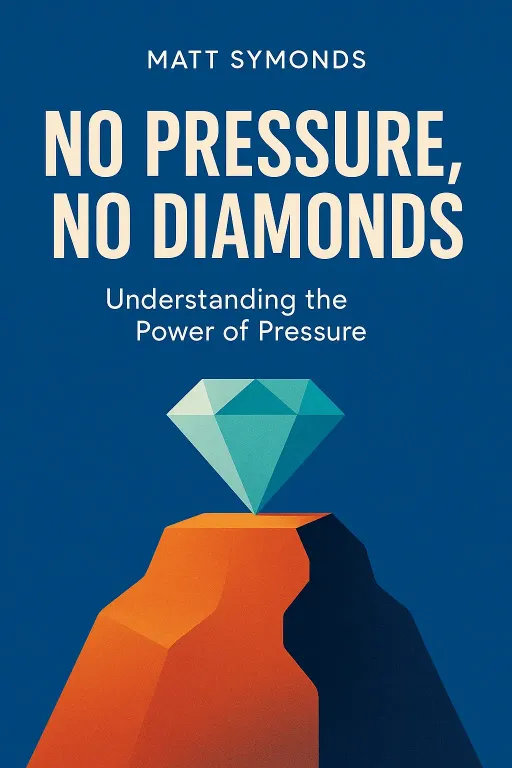
kover: And that equation is what we're exploring today, based on the book 'No Pressure, No Diamonds'. It's a shift from seeing pressure as this big, scary monster to seeing it as a system with levers you can actually pull. For someone like me, interested in building things and leading, that's a much more empowering way to look at it.
Dr. Warren Reed: Exactly. It’s about moving from being a victim of pressure to being a strategist. Today we'll dive deep into this from three perspectives. First, we'll decode the fundamental 'Pressure Equation' to understand what pressure actually is.
kover: Then, we'll explore the two different 'arenas' of pressure—the short-term peak and the long-term haul—and why you need to be skilled in both.
Dr. Warren Reed: And finally, we'll focus on the single most powerful tactic for conquering uncertainty in the moment: taking direct action. kover, as a young leader shaping your future, this book is essentially a mental toolkit. Let's open it up.
Deep Dive into Core Topic 1: The Pressure Equation
SECTION
Dr. Warren Reed: Let's start with that equation. The author, Matt Symonds, boils it down to a simple multiplication: Pressure equals Importance times Uncertainty times Volume. P = I x U x V. Three levers.
kover: So it’s not just one thing. It’s a combination of factors. That already makes it feel less mysterious.
Dr. Warren Reed: Precisely. Let's break it down. Importance is the stakes. How much does this outcome matter to you? Uncertainty is the unpredictability. You don't know what's going to happen. And Volume... that's the modern killer. It's the sheer number of demands on your plate.
kover: The endless to-do list, the constant notifications, the feeling of being pulled in a hundred directions.
Dr. Warren Reed: You got it. The book gives us two fantastic stories to see this in action. First, for Importance and Uncertainty, let's go back to that Navy SEAL, Curt Cronin. It’s ten years after 9/11, in a remote mountain valley in Afghanistan. Cronin and his team are moving towards a target under the cover of night. Suddenly, gunfire erupts from the darkness.
kover: Okay, so Importance is at maximum—it's life or death. And Uncertainty is also at maximum—they don't know where the fire is coming from or how many enemies there are.
Dr. Warren Reed: Perfect. The pressure is astronomical. And in that moment, Cronin sees his men, some of them less experienced, starting to freeze. Fear is taking over. He knows he has to act. He makes a split-second decision to call in support helicopters. He later said it might have been the second or third-best choice, but the fact that a decision was made, made it the best choice. The helicopters rained fire, the attack was repelled, and his team regained the offensive. He broke the paralysis of pressure by tackling the uncertainty with a decisive action.
kover: That's powerful. He didn't wait for perfect information, which is a trap I think a lot of us fall into. We want to reduce uncertainty to zero before we act, but in high-stakes situations, that’s impossible.
Dr. Warren Reed: Exactly. Now, contrast that with the 'Volume' component. The book tells a story about the Canadian Paralympic Committee. The board wanted a scorecard to track their goal of becoming a world-leading nation. So the executive team brainstormed every single metric they tracked.
kover: I can see where this is going.
Dr. Warren Reed: In just five minutes, they had 189 Post-it notes on the wall. Everything from 'number of gold medals' to 'staff satisfaction with IT'. It was impossible to manage. That feeling of drowning in important tasks? That's the pressure of Volume. So, kover, you're interested in innovation and technology. How do you see this equation playing out in a startup environment?
kover: It's a perfect model. A startup's very existence is high 'Uncertainty.' You're betting on an unproven idea. The 'Importance' is massive for the founders—it's their money, their reputation, their dream. But the real killer, I think, is 'Volume.' In the early days, you're the CEO, the marketer, the coder, the janitor. The equation shows why founder burnout is so common. It's not just one thing, it's all three variables turned up to eleven.
Dr. Warren Reed: So what's the strategic takeaway for a young founder?
kover: The key isn't to eliminate uncertainty—you can't in a startup. It's to consciously manage the 'Importance' you assign to daily tasks. Not everything is a life-or-death mission. And you have to be absolutely ruthless about simplifying the 'Volume.' You have to decide what to do. That's a leadership skill in itself.
Deep Dive into Core Topic 2: Pressure Ambidexterity
SECTION
Dr. Warren Reed: That's a brilliant connection. And it leads perfectly to our second idea. Because managing that startup 'Volume' over years is very different from handling a single, make-or-break investor pitch. The book calls this being 'pressure ambidextrous'—mastering both the long haul and the peak moment.
kover: Like being skilled in both a marathon and a sprint.
Dr. Warren Reed: Exactly. And there's no better story for this than Jeremiah Brown, the Olympic rower. In 2008, he's a former football player who watches the Canadian rowing team win gold. He decides, right then, that he'll be in the boat at the 2012 London Olympics. The problem? He has almost zero rowing experience.
kover: That sounds... ambitious.
Dr. Warren Reed: To say the least. What followed was three years of the 'long haul.' He moved across the country, woke up at 4:30 AM for grueling rows on icy water, worked a full-time job at a bank, and his personal relationships were strained to the breaking point. The book quotes him saying, "Rowing is a pain game." That's the long haul. It's about commitment, resilience, and just grinding it out when no one is watching.
kover: That’s the part of success we don't often see. The unglamorous, repetitive work. It requires a specific kind of mindset, a deep connection to your 'why'.
Dr. Warren Reed: A deep connection is right. But then, he makes it. He's at the 2012 Olympics. And in their very first heat, his team, ranked third in the world, comes in dead last. A total disaster. This is the 'peak pressure moment.' All the importance and uncertainty of three years of sacrifice, compressed into one do-or-die repechage race. The pressure is so intense, his coach actually comes up to him and says, "Think about your son, Jeremiah. He doesn’t want his dad to let him down, does he?"
kover: Wow. That's adding pressure, not helping! It highlights how even our support systems can misfire. But that distinction between the long haul and the peak moment is critical for leadership. You need a 'long haul' mindset to build a team and a culture, which requires patience and a focus on process. But you need a 'peak moment' mindset for a crisis, like a server crash or a PR disaster, which requires decisive, immediate action. They're almost opposing skills.
Dr. Warren Reed: And great leaders can switch between them.
kover: Right. It reminds me of that amazing Kyle Lowry quote from the book. He's in the NBA Finals, a huge peak pressure moment, and a reporter asks him about pressure. Instead of talking about the game, he talks about his mom getting up at 5 AM to make him cereal when they had nothing. He was framing a peak moment through the lens of his life's long haul. That's perspective. That's pressure ambidexterity.
Deep Dive into Core Topic 3: The Antidote of Direct Action
SECTION
Dr. Warren Reed: Exactly. Perspective is everything. And in those peak moments, like Jeremiah's disastrous heat, when uncertainty is screaming in your ear, the book gives us a powerful antidote: Take Direct Action. Focus on the one thing you can control.
kover: This is where it gets really practical. This is the 'what to do'.
Dr. Warren Reed: It is. The story that nails this is about Martin Reader, a Canadian beach volleyball player. It's the final of the Olympic qualifying tournament in Mexico. The winner goes to the London Olympics. The stadium is packed with a hostile hometown crowd. The match goes to a third, winner-take-all game. It's 13-13. The pressure is suffocating. Reader steps back to the service line.
kover: He can't control the crowd, the score, his opponent... the uncertainty is overwhelming.
Dr. Warren Reed: But he can control his serve. And the book reveals he had spent months practicing one specific, high-risk, high-reward serve, just for a moment like this. In that chaos, he tunes everything out and focuses only on the ball in his hand, on the motion he has repeated thousands of times. He takes direct action on the one thing in the universe he can control. He serves an ace. They win the next point and qualify for the Olympics.
kover: That's incredible. He didn't try to control the whole situation. He controlled his little piece of it, and that was enough to change the outcome.
Dr. Warren Reed: This feels very Stoic, very Socratic—this idea of focusing only on your own actions. How does that connect for you, with your interest in philosophy?
kover: It connects completely. It's the dichotomy of control, a core tenet of Stoicism. Epictetus, Seneca... they all taught that our peace of mind comes from distinguishing what we can change from what we can't. In a creative project or a tech venture, you can't control if the market will love your product. That's a paralyzing uncertainty. But you can control the next sentence you write, the next line of code you commit, the next customer you call. That 'direct action' isn't just about making progress; it's a psychological tool to reclaim your agency from the chaos. It's how you find certainty in an uncertain world.
Dr. Warren Reed: And it's a skill. The book also tells the story of commentator Tracy Wilson, who was suddenly told she had to interview President Bush live on air with minutes to prepare. She panicked, but her body, trained as an athlete, defaulted to what it could control: her breathing. Deep belly breaths. That was her direct action.
kover: It's the smallest controllable unit. Your breath. It's always there. That's a powerful thought.
Synthesis & Takeaways
SECTION
Dr. Warren Reed: So, let's tie this all together. We have the Pressure Equation—Importance, Uncertainty, Volume—to diagnose the problem. We have the two arenas—the long haul and the peak moment—to understand the context and know which skills to deploy.
kover: And we have Direct Action as our tactical weapon against the paralysis of uncertainty in those peak moments.
Dr. Warren Reed: It’s a complete system. So, kover, for you and for our listeners, what's the single biggest takeaway?
kover: I think the biggest takeaway for me is to stop being a passive victim of pressure. The book gives us permission to be analytical about it. So the next time you feel that wave of anxiety, that tightness in your chest, don't just endure it. Interrogate it. Ask yourself: What's driving this—Is it Importance, Uncertainty, or Volume? And then, what is the single smallest, controllable action I can take right now to move forward?
Dr. Warren Reed: It's a diagnostic process.
kover: Exactly. It's a diagnostic process that feels like a superpower. It turns you from the subject of the pressure into the scientist studying it. And that shift in perspective changes everything.
Dr. Warren Reed: A superpower forged in pressure. kover, thank you. This was a fantastic breakdown.
kover: Thanks for having me. This was so insightful.