Redefining Achievement Beyond the Hustle Culture
Golden Hook & Introduction
SECTION
Nova: Most of us are sprinting toward a finish line that doesn't actually exist. We treat success like a solo sport, measuring our worth by how many people we’ve outpaced, only to find that when we finally reach the top, it’s remarkably lonely.
Atlas: That is a brutal way to start the morning, but you have a point. We spend our entire careers building these internal fortresses of achievement, and then we wonder why we feel like we are trapped inside them. It feels like the more we accomplish, the more isolated we become.
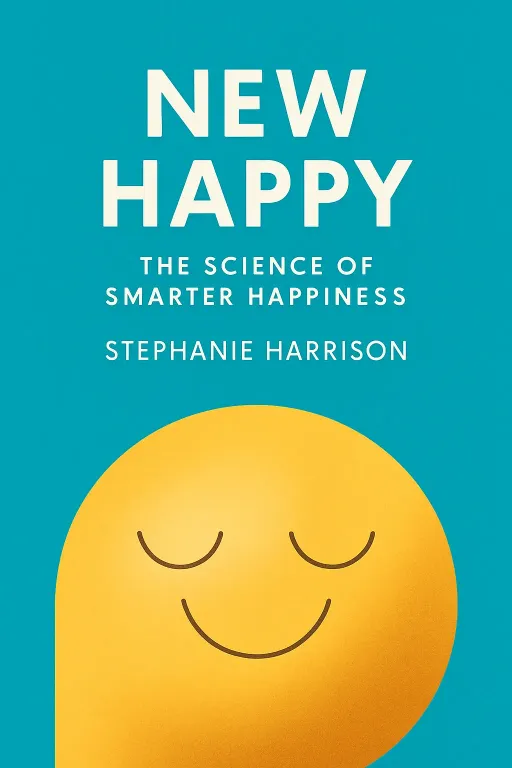
Nova: That is exactly the dynamic we are going to dissect today. We are looking at two powerful frameworks that challenge this default setting. First, we have New Happy by Stephanie Harrison, which forces us to rethink what success actually looks like. She argues that the pursuit of individualistic accolades is a dead end, and that true fulfillment comes from redirecting our talents toward collective well-being.
Atlas: And that sounds noble, but it also sounds like a recipe for burnout if you are not careful. Which is why I am glad we are also discussing The Happiness Trap by Russ Harris. He uses Acceptance and Commitment Therapy, or ACT, to explain why our very attempts to be happy are often what make us miserable in the first place.
Nova: It is the ultimate paradox. We are going to bridge these two ideas—the external shift toward community and the internal shift toward accepting our emotions—to help you build a more resilient, sustainable way of working and living.
The Trap of Individualistic Success
SECTION
Atlas: Okay, let’s start with the individualistic side of things. I see this all the time. You have people who are high performers, maybe architects or strategists, who view their career as a ladder they have to climb alone. They think that once they hit that next title or salary bracket, the stress will vanish. But Stephanie Harrison in New Happy suggests that this is fundamentally flawed. How does she frame this?
Nova: Harrison identifies a major cultural issue: we are conditioned to believe that success is about self-validation. We think that if we get the promotion, the award, or the recognition, our internal state will finally shift to one of contentment. But what she reveals is that this creates a cycle of isolation. You are constantly looking for the next external metric to prove you are enough.
Atlas: Right, and that validation is fleeting. You get the promotion, you feel good for a week, and then you are looking for the next thing. It is like drinking salt water to quench your thirst.
Nova: Exactly. Harrison suggests that the alternative is shifting your mindset toward community impact. It is not about abandoning your ambition. It is about changing the destination of that ambition. Instead of asking, how can I use my skills to get ahead, you start asking, how can I use my skills to help the people around me thrive?
Atlas: But let’s play devil’s advocate. If I am an architect, my job is to design a great building. If I focus all my energy on helping my peers, does my actual work suffer? Is there a risk that I lose my competitive edge?
Nova: That is the fear, isn't it? That being collective means being mediocre. But think about it from a leadership perspective. If you are a leader who uses your strengths to elevate your team, you are not just designing a building; you are designing a high-performing ecosystem. That creates a different kind of success—one that is durable because it is shared.
Atlas: That makes sense. It changes the architecture of your influence. Instead of being a siloed genius, you become a force multiplier. But I imagine this is hard to implement when you are in a high-pressure environment. If your boss is judging you on individual KPIs, it feels dangerous to pivot to community impact.
Nova: That is where the tension lies. It requires a fundamental shift in how you view your resources. Most people view their time and talent as a finite pie. If I give a slice to you, I have less for me. Harrison argues that when you contribute to the well-being of others, you are actually creating more value, more connection, and ultimately, more satisfaction for yourself. It is a different economy of success.
Atlas: I see. It is moving from a zero-sum game to a positive-sum game. You are saying that by investing in the collective, you are actually building a stronger foundation for your own career.
The Emotional Quicksand
SECTION
Nova: Precisely. And that brings us to the second piece of our puzzle, because you cannot effectively contribute to others if you are drowning in your own unresolved emotions. This is where Russ Harris and The Happiness Trap come in. He talks about how we treat our difficult emotions like enemies to be defeated.
Atlas: I know that feeling well. You have a bad day, you feel anxious about a deadline, and your first instinct is to suppress it. You tell yourself, stop feeling this way, get it together, focus.
Nova: And that is exactly what Harris calls the trap. The more you fight those difficult emotions, the more power you give them. He uses this brilliant metaphor of quicksand. If you fall into quicksand, your instinct is to struggle, to thrash about, to try to pull yourself out. But the harder you thrash, the deeper you sink.
Atlas: I love that analogy. It is so visceral. Because we do that with stress. We have a stressful week, and we think, if I just work harder, if I just ignore the stress, it will go away. But the stress just compounds because we are also stressed about being stressed.
Nova: You have hit the nail on the head. That is the secondary layer of suffering. It is not just the stress; it is the judgment we place on ourselves for feeling the stress. Harris introduces ACT—Acceptance and Commitment Therapy—as the way out. You stop fighting the quicksand. You accept that the emotion is there, you make room for it, and then you focus your energy on committed action.
Atlas: So, let me make sure I understand this. If I am an architect and I am feeling overwhelmed by a project, instead of trying to force myself to feel calm—which clearly isn't working—I should just acknowledge, okay, I am feeling overwhelmed right now.
Nova: Exactly. You label it. You say, I am having a thought that I am overwhelmed. Or, I am noticing a feeling of anxiety in my chest. You create a tiny bit of distance between you and the emotion. You don't have to like it, and you don't have to agree with it. You just have to stop wrestling with it.
Atlas: That sounds like a massive energy saver. Think about how much mental bandwidth we waste every day trying to regulate our moods or pretend we are feeling something we are not. If you could reclaim that energy, you would have so much more capacity for the work that actually matters.
Nova: That is the breakthrough. When you stop using all your energy to maintain a facade of constant positivity, you suddenly have a surplus of capacity. And that is the perfect bridge back to Harrison’s point about collective well-being. When you aren't exhausted from fighting your own mind, you have the emotional bandwidth to actually show up for your peers.
Atlas: That is a powerful connection. You are saying that the "New Happy" isn't just a philosophy; it is a byproduct of emotional maturity. You get to the community-focused stuff by first getting your own internal house in order.
Bridging the Concepts
SECTION
Nova: Right. Think about a project team in a high-stakes environment. If everyone on that team is personally "trapped" in their own emotional struggle—suppressing anxiety, fearing failure, pretending to be fine—the team dynamic is going to be defensive. Everyone is protecting their own ego.
Atlas: Everyone is trying to look like the smartest person in the room because they are terrified of being exposed. And that destroys trust.
Nova: Exactly. Now, imagine if that same team operated with the principles from these books. Each person has the emotional resilience to accept their own stress without projecting it onto others. Because they are not fighting their own internal wars, they are free to look outward. They can ask, how can I help my colleague solve this design flaw? How can I support the team to reach the objective?
Atlas: It changes the entire culture. You move from a culture of performance to a culture of contribution. And I think for our listeners who are focused on self-mastery, this is the ultimate upgrade. It is not about being a robot who feels nothing; it is about being a human who can process everything and still choose to act in a way that benefits the group.
Nova: That is the definition of a capable leader. It is someone who is aware of their internal state but refuses to let it dictate their external behavior. They are committed to the goal and to the people, regardless of whether they feel happy, stressed, or uncertain in that moment.
Atlas: I am curious, though. How do you deal with the "what if" scenarios? What if you are in a toxic environment where no one else is doing this? What if you are the only one trying to shift from individual validation to collective impact?
Nova: That is a great question. You start small. You do not need to change the entire organization overnight. You start with your own sphere of influence. You apply the "Tiny Step" that we mentioned earlier. You identify one personal strength you have—maybe it is your ability to simplify complex data, or your knack for spotting risks—and you use it to support just one peer today.
Atlas: That is actionable. It is not a massive overhaul of your identity; it is a tactical decision. You are using your skill as a tool for someone else.
Nova: And notice what happens when you do that. You immediately break the pattern of isolation. You are no longer just an architect of your own career; you are an architect of relationships. You are building trust, you are building reciprocity, and you are building a reputation as someone who elevates others.
Atlas: And from a strategic standpoint, that is the best career insurance you can have. People want to work with people who make them better. It is almost a selfishly good strategy, if you think about it.
Nova: You could look at it that way. It is a strategic advantage to be a person who fosters collective well-being. It makes you indispensable, not because you are the smartest person in the room, but because you are the one who makes the whole room smarter.
Synthesis & Takeaways
SECTION
Atlas: This has been a really grounding conversation. I think I went into this expecting to hear about productivity hacks, but we ended up talking about something much more foundational—human connection and emotional honesty.
Nova: It is the difference between building a house of cards and building a foundation of stone. The cards look impressive for a moment, but they cannot withstand any pressure. The stone foundation requires more work, but it holds everything else up.
Atlas: I like that. So, for anyone listening who wants to start applying this today, let’s synthesize this. We have the "New Happy" shift: moving from asking "How does this benefit me?" to "How can I contribute to the success of my team?" And we have the "Happiness Trap" shift: moving from fighting your emotions to making room for them so they don't drive the bus.
Nova: That is exactly it. If you are feeling stressed, don't fight it. Name it, accept it, and then pivot your attention outward. Use your strength to help someone else. It is the most effective way to break out of the cycle of self-validation.
Atlas: I am going to try that today. I have a colleague who is struggling with a complex data set, and instead of just focusing on my own tasks, I am going to carve out twenty minutes to sit with them and help them troubleshoot. It is a small thing, but I can see how that changes the dynamic.
Nova: And that is exactly how you start. You are not just solving their problem; you are building a more resilient, connected way of working. You are proving that you don't need to be in a state of perfect happiness or total calm to be a leader. You just need to be present and willing to act in service of others.
Atlas: It is a refreshing perspective. It is less about "fixing" yourself and more about "redirecting" your energy.
Nova: Precisely. And that, in the end, is the most sustainable way to build a legacy. Thank you for joining us in this exploration of how to redefine what it means to be successful.
Atlas: This has been a great dive. I feel like I have a much clearer blueprint for the week ahead.
Nova: Then our work here is done. This is Aibrary. Congratulations on your growth!