Breaking Free from the External Approval Trap
Golden Hook & Introduction
SECTION
Nova: Pause for five seconds. Think about the last time you refreshed your feed just to see if someone liked your post, or felt a quick spike of anxiety when a message went unread. If you felt that familiar twinge, you are already paying a tax you never signed up for.
Atlas: That is a brutal way to start, but I suspect it hits home for almost everyone listening. We treat those digital interactions like they are currency, but the exchange rate is completely rigged against our mental health.
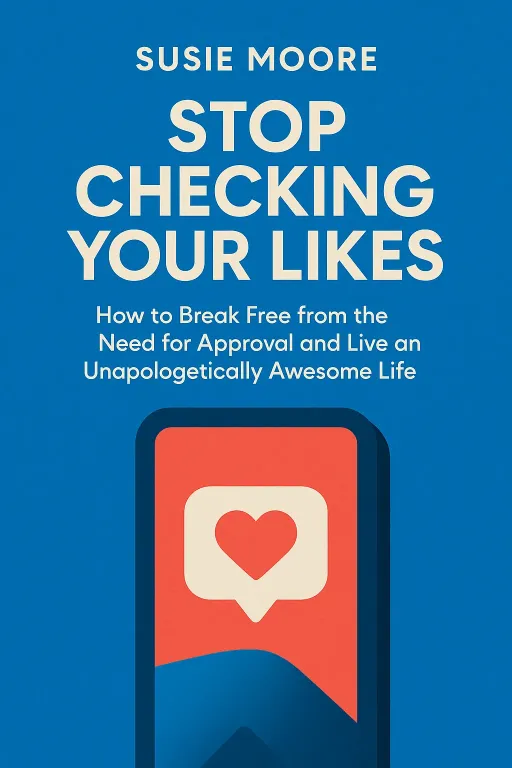
Nova: It is the ultimate distraction. Today, we are dismantling that rigged system. We are diving into two powerful books that, when read together, provide a complete toolkit for reclaiming your autonomy. First, we have Stop Checking Your Likes by Susie Moore, which serves as a tactical roadmap for dismantling the approval trap.
Atlas: And to balance that out, we are looking at New Happy by Stephanie Harrison. She takes a scalpel to the societal myths we have been fed about what happiness actually is. It is not just about getting what you want; it is about how you contribute to the world.
Nova: Exactly. We are moving from the external validation loop into a state of internal alignment. For our listeners who value precision and long-term strategy, this is about building a foundation that actually lasts.
The Approval Trap
SECTION
Atlas: Let’s start with the approval trap. I have always viewed seeking validation as a biological hangover. We are wired to want the tribe’s approval because, historically, being cast out meant death. But Susie Moore seems to argue that in the digital age, this survival instinct has mutated into something destructive.
Nova: You hit the nail on the head. Moore’s work is fascinating because she doesn’t tell you to delete your accounts or throw your phone in the ocean. She acknowledges that we are social creatures. The core issue she identifies is the shift from seeking connection to seeking validation. When you post something, are you looking to share a part of yourself, or are you looking for a metric of your own worth? That is the dividing line.
Atlas: It sounds like a subtle distinction, but the emotional impact is massive. I imagine a lot of our listeners struggle with this professional paradox. You need visibility to succeed in most modern careers, but the moment you start performing for the metrics, you lose your unique voice. How does Moore suggest we navigate that?
Nova: She suggests a radical shift in how we define success. It comes down to establishing what she calls a personal standard. If your standard of success is tied to external metrics—like engagement, praise, or even the approval of a boss—you are essentially handing the remote control of your emotional life to other people.
Atlas: That is a terrifying thought. If I hand over the remote, I have no idea what channel I am going to end up on.
Nova: Precisely. And the algorithm is a chaotic programmer. It rewards outrage, shock, and conformity. Moore’s argument is that you must define a standard that is entirely independent of that machine. For an architect of their own life—which is exactly how our listeners approach their growth—this means defining your win conditions before you even step into the arena.
Atlas: This reminds me of the concept of "internal locus of control." If I decide that my win condition is "did I provide value today?" or "did I act with integrity?" rather than "did I get the recognition I wanted?", the feedback loop changes entirely. It stops being about the audience and starts being about the craft.
Nova: That is the pivotal shift. Moore discusses how this creates a protective buffer. When you have an internal standard, external criticism—or worse, the silence of being ignored—doesn't shatter your self-confidence. It just becomes data. You can look at it, learn from it, and decide whether it’s useful or if it’s just noise.
Atlas: I am curious about the practical side of this. If I’m in a high-stakes environment where feedback is constant, how do I distinguish between useful feedback and the trap of seeking approval?
Nova: You look at the source and the intent. Useful feedback is specific, actionable, and aimed at improvement. It helps you build the structure. Approval seeking is vague, emotional, and aimed at validation. It is like the difference between a structural engineer checking your blueprints and a crowd cheering at a concert. You need the engineer to ensure the building doesn't collapse. You do not need the crowd to tell you if the building is well-designed.
The Happiness Myth
SECTION
Atlas: That brings us to a really interesting pivot. If we stop living for the crowd’s approval, we are left with the question of what we are actually living for. And that leads directly into Stephanie Harrison’s work in New Happy. I’ve always been skeptical of the "happiness industry." It feels like we are constantly told to chase a feeling that is fundamentally fleeting.
Nova: Harrison dismantles that entire premise. She argues that the "Old Happy"—the version of happiness that society sells us—is a myth. It is the idea that happiness is a destination. You get the promotion, you buy the house, you get the validation, and then you arrive at "Happy."
Atlas: The problem is that the destination keeps moving. As soon as you arrive, the goalposts shift. It is the classic hedonic treadmill.
Nova: Exactly. Harrison’s research suggests that the "New Happy" isn't a feeling you catch; it is a way of living. She frames it as a combination of self-alignment and contribution. It is about realizing that your happiness is inextricably linked to how you show up for others.
Atlas: That feels counterintuitive to our culture of hyper-individualism. We are told to "find ourselves," which usually implies looking inward until you are staring at your own navel. Harrison is suggesting that the path to the self is actually through the service of others?
Nova: It is not about self-sacrifice. It is about alignment. When you align your natural strengths, your values, and your interests with a way to contribute to the world, you achieve a state of flow that is far more durable than the fleeting joy of an achievement. Think about the most satisfied people you know. Are they the ones who are constantly chasing the next accolade, or are they the ones who are deeply engaged in work that matters to them and helps others?
Atlas: They are definitely the engaged ones. But how does this play out for someone who is already burnt out? If I am overwhelmed, the idea of "contributing to others" sounds like another item on a never-ending to-do list.
Nova: That is a crucial point, and it is where the two books harmonize. If you are stuck in the approval trap—constantly performing for others—you are exhausted because you are acting. You are wearing a mask. The burnout comes from the dissonance between who you are and what you are projecting. Harrison’s version of contribution is not about doing more for everyone else; it is about doing the right things from a place of authenticity.
Atlas: So, it is not about "adding" more tasks. It is about "subtracting" the inauthentic ones so that the work you do is inherently meaningful.
Nova: Precisely. It is about finding the intersection. What are you good at? What do you value? And where does the world need that specific combination? When you operate from that intersection, the "chasing" stops. You aren't hunting for happiness; you are building a life that produces it as a byproduct.
Synthesis & The Architect's Roadmap
SECTION
Atlas: I like the structural logic of that. It turns life from a scavenger hunt into an architecture project. You are building a system where your internal standards guide your actions, and your actions naturally lead to contribution.
Nova: And that brings us to the ultimate takeaway for our listeners. We are talking about building a foundation that lasts. The challenge for this week is simple but demanding. Define one personal standard of success that is entirely independent of external recognition.
Atlas: I love that. Let’s make this concrete. If I am a strategist, maybe my standard isn't "get the client to praise this deck." Maybe my standard is "did this deck clearly solve the client's problem with maximum efficiency?"
Nova: That is perfect. Because if you solve the problem efficiently, you have contributed. If the client praises it, that is just a nice bonus. If they don't, you still know you succeeded because you met your own internal standard.
Atlas: It removes the anxiety. I am not waiting for their reaction to know if I did a good job. I already know.
Nova: That is the freedom. And when you do that, you stop being a performer and start being a professional. You start being an architect. You stop checking your likes, and you start checking your alignment.
Atlas: It is a profound shift. It moves the center of gravity from the outside world to the inside. I think the most important thing for our listeners to realize is that this is a practice, not a one-time decision. You will catch yourself slipping back into the approval trap. The algorithm is designed to pull you back in.
Nova: You will slip. But the moment you notice it, you have already won. That awareness is the system working. The goal isn't to be perfect; the goal is to be conscious.
Atlas: So, for the next seven days, we are treating our own standards as the only metric that matters. I am curious to see how that changes the quality of work—and life—for everyone listening.
Nova: It will be transformative. Because when you stop looking for the "like," you finally start doing the work you were meant to do.
Atlas: And that is a much better way to live. Thank you for walking us through this. This feels like the kind of mental architecture that actually holds up under pressure.
Nova: It is the only kind that does. Thank you for the questions today, Atlas. This is Aibrary. Congratulations on your growth!