

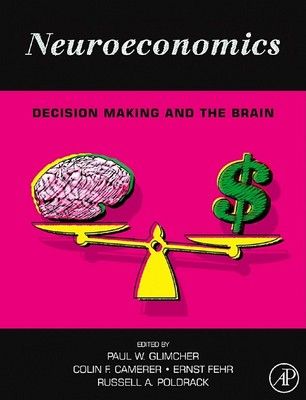
Neuroeconomics
Decision Making and the Brain
Introduction: Mapping the Mind's Marketplace
Introduction: Mapping the Mind's Marketplace
Nova: Welcome to the show. Today, we are diving deep into the fascinating, and frankly, revolutionary field born from the collision of spreadsheets and synapses: Neuroeconomics. Specifically, we're dissecting the foundational text that helped define this space: Paul W. Glimcher’s book, Neuroeconomics: Decision Making and the Brain.
Nova: : That sounds incredibly dense, Nova. Are we talking about scanning people’s brains while they fill out tax forms? Because that’s my definition of torture.
Nova: Not quite! But you’re close to the spirit of it. Glimcher essentially asks: Where in the three-pound universe inside our skulls does the concept of 'value' actually live? Is the brain a perfect, rational calculator, as classical economics assumes, or is it a messy, biological marketplace?
Nova: : A messy marketplace sounds much more accurate to my daily life. So, what’s the big takeaway from Glimcher’s work that separates this from just standard psychology or economics?
Nova: The key is the synthesis. He argues that to truly understand why we choose A over B, we can’t just look at the choice; we have to look at the the brain uses to compare A and B. It’s about finding the common language of decision-making in the brain.
Nova: : So, this book is the Rosetta Stone for translating economic choice into biology? Why should our listeners care about this translation?
Nova: Because once you know the mechanism, you understand the flaws. You understand why you bought that impulse item, why you procrastinated on that big project, or why you gamble. It moves us past 'irrational' and toward 'biologically determined.' Let’s jump into the core concept that underpins everything: Subjective Value.
Nova: : Lead the way, Nova. I’m ready to see what my neurons are actually valuing.
Key Insight 1
The Currency of Choice: Subjective Value Computation
Nova: The first major theme Glimcher hammers home is the concept of Subjective Value, or SV. Imagine you’re choosing between three options: a $10 bill, a piece of chocolate cake, or an extra hour of sleep. Objectively, these are incomparable. Ten dollars is a unit of currency, cake is mass and sugar, sleep is time.
Nova: : Exactly. An economist might try to assign a dollar value to the sleep, but that feels forced. How does the brain handle this?
Nova: Glimcher shows that the brain seems to have a mechanism, a common neural code, that converts all these disparate options into a single, comparable metric—the Subjective Value. Research points heavily toward areas like the ventromedial prefrontal cortex, or vmPFC, as a hub for this computation.
Nova: : So, when I’m agonizing over whether to take the early flight or the later one, my vmPFC is essentially running a quick, internal auction where the price is determined by my current state—am I tired, am I hungry, how much do I value that extra hour of rest?
Nova: Precisely. And here’s a surprising finding Glimcher highlights: this valuation process happens the final motor command to choose. The brain calculates the SV for all options simultaneously, and the one with the highest computed SV wins, often before we are consciously aware of the final decision.
Nova: : That’s unsettling. It suggests consciousness is more of a spectator than the CEO of my decision-making process.
Nova: It certainly challenges that notion. Think about intertemporal choice—the classic 'money now or more money later.' Glimcher’s work looks at how the brain weights the. The objective delay is fixed, but the subjective experience of that delay changes as the reward gets closer. The neural activity reflecting the value of the immediate reward skyrockets as the wait time shrinks.
Nova: : That explains why I can resist a $100 reward in a year, but if you offer me $50 right now, I’ll take it instantly. The subjective value of 'now' is disproportionately high.
Nova: It is. And Glimcher uses studies showing that the same neural circuits used to value a simple monetary reward are activated when subjects value abstract things like social approval or even moral choices. It suggests a universal biological utility function.
Nova: : So, the brain isn't using separate calculators for money, time, and pleasure; it’s using one universal calculator, and that calculator is highly susceptible to context and internal state.
Nova: That’s the essence of it. It’s a powerful, efficient system, but it’s not necessarily the perfectly rational system classical economics requires. This leads perfectly into our next chapter: challenging that rationality head-on.
Key Insight 2
The Inefficient Patchwork: Challenging Rational Choice Theory
Nova: Classical economics is built on the assumption of the rational agent—someone who always maximizes utility based on stable preferences. Glimcher’s findings, supported by neuroscience, suggest this model is fundamentally incomplete, if not outright wrong.
Nova: : I love this. It’s the brain saying, 'Sorry, Mr. Economist, your math doesn't account for my dopamine levels.' What is Glimcher’s main critique?
Nova: He suggests that human choice behavior is not the result of one elegant, optimizing algorithm, but rather an 'inefficient patchwork of competing mechanisms.' We aren't one rational agent; we are a collection of specialized, sometimes conflicting, biological modules.
Nova: : An inefficient patchwork. That sounds like my garage, not my mind. Can you give us an example of how this patchwork manifests in a way that breaks the rational model?
Nova: Absolutely. Consider the famous St. Petersburg Paradox. Rationally, you should be willing to pay a finite amount for a game with infinite expected payoff. But nobody does. Glimcher connects this to how the brain handles extreme risk. The neural systems responsible for valuing certainty might be fundamentally different from those valuing high-variance gambles, leading to predictable, non-rational aversion.
Nova: : So, the system designed to keep us alive by avoiding immediate catastrophe—a very useful, evolutionarily sound mechanism—overrides the system designed for long-term mathematical optimization.
Nova: Precisely. And to offer a biological alternative, Glimcher explores concepts like Physiological Utility Theory, or PUT. This theory posits that value isn't just an abstract number; it’s rooted in the brain’s physiological state—its current energy reserves, its need for homeostasis.
Nova: : That makes intuitive sense. If I’m starving, a small piece of bread has a vastly higher subjective value than if I just finished a five-course meal. The objective calorie count hasn't changed, but my physiological need has.
Nova: Exactly. The brain is constantly solving for survival and immediate well-being first. Glimcher argues that economic models must incorporate these biological constraints. When we see 'irrational' behavior, we are often just seeing the output of a system prioritizing a different, more fundamental utility—survival—over abstract economic optimization.
Nova: : It reframes 'mistakes' as 'successful biological adaptations' that are simply misaligned with modern financial markets. That’s a powerful shift in perspective.
Nova: It is. And to show how universal this valuation system is, let’s look at how Glimcher applies these principles outside of human labs, into the animal kingdom.
Case Study & Deep Dive
From Bees to Brokers: Universal Valuation Mechanisms
Nova: One of the most compelling parts of the book is Glimcher’s insistence that we look beyond human subjects. He draws parallels between complex human trading decisions and basic animal behaviors.
Nova: : Like what? Are bees trading stocks?
Nova: Not quite, but they are making complex economic decisions! Glimcher discusses studies on. Bees have to decide where to expend energy collecting nectar. They weigh the energy cost of flying to a distant flower patch against the expected caloric reward of the nectar there.
Nova: : That’s a perfect analogy for resource allocation! The bee is calculating subjective value: Energy Cost vs. Nectar Benefit.
Nova: It is. And the neural mechanisms governing that trade-off in a bee, while vastly simpler, share fundamental computational principles with the mechanisms in the human vmPFC when we decide whether to take a high-risk, high-reward stock option.
Nova: : So, the core algorithm for optimizing resource deployment is ancient and conserved across species.
Nova: Exactly. Another area Glimcher explores is. He references studies looking at the neural correlates of choosing 'now or just as soon as possible.' This is where the subjective value of immediacy really shines.
Nova: : I know that feeling well. That immediate gratification signal seems to hijack the slower, more deliberative parts of the brain.
Nova: It does. And the research shows that as the delay shortens, the brain regions associated with immediate reward processing become hyperactive, essentially drowning out the prefrontal cortex areas responsible for long-term planning. It’s a biological tipping point.
Nova: : It sounds like the brain has built-in mechanisms that favor short-term survival and reward, which is great if a predator is chasing you, but terrible when you’re trying to save for retirement.
Nova: That’s the tension neuroeconomics seeks to resolve. If we can map the neural signature of that tipping point—the moment the impulsive system wins—we might be able to develop targeted interventions, whether through cognitive training or even pharmacology, to strengthen the rational side.
Nova: : So, Glimcher isn't just describing the problem; he’s laying the groundwork for a biological solution to our own cognitive biases.
Nova: That’s the hope. By understanding the hardware, we can better understand the software glitches. It moves us from simply observing behavior to understanding the at the cellular level. It’s a massive step forward from just observing market bubbles.
Conclusion: The Future of Decision Science
Conclusion: The Future of Decision Science
Nova: We’ve covered a lot of ground today, moving from the abstract concept of value to the concrete firing of neurons. The key takeaway from Glimcher’s Neuroeconomics is that decision-making is fundamentally a biological process of computing subjective value.
Nova: : And that this computation is not always perfectly rational. We are indeed that 'inefficient patchwork,' driven by ancient survival mechanisms that sometimes clash with modern economic goals.
Nova: Precisely. The book forces us to accept that our choices are constrained by our biology. The brain doesn't calculate utility based on abstract math; it calculates it based on physiological need and immediate neural reward signals.
Nova: : So, what’s the actionable takeaway for the listener who isn't planning on getting an fMRI scan anytime soon?
Nova: Recognize the context. If you know you are in a state of high stress, fatigue, or immediate need, understand that your Subjective Value calculation is temporarily skewed toward immediacy and safety, not long-term optimization. Be skeptical of your own 'gut feeling' when the stakes are high and you’re tired.
Nova: : That’s excellent advice. It’s about building self-awareness around our own internal hardware limitations.
Nova: Absolutely. Glimcher’s work is a call to action for both economists and neuroscientists to stop working in silos and start building unified theories of choice. The future of understanding human behavior lies in that intersection.
Nova: : It’s a field that promises to redefine everything from marketing to public policy. A truly thought-provoking journey into the mind's marketplace.
Nova: Indeed. Thank you for joining us for this deep dive into Paul Glimcher’s Neuroeconomics. This is Aibrary. Congratulations on your growth!