

Understanding the Architecture of Human Behavior
Golden Hook & Introduction
SECTION
Nova: Most of us walk around believing we are the ultimate authors of our own character, that we are blank slates shaped entirely by our experiences. It is a comforting thought, but evolutionary psychology suggests it is fundamentally, perhaps even dangerously, wrong.
Atlas: That is a heavy way to start a conversation. You are basically saying that we are not just clay waiting to be molded, but that we come out of the box with specific, pre-installed software.
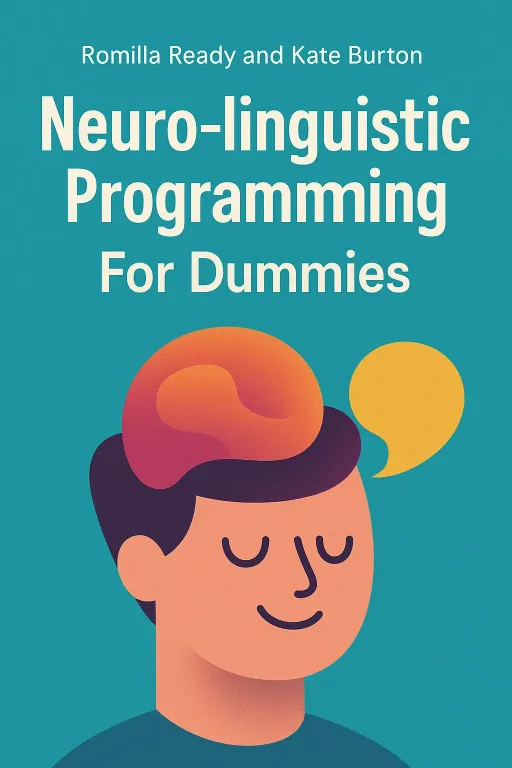
Nova: That is exactly the point. Today we are looking at the architecture of human behavior. We are diving into two distinct but deeply complementary works. First, we have The Blank Slate by Steven Pinker, which forces us to confront the biological reality of our nature. Then, we are pairing that with Neuro-linguistic Programming For Dummies by Romilla Ready and Kate Burton, which offers the tools to actually navigate that reality through the power of language.
Atlas: I know Pinker. His work has always been a lightning rod for controversy because it challenges the idea that we can just engineer a perfect society if we just tweak our environment enough. He argues that our genes are driving the bus more than we like to admit.
Nova: Precisely. Pinker is a cognitive psychologist who really shook the foundations of social science. And then you have Ready and Burton, who take a much more pragmatic, almost tactical approach to the mind. They wrote for the popular For Dummies series, which is interesting because it strips away the academic pretense and gets right to the mechanics of how we communicate with ourselves and others.
Atlas: Okay, so we have the hardwiring on one side and the software updates on the other. That sounds like a perfect framework for anyone trying to build a more conscious life. Where do we even start?
The Biological Baseline
SECTION
Nova: We start by acknowledging the baseline. When you look at The Blank Slate, Pinker is essentially dismantling the idea that human nature is just a product of our upbringing or our culture. He argues that we have a shared human nature—a set of hardwired tendencies that influence everything from empathy to social conflict.
Atlas: I can see why that rubs people the wrong way. If you tell someone that their aggression or their tendency toward tribalism is hardwired, it sounds like you are giving them an excuse to say, that is just who I am, I cannot change.
Nova: That is the danger, but it is also the liberation. Think about family dynamics. How many times have you seen siblings who grow up in the exact same household, eat the same food, go to the same school, and yet turn out to be polar opposites? If we were truly blank slates, they should be identical.
Atlas: That is a fair point. I have two brothers, and we are fundamentally different people. One is naturally risk-averse, the other is constantly jumping out of planes. We had the same parents, the same rules, the same dinner table.
Nova: Exactly. Pinker would say that you are seeing the biological reality of temperament and predispositions. We come into the world with a unique genetic configuration. When we ignore that, we create systems, schools, and workplaces that try to force everyone into the same mold. We blame the individual for failing to fit, or we blame the parents for failing to shape them correctly, when in reality, we are fighting against the grain of human nature.
Atlas: So if we are hardwired for certain behaviors—like tribalism or self-preservation—does that mean we are doomed to repeat the same conflicts over and over? Is there no room for growth?
Nova: That is where the tension lies. Pinker does not say we are robots. He says we have a nature, but we also have the capacity for reason. The problem is that we often use our reason to justify our biological impulses rather than to override them. We feel that surge of anger when a coworker disagrees with us, and our biological brain screams, that is a threat to my status, I need to defend my territory.
Atlas: I know that feeling. It is that instant, visceral reaction where you feel the heat in your chest. It is not a logical thought process; it is a full-body alert.
Nova: Right. And that is the biological reality. But here is the critical distinction: the impulse is biological, but the interpretation is where we have agency. If we do not understand that our biology is pushing us toward these reactions, we become slaves to them. We think we are being rational, but we are actually just rationalizing our instincts.
Atlas: I can see how that plays out in high-stakes environments. If you are in a boardroom and someone challenges your idea, your brain treats it like an attack on your survival. If you do not recognize that this is just an ancient survival mechanism misfiring in a modern office, you are going to react defensively, maybe even aggressively. You are going to burn bridges because your prehistoric brain thinks you are fighting for your life.
Nova: That is the perfect example. You are reacting to the biological reality of a perceived threat, but the environment is not a jungle, it is a business meeting.
The Linguistic Lens
SECTION
Atlas: Okay, so I accept that my brain has these prehistoric, hardwired tendencies. It wants to protect my status, it wants to be tribal, it wants to avoid discomfort. But what do I do with that? Do I just sit there and watch my brain misfire?
Nova: This is where we pivot to the second part of our discussion. If Pinker gives us the map of the terrain, Ready and Burton give us the vehicle to drive through it. Neuro-linguistic Programming, or NLP, is essentially the study of how our language patterns—the things we say to ourselves and others—structure our experience of that biological reality.
Atlas: I have heard the term NLP thrown around a lot, often in self-help circles, and sometimes it sounds a bit like pseudoscience. What is the actual, practical core of it?
Nova: It is best to think of it as a user manual for your brain. The core premise is that the map is not the territory. We do not experience the world directly; we experience it through a filter of language, beliefs, and sensory representations. When you have that reaction in the boardroom, you are telling yourself a story about it. You are saying, this person is attacking me, or this is a disaster.
Atlas: So, you are saying the language I use to describe the event is actually creating the event for me?
Nova: Exactly. Ready and Burton emphasize that we can reframe these experiences. If you change the language, you change the internal representation, and eventually, you change the emotional response.
Atlas: Give me an example of that in practice. Let us go back to the boardroom. I feel that surge of anger. What is the reframe?
Nova: Instead of telling yourself, they are attacking me, which triggers that fight-or-flight response, you could use a linguistic reframe to change the focus. You might say, this person is offering a different perspective that I have not considered yet.
Atlas: That sounds a bit like forced positive thinking. Does it actually work?
Nova: It is not about forcing positivity; it is about precision. When you use the phrase they are attacking me, you are assuming intent and creating a villain. That is a linguistic choice that locks you into a defensive state. When you say, they are offering a different perspective, you are accurately describing the event—they are talking—while stripping away the emotional charge. It is a more accurate map of the reality.
Atlas: I see. So it is not about pretending the person is nice; it is about describing the situation in a way that keeps my own brain from going into a panic.
Nova: Precisely. Ready and Burton talk a lot about boundaries. A lot of people struggle with boundaries because they feel like they are being mean or selfish when they say no. That is a linguistic trap. They suggest reframing the boundary not as a rejection of the other person, but as a preservation of your own capacity to serve.
Atlas: That is interesting. If I am a high-stakes professional, saying no to a project feels like a failure. But if I reframe it as, I am protecting the quality of my current work so I can deliver excellence, it changes the entire dynamic. It shifts from a defensive stance to a strategic one.
Nova: You just hit on the core of the Conscious Architect approach. You are using language to build a structure that supports your goals, rather than letting your biological impulses tear down your focus.
Atlas: But what about the biological reality Pinker talks about? If I am wired to be a people-pleaser because I am biologically predisposed to seek social validation, can I just talk myself out of that with a few NLP tricks?
Nova: You cannot erase the impulse, but you can build a system around it. This is the synthesis. You acknowledge the biological reality—I am feeling the urge to please this person because my ancient brain craves social approval—and then you apply the linguistic tool to manage that urge. You say to yourself, I am feeling a need for validation, and that is a normal human response, but it is not the most effective response for this situation.
Atlas: That is a powerful distinction. It validates the feeling without letting it dictate the behavior. It is like driving a car. You recognize the engine is revving—the biological impulse—but you are the one steering the wheel.
Nova: Exactly. And Ready and Burton offer some very specific tools for this. They talk about something called the meta-model, which is essentially a way to challenge your own vague language. When you say, I am overwhelmed, that is a very dangerous, vague, and absolute statement. It is a linguistic trap.
Atlas: How is that a trap? If I feel overwhelmed, I feel overwhelmed. That is a fact.
Nova: Is it? If you ask yourself, what specifically is overwhelming me, you might find that it is just one email from your boss. Suddenly, the problem is not your entire life or your entire career; it is one email. You have gone from a global, catastrophic feeling to a specific, manageable task. That is the power of reframing.
Synthesis & Takeaways
SECTION
Atlas: This is fascinating because it connects the two books perfectly. Pinker explains why we have these messy, prehistoric feelings in the first place—they are our biological inheritance. And Ready and Burton explain how we can use language to stop those feelings from running our lives.
Nova: That is the bridge. The deep question we posed at the beginning is, when you feel overwhelmed by family or work interactions, are you reacting to the biological reality of the situation or a learned linguistic pattern?
Atlas: And the answer seems to be that it is almost always a mix of both. The raw material is the biology, but the shape it takes is the language.
Nova: Right. And as the Conscious Architect, your job is to become the editor. You do not have to accept the first draft of your internal monologue. You can see the biological surge—the anger, the anxiety, the desire for validation—and you can consciously choose the language you use to describe it.
Atlas: I think the most important takeaway for me is that I have more control than I thought, but less than I wanted. I cannot just wish away my biological predispositions, and I cannot pretend I am a blank slate. But I can absolutely change the way I narrate my own life.
Nova: That is the ultimate act of self-mastery. It is not about becoming a different person; it is about becoming a more conscious version of the person you already are. It is about pruning the non-essential reactions and focusing on the responses that actually align with your purpose.
Atlas: If I could give our listeners one action item based on this, it would be to catch those absolute, catastrophic labels in their own speech. Next time you feel that surge of stress, stop and ask, what is the specific, small reality here, and what is the story I am telling myself about it?
Nova: That is a perfect challenge. Separate the event from the interpretation. Your biology will give you the event, but you get to write the interpretation.
Atlas: It makes me feel much more empowered to know that I am not just a victim of my own wiring. I am the architect of my own experience.
Nova: And that, really, is the essence of sustainable growth. It is acknowledging the reality of who we are, and then using the tools we have to build something better.
Atlas: I love that. It is practical, it is grounded, and it gives me a clear path forward.
Nova: Thank you for diving into this with me today, Atlas. It has been a great exploration of the human machinery.
Atlas: Anytime. This was exactly the kind of clarity I needed.
Nova: And to all our listeners, thank you for joining us in the architect’s studio. Remember, you are building your life every single day. Make sure you are using the right tools. This is Aibrary. Congratulations on your growth!









