

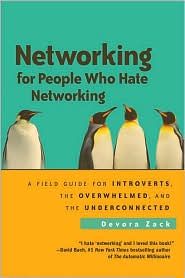
Networking for People Who Hate Networking
Introduction: The Universal Dread of the Cocktail Hour
Introduction: The Universal Dread of the Cocktail Hour
Nova: Welcome back to the show! Today, we are tackling a topic that sends shivers down the spines of millions: networking. If the phrase 'work the room' makes you want to hide under the hors d'oeuvres table, you are in the right place. We’re diving deep into Devora Zack’s game-changing book, 'Networking for People Who Hate Networking.'
Nova: : I feel personally attacked by that title, Nova. I think most people picture a room full of overly enthusiastic people aggressively shoving business cards into your hand. It sounds less like relationship building and more like a high-stakes card game where you always lose.
Nova: Exactly! That's the traditional, extrovert-centric model Zack completely dismantles. Her core premise is revolutionary: the very traits that make you hate networking—maybe you’re quiet, maybe you prefer one-on-one depth—are actually your secret weapons for forging effective connections.
Nova: : Wait, my aversion to small talk is a superpower? That’s the best news I’ve heard all week. So, what is the fundamental shift Zack is asking us to make right out of the gate? Is it about faking extroversion?
Nova: Absolutely not. That’s the first myth she crushes. She says you don't need to change who you are. Instead, you need to harness your natural strengths. She wrote this as a field guide for introverts, the overwhelmed, and the underconnected. It’s about building a social toolkit that fits your actual personality, not some manufactured persona.
Nova: : That sounds incredibly liberating. So, let's start there. If we aren't supposed to be the life of the party, what are we supposed to be? What’s the first big insight for the naturally reserved listener?
Nova: We’re going to explore the Introvert Advantage, where we discuss why deep focus beats wide surface area. Get ready, because this is where the research really shines.
Key Insight 1: Harnessing Natural Strengths
The Introvert Advantage: Depth Over Breadth
Nova: Zack points out that the traditional networking advice—'work the room'—is designed for maximum breadth. It’s about collecting as many contacts as possible. But for introverts, that’s exhausting and inauthentic.
Nova: : It’s the sheer volume that kills me. I can only sustain that high-energy, superficial interaction for about twenty minutes before I need a full day in a dark room to recover. What does Zack suggest we do instead of 'working the room'?
Nova: She suggests we leverage our natural inclination toward depth. Introverts are often better listeners, more thoughtful question-askers, and more capable of sustained focus. She argues that a single, deep, meaningful conversation with the right person is worth a hundred awkward exchanges where you only learn someone’s name and job title.
Nova: : That makes intuitive sense. I remember reading a summary that highlighted how introverts are naturally good at asking 'well-formed questions.' Can you elaborate on that? What makes a question 'well-formed' in this context?
Nova: A well-formed question isn't just a data-gathering query; it’s an invitation to connect. Instead of 'What do you do?', which invites a rehearsed answer, Zack encourages questions that reveal values or passions. For example, 'What’s the most interesting challenge you’re tackling right now?' or 'What got you excited about this industry in the first place?'
Nova: : That shifts the entire dynamic. It moves the focus from my own anxiety about what to say next to genuine curiosity about the other person. It’s turning the spotlight outward, which is often easier for introverts.
Nova: Precisely. And think about the energy expenditure. Collecting 50 business cards requires 50 surface-level interactions, draining your social battery rapidly. Nurturing three deep connections requires focused energy, but the return on investment in terms of genuine support and opportunity is exponentially higher.
Nova: : So, the goal isn't to be the loudest person in the room, but to be the most present person in a small corner of the room. It reframes success from visibility to connection quality.
Nova: Absolutely. She even touches on the idea that extroverts often to network because they thrive on external stimulation, whereas introverts can be highly effective by being strategic and selective about where they expend that precious energy. It’s about efficiency through authenticity.
Nova: : I’m already feeling less stressed. Let’s move on to the mantra that seems to underpin the whole philosophy: connecting over collecting. That feels like the thesis statement of the entire book.
Key Insight 2: Measuring Success by Depth
Connecting Over Collecting: The Anti-Business Card Mentality
Nova: This is perhaps the most crucial takeaway. Zack states clearly: 'Quantity is an exhausting and inauthentic measurement of networking success.' She wants us to value connecting over collecting.
Nova: : That directly challenges decades of conventional wisdom, which always focused on the size of your contact list. If I walk away from an event with 30 cards, I’m supposed to feel successful, right? Zack says no.
Nova: She says that stack of cards is just potential energy, often wasted. If you don't follow up meaningfully, or if the initial interaction was purely transactional, those cards are just paper clutter. The goal is to create a that sharpens receptivity for future contact.
Nova: : So, the follow-up isn't just sending a generic email saying, 'It was nice meeting you.' It has to reference that deep connection we just talked about.
Nova: Exactly. If you had a great conversation about, say, sustainable urban farming, your follow-up email shouldn't be 'Let's connect on LinkedIn.' It should be, 'I was thinking about our chat on vertical farming techniques; I just came across this fascinating article on hydroponics in Singapore. Thought you might find it interesting.'
Nova: : That’s brilliant. It immediately proves you were listening, you valued the conversation, and you’re not just spamming your list. It’s a personalized value exchange.
Nova: And this is where the introvert’s patience pays off. Because you aren't rushing to the next person, you can actually for those commonalities. Zack emphasizes that discovering those links is what makes maintaining connections easier later on.
Nova: : I wonder how this applies to digital networking, like on LinkedIn. Does 'collecting' still happen there?
Nova: It happens even more aggressively online! People send connection requests without context. Zack’s philosophy applies perfectly: don't just connect with everyone. Connect with intention. If you send a request, reference a shared interest or a piece of content they posted. Make it a connection, not a collection request.
Nova: : It forces us to be more deliberate with our time, which, as introverts, we naturally value. If we only have a limited social budget, we should spend it on interactions that actually build something.
Nova: It’s resource management for your social capital. And this leads us perfectly into the mechanics. How do you actually this connecting thing when you’re standing there, feeling the pressure to perform?
Key Insight 3: Practical Tools for Social Anxiety
The Conversation Arc: Starting, Sustaining, and Graceful Exits
Nova: Many people hate networking because they don't know how to start, how to keep it going when the small talk stalls, or—perhaps most terrifyingly—how to end it without seeming rude.
Nova: : The exit is the worst! You’re having a decent conversation, but you see someone else you need to talk to, or you just need to leave, and you get trapped in this endless loop of nodding and smiling.
Nova: Zack provides specific scripts for all three phases. For starting, she advocates for using context. Don't just walk up to a group. Comment on the venue, the speaker, or something happening nearby. It’s a low-stakes entry point.
Nova: : So, instead of, 'Hi, I’m Nova, I’m in marketing,' it’s, 'Wow, this keynote speaker is really challenging my assumptions about AI. What did you think of that last point?'
Nova: Precisely. It’s immediate shared ground. Now, for sustaining the conversation, this is where those well-formed questions come back. But what happens when the other person gives a short answer? Zack suggests using 'bridging statements' to pivot back to them or introduce a related topic smoothly.
Nova: : Give me an example of a bridging statement. I need a lifeline for when the conversational well runs dry.
Nova: If they say, 'My job is fine,' you bridge by saying something like, 'That sounds like a stable foundation. What’s one aspect of your work that you find genuinely energizing, even on a tough day?' See how you’re gently redirecting them toward passion without dismissing their initial answer?
Nova: : That’s tactical gold. Okay, but the exit strategy. I need the foolproof escape route that doesn't involve faking an emergency phone call.
Nova: Zack’s favorite exit strategy is the 'Future Connection Bridge.' It’s polite, it honors the conversation you just had, and it sets up the next step. You say something like, 'I’ve really enjoyed learning about X from you. I need to circulate a bit more before I leave, but I’d love to continue this discussion next week. Can I grab your card?'
Nova: : That frames the departure as a necessary action, not a rejection of them. It implies the conversation was valuable enough to warrant a continuation. It’s respectful of both parties’ time.
Nova: And crucially, it fulfills the 'connecting over collecting' mandate. You’re not just leaving; you’re scheduling the next, deeper connection. It turns the end of the event into the beginning of a relationship.
Key Insight 4: Being True to Who You Are
Authenticity as Your Ultimate Strategy
Nova: We’ve talked about leveraging introversion and focusing on depth. But the thread tying it all together is authenticity. Zack is adamant that trying to be someone you’re not is the fastest way to fail at networking.
Nova: : Why is faking it so detrimental? I mean, sometimes you feel like you to put on a performance to be taken seriously in certain circles.
Nova: Because people can sense it, especially the people you want to build real relationships with. Fakeness creates distance. If you pretend to be an aggressive extrovert, you’ll burn out quickly, and the connections you make will be based on a false premise. When you need help later, the real you won't match the persona you presented.
Nova: : That’s a powerful point. If I network my way into a mentorship by pretending to be a high-energy go-getter, and then I show up as my quiet, thoughtful self, the mentor might feel misled.
Nova: Exactly. Zack says you need to be true to who you are, but about how you present that self. For instance, if you hate small talk, don't force it. Instead, look for the person standing alone—the other introvert who is also dreading the room. You instantly have a shared, authentic bond.
Nova: : That’s a fantastic visual. The 'lonely island' strategy. You’re not approaching a group; you’re offering sanctuary to another person in the same boat.
Nova: And this ties back to the idea that introverts are great at focusing. When you find that person, you focus entirely on them. You don't scan the room for the next target. You give them your undivided attention, which is a rare and highly valued commodity in today’s distracted world.
Nova: : It sounds like Zack is advocating for a complete philosophical overhaul. It’s not about something from people; it’s about someone worth connecting with.
Nova: That’s the essence of it. She wants you to network as an act of generosity and genuine curiosity, not as a necessary evil to climb a ladder. When you operate from a place of 'How can I learn from this person?' or 'What value can I offer them right now?' the anxiety melts away because the focus shifts from self-preservation to contribution.
Nova: : So, the final takeaway here is that the most effective networking strategy for the person who hates networking is simply to be the most authentic, curious version of themselves they can be in a one-on-one setting.
Nova: Precisely. It’s about leveraging your natural wiring for deep, meaningful engagement, rather than fighting against it to mimic superficial extroversion.
Conclusion: Your Network is Your Net Worth, Built Slowly
Conclusion: Your Network is Your Net Worth, Built Slowly
Nova: We’ve covered a lot of ground today, moving from the dread of the event to the power of authentic connection. The core message from Devora Zack’s book is that networking isn't a performance; it’s relationship cultivation.
Nova: : And the key shift we need to internalize is moving away from the 'collecting' mindset—that frantic gathering of business cards—to the 'connecting' mindset, where depth is the only metric that matters. That instantly lowers the stakes and reduces the anxiety.
Nova: Absolutely. Remember the practical tools: use context to start conversations, employ bridging statements to sustain them when they stall, and use the Future Connection Bridge to exit gracefully, setting up the next meaningful touchpoint.
Nova: : And most importantly, stop trying to be someone else. Our introverted strengths—listening, focus, thoughtful questioning—are the very things that build resilient, long-term professional relationships.
Nova: It’s a marathon, not a sprint. Your network is your net worth, but that worth is built one genuine conversation at a time, not one crowded room at a time. If you’ve been avoiding networking because it felt fake or draining, pick up this book. It gives you permission to be yourself while still succeeding.
Nova: : It truly reframes a dreaded chore into a manageable, even enjoyable, act of genuine human interaction. I feel ready to attend a small, curated gathering now.
Nova: That’s the goal! Embrace your quiet power. This is Aibrary. Congratulations on your growth!