

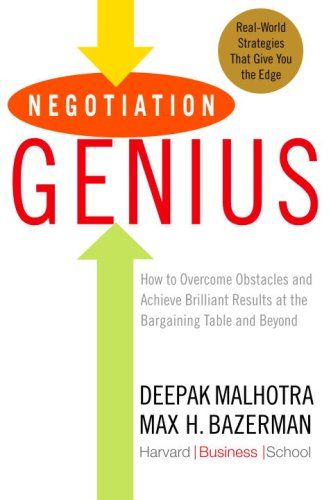
Negotiation Genius
Introduction: Redefining Negotiation Success
Introduction: Redefining Negotiation Success
Nova: Welcome to the show. We're diving into a topic that touches every corner of our professional and personal lives: negotiation. But forget everything you think you know about haggling over a used car or a salary bump. We’re dissecting the Harvard Business School framework from Deepak Malhotra and Max Bazerman’s book, Negotiation Genius.
Nova: : Wait, Nova, 'Genius' sounds intimidating. Does this book promise we’ll suddenly become master manipulators? Because that’s not what I want.
Nova: That’s the perfect starting point! The book’s first major revelation is that a 'Negotiation Genius' isn't a shark. Malhotra defines it as someone who consistently negotiates successful deals while simultaneously preserving their integrity and, crucially, strengthening their relationships. It’s about sustainable success, not one-time victories.
Nova: : Strengthening relationships? That’s a huge departure from the classic adversarial model. So, it’s less about crushing the other side and more about building a better long-term structure?
Nova: Exactly. They argue that focusing purely on maximizing your slice of the pie often shrinks the pie itself. The genius negotiator looks at the entire ecosystem. They move beyond the zero-sum game mindset that traps most people at the table.
Nova: : That makes sense. If I burn a bridge today to get an extra two percent, I’ve lost future opportunities. So, what’s the roadmap they give us to achieve this sustainable success?
Nova: They break the entire process down into three distinct, yet interconnected, phases. It’s a holistic approach that starts long before you even sit down. We're calling our first deep dive into that structure: The Three Pillars of Genius.
Nova: : Lead the way, Nova. I’m ready to see how they structure mastery.
The Holistic Negotiation Framework
The Three Pillars of Genius: Pre, During, and Post
Nova: The first pillar, and perhaps the most underrated, is Pre-Negotiation. This is preparation. Malhotra stresses that you must exhaust all information sources. This isn't just knowing your bottom line; it’s understanding the context, the counterpart’s likely motivations, and identifying your own assumptions.
Nova: : I always thought preparation meant knowing exactly what I wanted and how much I could concede. What else is there to know?
Nova: Think about it like this: If you’re negotiating a software contract, you need to know the market rate, yes. But a genius also researches the vendor’s quarterly earnings pressure, their CEO’s recent public statements, and whether they value long-term stability over a quick, large upfront payment. That context is leverage.
Nova: : That’s deep intelligence gathering. It sounds like homework, but the payoff must be huge. What happens in the second pillar, the 'During Negotiation' phase?
Nova: This is where the action happens—Claiming and Creating Value. Most people only focus on claiming, which is demanding a bigger piece of the existing pie. The genius spends significant time creating value first. They look for trade-offs.
Nova: : Trade-offs. Can you give us a concrete example of creating value that isn't just about money?
Nova: Absolutely. Imagine you’re negotiating a salary. You want $10,000 more in base pay. They say no. A novice stops there. A genius asks, 'If the base salary is fixed, could we perhaps structure a $5,000 increase in base, plus a guaranteed $5,000 signing bonus, and an extra week of vacation?' Money, timing, and perks are all different currencies.
Nova: : Ah, so you’re trading something you value less—like vacation time, maybe—for something you value more, like immediate cash flow, while the company might value the vacation time more than the cash bonus due to their internal budgeting cycles. It’s about finding those differential valuations.
Nova: Precisely! You’re expanding the pie before you start slicing it. Now, the third pillar is Post-Negotiation. This is often ignored, but Malhotra says it’s vital for long-term success. It involves maximizing satisfaction and ensuring the agreement sticks.
Nova: : How do you maximize satisfaction after the deal is signed? Isn't that their problem now?
Nova: Not if you want repeat business or a good reference! The book suggests clearly articulating what you conceded to generate goodwill. You frame your concessions not as losses, but as acts of compromise that built trust. This sets a positive tone for implementation and future interactions.
Nova: : So, Pillar One is intelligence, Pillar Two is expansion and extraction, and Pillar Three is relationship reinforcement. That’s a comprehensive cycle. It really reframes negotiation as a process, not an event.
Nova: It is a process. And the research shows that negotiators who systematically address all three pillars are the ones who consistently outperform. They aren't just lucky; they are methodically prepared and relationship-aware. Let’s move into the core strategy of that middle pillar: how do you actually create and claim that value effectively?
Creating and Claiming Value
The Art of Value Creation: Beyond Zero-Sum Thinking
Nova: Let’s dig into the heart of the matter: creating value. Malhotra and Bazerman make a strong case that the goal isn't just a 'win-win,' but rather creating value such that both parties are better off with an agreement than without one. That’s a higher bar than just avoiding a loss.
Nova: : That sounds philosophical, but practically, how do I discover these hidden value pools? I feel like I’m already asking all the right questions.
Nova: The key is asking questions that uncover, not just stated positions. A position is 'I need $150,000.' The motivation might be 'I need to cover my mortgage payments in the next six months while I finish my certification.' If you know the motivation, you can offer a $10,000 lower base salary but offer to pay the certification fees upfront, or structure a larger bonus paid in six months.
Nova: : That’s brilliant. You’re addressing the underlying need with a lower-cost solution for them. The research also mentioned something about making the first offer. I always thought making the first offer was risky.
Nova: It is risky if you’re completely unprepared. But if you’ve done your Pre-Negotiation homework, making the first offer sets the 'anchor.' It frames the entire discussion around your number. Malhotra advises that if you have a strong informational advantage, you should anchor aggressively, but reasonably.
Nova: : What if the other side anchors first with something completely outlandish? Say, they offer me $50,000 for a job that’s clearly worth $120,000.
Nova: That’s where you must resist the urge to react emotionally or immediately counter. The book suggests you should acknowledge their offer but immediately pivot to information gathering, perhaps by asking them to explain the rationale behind that number. You need to neutralize the anchor without accepting it.
Nova: : And what about claiming value once the pie is expanded? How do you ensure you get your fair share of the newly created wealth?
Nova: This is where labeling concessions comes in. When you give something up, don't just slide it across the table quietly. Explicitly state what you are giving up and frame it as a difficult concession made in the spirit of compromise. For example: 'Because I truly value getting this deal done quickly, I am willing to absorb the cost of expedited shipping, which is a significant expense for us.'
Nova: : So you’re making the other side aware of the cost of your goodwill, which encourages reciprocity?
Nova: Exactly. You’re highlighting what you’re conceding to generate goodwill, which the research shows makes the counterpart more likely to reciprocate. It’s strategic transparency. If you just quietly concede, they might assume that was your starting point all along, and they’ll just ask for more.
Nova: : It sounds like the genius negotiator is constantly managing perceptions—perceptions of value, perceptions of fairness, and perceptions of their own flexibility. This is much more psychological than I anticipated.
Avoiding the Pitfalls of Cognitive Bias
The Mental Traps: Common Mistakes That Derail Negotiations
Nova: Let’s pivot to the mistakes. Because often, knowing what to do is half the battle. Malhotra highlights several cognitive traps that trip up even experienced negotiators. The most immediate one he calls out is immediately giving in to ultimatums.
Nova: : Ultimatums are tough. If someone says, 'Take this or walk away,' my instinct is to panic or feel backed into a corner.
Nova: That’s the intended effect. But Malhotra advises that if someone issues an ultimatum, your response should almost always be to ignore it, at least initially. People often issue ultimatums in haste or when they are trying to seize control of the conversation. By ignoring it and redirecting back to interests, you signal that you control the pace, not them.
Nova: : That requires serious composure. What’s another major error in the preparation phase?
Nova: Failing to thoroughly prepare. This goes beyond just knowing your BATNA—your Best Alternative To a Negotiated Agreement. It means identifying your assumptions and actively seeking information that might prove those assumptions wrong. If you assume the other side sell by Friday, but you haven't verified that, you’ve built your strategy on sand.
Nova: : I can see that. We often negotiate against our own internal narrative rather than the reality of the situation. What about mistakes made during the interaction itself?
Nova: A huge one is focusing too much on your own needs and concerns, and not enough on the perspective of the other party. This is the classic 'me-first' approach that prevents value creation. If you spend 80% of your mental energy thinking about what need, you’ll miss the key piece of information that unlocks a massive concession for the other side.
Nova: : So, the genius spends more time trying to understand the other side’s constraints and desires than articulating their own?
Nova: In the information-gathering stage, yes. Another common mistake, especially in sales contexts, is apologizing for having a high price. If you present a $100,000 proposal and immediately say, 'I know this is high, but…' you’ve already conceded the high ground before the negotiation even begins. You must be assertive about the value you represent.
Nova: : That’s a tough habit to break. It feels polite to apologize for being expensive, but it undermines the entire offer. It’s about owning the value proposition.
Nova: Exactly. Owning the value. And finally, a mistake related to claiming value: not being flexible in your currency. If you only negotiate on price, you limit the potential for creative solutions. If you are only willing to move on salary, you miss out on better vacation, better title, or better professional development opportunities that might be cheaper for them to give but more valuable to you.
Nova: : This is a masterclass in self-correction. It’s about recognizing our natural, often biased, reactions—the panic at an ultimatum, the need to apologize, the tunnel vision—and replacing them with deliberate, researched responses. We’ve covered the framework and the pitfalls. Let’s wrap up with the final synthesis.
Conclusion: The Path to Negotiation Mastery
Conclusion: The Path to Negotiation Mastery
Nova: We’ve covered a lot of ground today, moving from the definition of a 'Negotiation Genius' to the practical steps required to become one. The core message from Malhotra and Bazerman is that negotiation is a skill built on behavioral science, not just intuition.
Nova: : If I had to boil down the key actionable takeaways, I’d say: First, preparation must be exhaustive, focusing on context and assumptions, not just numbers. Second, always prioritize value creation—look for trade-offs across multiple currencies before you start claiming your share.
Nova: I agree completely. And I’d add the third: Master the framing. Frame your concessions as costly acts of goodwill, and refuse to accept ultimatums at face value. You control the pace of the conversation by controlling your reaction to pressure.
Nova: : It’s fascinating how much of this is about managing your own psychology. It’s not about tricking the other person; it’s about overcoming your own cognitive biases to see the full landscape of possibilities.
Nova: That’s the ultimate insight. True negotiation genius isn't about being the loudest or the toughest; it’s about being the most insightful, the most prepared, and the most relationship-aware. It’s about creating agreements that are not just good for you today, but sustainable for the relationship tomorrow.
Nova: : So, the next time I’m at the table, I need to stop thinking about 'winning' and start thinking about 'building a better structure' for both sides. That’s a powerful shift in perspective.
Nova: It is. Take these principles—the three pillars, the focus on underlying interests, and the awareness of common traps—and apply them deliberately. You’ll find your outcomes improve dramatically, and your reputation will follow.
Nova: : Fantastic discussion, Nova. I feel equipped to approach my next tough conversation with a lot more strategy and a lot less anxiety.
Nova: That’s what we aim for. This has been a deep dive into Negotiation Genius. This is Aibrary. Congratulations on your growth!