

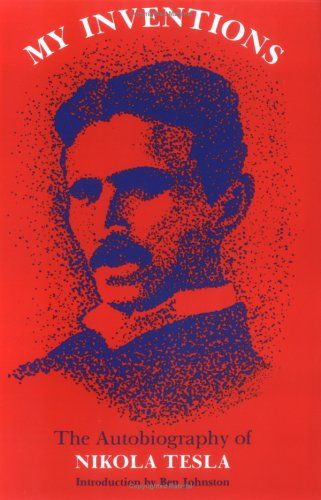
My inventions
The Autobiography of Nikola Tesla
Introduction
Nova: Have you ever looked at a piece of technology, like your smartphone or even just a light switch, and wondered if the person who invented it was actually from this planet? Because when you read Nikola Tesla's autobiography, My Inventions, you start to seriously question if he was operating on a completely different frequency than the rest of us.
Nova: It is actually both. It is a fascinating series of six articles he wrote in 1919 for a magazine called Electrical Experimenter. What makes it so special is that it is Tesla in his own words, explaining not just what he built, but how his brain actually worked. He didn't just design machines; he lived with them in his mind long before they ever touched a workbench.
Nova: Well, prepare yourself, because we are going to explore everything from his childhood encounters with static electricity on a cat's back to his vision for a world where energy is as free and wireless as the air we breathe. This is the story of a man who saw the 21st century while he was still living in the 19th.
Key Insight 1
The Internal Laboratory
Nova: To understand Tesla, we have to start with his most famous and honestly terrifying mental ability. In My Inventions, he describes a process that most engineers today would pay millions for. He didn't use drawings or models for his initial designs. He built them entirely in his mind.
Nova: It was closer to the 3D software. He claimed that he could visualize a machine so vividly that he could actually run it in his head to see where the parts would wear out. He would literally say, I start the device, let it run for two weeks in my imagination, and then I take it apart to see which parts show friction.
Nova: He attributes it to a condition he had as a child where he would see flashes of light and vivid images of objects he had seen before. It was actually quite distressing for him. To cope, he started traveling in his mind to new cities and countries he had never been to, meeting people and making friends, all while sitting in his room.
Nova: Exactly. He called them appearances. They would just pop up and obscure his real vision. But he eventually learned to control them, and that is how his mental laboratory was born. He says in the book that when he had an idea, he would immediately begin building it up in his imagination. He didn't rush into manual work. He would change the construction, make improvements, and operate the device in his mind.
Nova: That was exactly his critique of other inventors. He specifically mentions that many people rush into ideas and get bogged down in details, whereas he could see the finished product before he ever touched a tool. By the time he actually built a physical prototype, it almost always worked exactly as he had imagined it would.
Key Insight 2
The Spark of Genius
Nova: You are spot on about the bugs. But before we get to his eccentricities, we have to talk about where that spark came from. In My Inventions, Tesla shares this incredible story from when he was a young boy in modern-day Croatia. He was stroking his cat, Macak, and he saw sparks flying off the cat's back.
Nova: Not at all. He asked his father what it was, and his father told him it was electricity, the same thing as lightning. Tesla writes that he was fascinated by the idea that nature was just a giant cat, and he wondered who was stroking its back to make the lightning. That was the moment he became obsessed with the mystery of electricity.
Nova: It was actually quite tragic. He talks about the death of his older brother, Dane, who he believed was far more gifted than he was. Tesla spent much of his life trying to live up to the expectations his parents had because of Dane's brilliance. He also faced several near-death experiences with illness, including a severe bout of cholera where he almost died.
Nova: Yes! His father wanted him to enter the priesthood, but as Tesla lay on his deathbed, he told his father he might recover if he were allowed to study engineering. His father promised he could go to the best technical school in the world, and Tesla says he miraculously recovered shortly after. Talk about a high-stakes negotiation.
Nova: Right. He was at the Polytechnic School in Graz, and he saw a Gramme dynamo that sparked heavily when it ran on direct current. He told his professor that the sparks weren't necessary and that they could use alternating current instead. His professor actually ridiculed him in front of the whole class, saying it was a physical impossibility, like a perpetual motion machine.
Nova: He carried that challenge in his head for years. He didn't solve it immediately. He actually had a nervous breakdown because he was working so hard on it. But then, one afternoon in 1882, he was walking in a park in Budapest, reciting poetry from Goethe's Faust, and the solution hit him like a lightning bolt. He literally drew the diagram for the rotating magnetic field in the sand with a stick.
Key Insight 3
The Master of Lightning
Nova: Once he had the rotating magnetic field figured out, the world changed. But My Inventions isn't just a list of his patents. It is about his philosophy of invention. He famously said that the progressive development of man is vitally dependent on invention, and that its ultimate purpose is the complete mastery of mind over the material world.
Nova: That is the big tragedy of his life. He was a visionary, not a businessman. He describes his work on the Tesla Coil and high-frequency currents with such pure joy. He wasn't thinking about how to monetize a lightbulb; he was thinking about how to send energy through the air so that a farmer in the middle of nowhere could have light without a wire.
Nova: He actually gives Edison some credit for his hard work and grit, but you can feel the tension. Tesla was all about theory and mental visualization, while Edison was the king of trial and error. Tesla once said that if Edison had to find a needle in a haystack, he would examine every straw until he found it, whereas Tesla would have used a little bit of math to find it instantly.
Nova: And he found them in ways that people still don't fully understand. He was experimenting with X-rays before Roentgen, and he was talking about remote control and robotics in the late 1890s. In the book, he talks about his telautomaton, which was a remote-controlled boat. When he showed it at Madison Square Garden, people thought it was magic or that there was a tiny monkey inside the boat.
Nova: He loved the spectacle, but he always insisted it was science. He wanted to show that we could create machines with their own borrowed minds. He was predicting the age of automation and AI over a hundred years ago. He saw a future where machines would do all the grueling labor, freeing up humanity for higher pursuits.
Key Insight 4
The Eccentricities of Genius
Nova: This is where the story gets really human and, frankly, a bit strange. Tesla's mind was so finely tuned that he became hypersensitive to the world around him. In My Inventions, he details some of his most famous phobias and compulsions. For instance, he had a literal physical revulsion to pearls.
Nova: He couldn't stand the sight of them. He said that if a woman at a dinner party was wearing pearls, he couldn't even look at her, let alone talk to her. He also had a major thing about the number three. He would walk around a building three times before entering it, and he always required eighteen napkins to wipe his table before a meal.
Nova: It almost certainly was. He was also a massive germaphobe, which he traced back to his childhood illness with cholera. He refused to shake hands with people and was constantly worried about the microbes on everything. But here is the thing: he didn't see these as weaknesses. He saw his strict routines as a way to preserve his energy for his work.
Nova: Exactly. He even talked about his diet and exercise in that way. He walked miles every day and was very particular about what he ate. But then there were the pigeons. Toward the end of the book and his life, his relationship with pigeons became his primary emotional connection.
Nova: It is bittersweet. He wrote about one particular white pigeon that he loved like a person. He claimed that when she died, a light came out of her eyes that was brighter than any lamp he had ever created in his lab. It sounds like he found a kind of spiritual peace with those birds that he couldn't find with people.
Key Insight 5
The Wireless Dream
Nova: The climax of My Inventions is really about his vision for the Wardenclyffe Tower and his World Wireless System. Tesla didn't just want to send telegrams without wires; he wanted to transmit electrical power through the Earth itself.
Nova: Yes. He believed that the Earth was a conductor and that he could create standing waves of energy that anyone, anywhere, could tap into just by sticking a rod in the ground. He called it the Magnifying Transmitter. He envisioned a world where information—pictures, music, even stock market reports—could be transmitted to a device no larger than a pocket watch.
Nova: He really was. But the project at Wardenclyffe failed because he lost his funding. J. P. Morgan, his main investor, reportedly asked, If anyone can draw on the power, where do I put the meter? When Morgan realized he couldn't monetize free energy, he pulled the plug.
Nova: Tesla was devastated, but he never lost faith in the idea. He writes in the book that his invention was simply ahead of its time. He said, Let the future tell the truth, and evaluate each one according to his work and accomplishments. The present is theirs; the future, for which I have really worked, is mine.
Nova: And he was right. Every time you use Wi-Fi, or turn on an AC motor, or look at a remote-controlled drone, you are seeing Tesla's legacy. He was the man who saw the invisible connections between everything. He understood that energy, frequency, and vibration are the keys to the universe.
Conclusion
Nova: As we wrap up this look at My Inventions, the biggest takeaway isn't just the technology. It is the reminder that progress isn't a straight line. It is driven by people who are brave enough to be misunderstood, eccentric enough to think differently, and dedicated enough to work for a future they might never see.
Nova: He taught us that the material world is something we can harness, but only if we have the discipline to master our own minds first. His autobiography is a manual for dreamers and a warning to anyone who thinks they have already figured out how the world works.
Nova: Thank you for joining us on this journey into the mind of the master of lightning. We hope you feel a little more spark in your own creative life today.
Nova: This is Aibrary. Congratulations on your growth!